EVGA GeForce GTX 1080 8GB GDDR5X Black
The Pascal-based GTX 1080 delivers 2560 CUDA cores at a 1860MHz boost clock, paired with 8GB of GDDR5X memory and a 320 GB/s bandwidth for strong 1080p gaming performance. Its ACX 3.0 dual-fan cooler, 10 power phases, and double BIOS add durability and overclocking flexibility, while RGB LED control via EVGA Precision XOC offers customization. This card suits gamers on a budget who prioritize 1080p play and value a reliable, adjustable cooling solution over newer-gen features.












Snapshot
The 30-Second Version
The EVGA GeForce GTX 1080 FTW GAMING ACX 3.0 is a former flagship that still handles 1080p gaming well, especially in esports and older titles. Its ACX 3.0 cooling and overclocking headroom are the standout features, but 8GB of VRAM and no DLSS support limit its future. At USD 230 to USD 250 it's a decent budget buy, but anything higher and you should look at newer used cards instead.
Pros & Cons
Pros
- Excellent ACX 3.0 cooling keeps temps low under load 72nd
- Strong overclocking headroom with 10 power phases and dual BIOS
- Customizable RGB lighting that owners genuinely enjoy
- Dual 8-pin connectors deliver stable power for OC attempts
- Still handles 1080p gaming at high settings in most titles
Cons
- 267mm length won't fit in smaller cases
- Requires two 8-pin power connectors, check your PSU first
- No SLI bridge included in the box
- 8GB VRAM limits texture quality in newer games
- Older Pascal architecture means no meaningful ray tracing or DLSS
What owners think
The Word on the Street
How owner sentiment changed over time
ExclusiveBased on when customers actually wrote their reviews - so you can see whether early praise held up.
25 written reviews, Mar 2026: 25 happy
Each dot is one written review, in the month it was written. Happy = 4-5★, mixed = 3★, unhappy = 1-2★.
The proof
Performance
The GTX 1080 posts a PassMark G3D score of 15606, which lands it in the 34th percentile for raster performance in our database. That sounds rough on paper, but context matters. This card was a flagship in 2016, and it still pushes 1080p ultra settings in most esports and older AAA titles without breaking a sweat. You'll see 100+ fps in games like CS2, Valorant, and Overwatch 2. For 1440p, expect medium to high settings in modern titles, with older games running maxed out.
The 8.87 TFLOPS of FP32 compute is respectable for the price bracket, though it's nowhere near what a modern RTX 5070 delivers. The 320 GB/s memory bandwidth keeps frame times smooth at 1080p, but the 8GB VRAM buffer is the real bottleneck. Games like Cyberpunk 2077, Hogwarts Legacy, and Starfield will force texture compromises. And don't even think about ray tracing, this card technically supports it through driver updates, but the performance hit makes it pointless. The 180W TDP is manageable, and the ACX 3.0 cooler does a solid job keeping temps in check, which owners consistently mention as a highlight.
Specifications
Full Specifications
Chipset
| GPU Chipset | GeForce GTX 1080 |
| Brand | NVIDIA |
| Architecture | Pascal |
| Class | consumer |
| Process | 16 |
Memory
| VRAM | 8 GB |
| Memory Type | GDDR5X |
| Memory Bus | 256 |
| Bandwidth | 320.3 |
Compute
| CUDA Cores | 2560 |
| Base Clock | 1721 |
| Boost Clock | 1860 |
| FP32 TFLOPS | 8.873 |
Performance
| PassMark G3D | 15606 |
| GPU Compute | 7627 |
Power & Cooling
| TDP | 180 |
| Recommended PSU | 500 |
| Power Connectors | 2 x 8-Pin |
| Cooler | Dual Fan |
| Fans | 2 |
Connectivity
| Interface | PCI Express 3.0 |
| DisplayPort | 3 |
| HDMI | 1 |
| Max Displays | 4 |
| Max Resolution | 7680 x 4320 |
Physical
| Length | 267 |
| Slot Width | 2 |
| Form Factor | Full Height |
| Weight | 1.4 kg / 3.0 lbs |
Features
| Ray Tracing | No |
| VR Ready | Yes |
| DirectX | 12 |
| RGB | Yes |
vs Competition
The elephant in the room is that this card's top competitors in our database are all RTX 5070 variants: the ASUS PRIME RTX 5070, ZOTAC Solid OC, MSI SHADOW, Gigabyte GAMING OC, and PNY OC. Those cards are in a completely different performance class, with 12GB of VRAM, DLSS 4 support, and ray tracing that actually works. But they also cost significantly more, so the comparison isn't entirely fair.
A more realistic matchup is against used RTX 3060 Ti or RX 6700 XT cards. The 3060 Ti beats the GTX 1080 in raster performance by a noticeable margin and adds DLSS support, which extends its lifespan considerably. The RX 6700 XT offers 12GB of VRAM, which is a bigger deal than raw speed for future-proofing. The GTX 1080's advantage is price, if you can find it cheap, and that EVGA build quality. But if you're spending over USD 300, skip this and look at newer used cards.
| Spec | EVGA GeForce GTX 1080 | Gigabyte GeForce RTX 5070 Ti Eagle Ice | MSI GeForce RTX 5070 Ti Ventus 3X OC | ASUS GeForce RTX 5070 Ti TUF Gaming OC | ZOTAC GeForce RTX 5080 APOCALYPSE | PNY GeForce RTX 5070 Ti OC |
|---|---|---|---|---|---|---|
| Chipset | GeForce GTX 1080 | GeForce RTX 5070 Ti | GeForce RTX 5070 Ti | GeForce RTX 5070 Ti | GeForce RTX 5080 | GeForce RTX 5070 Ti |
| Vram | 8GB GDDR5X | 16GB GDDR7 | 16GB GDDR7 | 16GB GDDR7 | 16GB GDDR7 | 16GB GDDR7 |
| Boost Clock Mhz | 1860 | 2542 | 2482 | 2610 | 2730 | 2450 |
| Tdp W | 180 | 300 | 300 | 300 | 360 | 300 |
| Memory Bus Bits | 256 | 256 | 256 | 256 | 256 | 256 |
| Ray Tracing | No | Yes | Yes | Yes | Yes | Yes |
| GPU Class | consumer | consumer | consumer | consumer | consumer | consumer |
| Compare | Compare | Compare | Compare | Compare |
| Product | AI | Rt | Vram | Raster | Compute | Feature | Thermal | User Sentiment | Efficiency | Connectivity | Affordability |
|---|---|---|---|---|---|---|---|---|---|---|---|
| EVGA GeForce GTX 1080 | 30.4 | 29.8 | 26 | 32.3 | 26.4 | 27.9 | 42 | 57.8 | 42.2 | 43.6 | 72.3 |
| Gigabyte GeForce RTX 5070 Ti Eagle Ice Compare | 79.1 | 88.7 | 86 | 89 | 88 | 95.8 | 91.9 | 85.2 | 71.7 | 94.2 | 22.8 |
| MSI GeForce RTX 5070 Ti Ventus 3X OC Compare | 79.1 | 92.4 | 86 | 89 | 88 | 95.8 | 91.9 | 85.2 | 71.7 | 94.2 | 22.4 |
| ASUS GeForce RTX 5070 Ti TUF Gaming OC Compare | 79.1 | 92.4 | 86 | 89 | 88 | 95.8 | 91.9 | 57.8 | 71.7 | 99.3 | 20.4 |
| ZOTAC GeForce RTX 5080 APOCALYPSE Compare | 85.4 | 97.6 | 89.1 | 94.5 | 93.4 | 95.8 | 91.9 | 99.5 | 56.8 | 94.2 | 22.6 |
| PNY GeForce RTX 5070 Ti OC Compare | 79.1 | 92.4 | 86 | 89 | 88 | 65.8 | 91.9 | 57.8 | 71.7 | 81.4 | 25.8 |
Price
Value & Pricing
Pricing on this card is all over the place. In the US, you'll see listings ranging from USD 230 to USD 379, and that spread matters a lot. At USD 230, this is a tempting budget option for 1080p gaming. At USD 379, you're dangerously close to used RTX 3060 Ti or RX 6700 XT territory, both of which offer more VRAM and modern features. The Newegg refurbished listings tend to sit at the higher end of that range, so shop around before pulling the trigger. If you can find one under USD 250, it's a reasonable buy for a budget build. Above that, the value proposition gets shaky fast.
Newegg 2 offers From CA$665
Price history
Read more
Overview
The EVGA GeForce GTX 1080 FTW GAMING ACX 3.0 sits in that weird middle ground of PC hardware: it's old enough to be cheap on the used market, but still capable enough to make budget builders curious. This is a Pascal-era card with 8GB of GDDR5X memory, 2560 CUDA cores, and a boost clock of 1860MHz. You'll find it floating around USD 230 to USD 379 depending on condition and seller, which puts it in direct competition with newer budget cards that sip power and come with warranties.
People searching for this card usually want to know one thing: can it still game in 2025? The short answer is yes, for 1080p and some 1440p, as long as you're not expecting ray tracing or frame generation. The 8GB of VRAM is the main constraint, and our database puts it at the 27th percentile for VRAM capacity among current GPUs. That's not a dealbreaker for older titles, but newer AAA games will force you to dial textures down.
What makes this specific EVGA model interesting is the FTW treatment. You get a custom PCB, 10 power phases, dual BIOS, and the ACX 3.0 cooler with RGB lighting. It's a card that was built for overclocking back when Pascal was king, and that heritage still shows in how owners talk about it.
Common Questions
Q: Is the EVGA GTX 1080 FTW good for 1080p gaming in 2025?
Yes, the GTX 1080 FTW still handles 1080p gaming well, especially in esports titles and older AAA games where you'll see high frame rates at max settings. Newer AAA games will require dropping texture settings due to the 8GB VRAM limit.
Q: What power supply do I need for the EVGA GTX 1080 FTW?
EVGA recommends a 500W power supply minimum, and the card requires two 8-pin PCIe power connectors. Make sure your PSU has both connectors available before buying.
Q: Does the EVGA GTX 1080 FTW support ray tracing?
Technically yes through driver updates, but the Pascal architecture has no dedicated RT cores, so ray tracing performance is poor enough to be unusable in practice. Don't buy this card expecting playable ray tracing.
Q: How does the GTX 1080 compare to the RTX 3060 Ti?
The RTX 3060 Ti is noticeably faster in raster performance and adds DLSS support, which makes it a better long-term buy. The GTX 1080's only real advantage is a lower used price, so it makes sense only if you find one significantly cheaper.
Who Should Skip This
Skip this card if you're building a new system for modern AAA games at 1440p or higher. The 8GB VRAM and lack of DLSS will frustrate you within a year. Also skip it if your case is compact, since the 267mm length and dual 8-pin power requirements rule out many smaller builds. If you want ray tracing, frame generation, or any kind of future-proofing, look at used RTX 3060 Ti, RX 6700 XT, or save up for an RTX 5070. And if you're pairing it with an older CPU, be aware that bottlenecking is a real concern owners have mentioned.
Verdict
Should you buy an EVGA GTX 1080 FTW in 2025? Only if the price is right and your expectations are realistic. This is a 1080p card for budget builds, not a 1440p monster. The cooling is genuinely good, the overclocking potential is fun to play with, and the RGB looks sharp. But the 8GB VRAM ceiling and lack of DLSS mean this card is on borrowed time for newer releases.
If you're building a cheap system for esports titles, older games, or light content creation, and you can snag this for under USD 250, it's a solid pick. If you're spending more than that, or you want to play the latest AAA games at high settings, save your money for something newer. The GTX 1080 was a legend in its day, but legends age too.
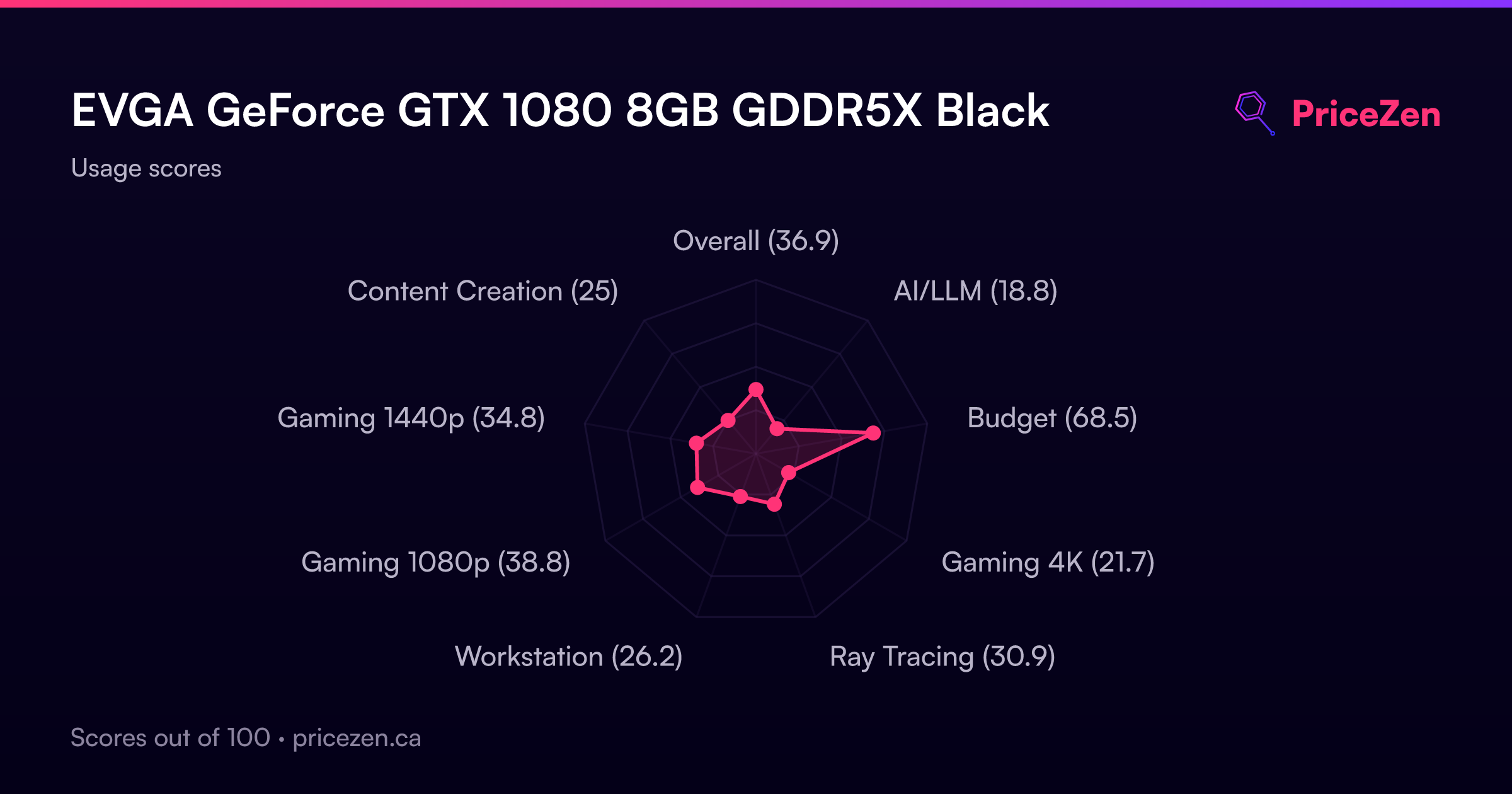
Usage Scores
- Overall36.9
- AI/LLM18.8
- Budget68.5
- Gaming 4K21.7
- Ray Tracing30.9
- Workstation26.2
- Gaming 1080p38.8
- Gaming 1440p34.8
- Content Creation25