MSI GeForce RTX 5070 Ti Ventus 3X 16GB GDDR7 Silver
The 16GB of GDDR7 memory on a 256-bit bus and 896 GB/s bandwidth drive strong 4K gaming performance, backed by 8960 CUDA cores and a 2452 MHz boost clock on the Blackwell architecture. Its triple-fan cooler keeps the 300W TDP in check within a relatively compact 303mm length, making it a practical fit for many ATX builds. This card is best for 4K gamers who want high frame rates without stepping up to the flagship tier.

No current retailer price
Where we saw it before. Check the store for today's price.


Snapshot
The 30-Second Version
A 32,373 PassMark G3D score and 896 GB/s of GDDR7 bandwidth make this one of the faster cards in our rankings, with 83.2/100 for 4K gaming. The 300W TDP and 750W PSU requirement are what owners complain about most. At USD 1,294 it's a performance buy, not a value buy.
Pros & Cons
Pros
- One of the best raster and compute scores in our GPU rankings, backed by a 32,373 PassMark G3D result 89th
- 16GB GDDR7 at 896 GB/s on a 256-bit bus, a standout for memory headroom 88th
- 83.2/100 for 4K gaming and 82.8/100 at 1440p and 1080p 86th
- Strong output selection: 3x DisplayPort 2.1b and 1x HDMI 2.1b on PCIe 5.0 85th
- Owners report high frame rates with no stuttering and decent temps
Cons
- USD 1,294 makes affordability a weak spot in our data
- 300W TDP and a 750W PSU requirement are the most common owner complaints
- Thermal and efficiency rankings only sit around the middle of the pack
- Workstation is the weakest use case at 70.4/100
- 303mm long and 2.9 slots thick, so small cases need measuring first
What owners think
The Word on the Street
How owner sentiment changed over time
ExclusiveBased on when customers actually wrote their reviews - so you can see whether early praise held up.
35 written reviews, Apr 2026: 21 happy, 14 without stars
Each dot is one written review, in the month it was written. Happy = 4-5★, mixed = 3★, unhappy = 1-2★.
The proof
Performance
Let's start with the numbers that matter: 43.94 FP32 TFLOPS, a 2,452MHz boost clock, 70 RT cores and 280 Tensor cores on Blackwell's 5nm process. Our scoring puts raster and compute among the best you can buy right now, with VRAM capacity and ray tracing close behind. The 896 GB/s memory bandwidth is the quiet hero here, since 16GB of GDDR7 across a 256-bit bus means texture-heavy 4K workloads aren't starved. AI throughput lands well above average rather than class-leading, and workstation is the softest spot at 70.4/100, so this is a gaming card first and a productivity card second.
Thermals and efficiency sit around the middle of the pack, which tracks with a 300W TDP and a triple-fan cooler on a 303mm, 2.9-slot card. One owner reports 72C to 78C in a Thermaltake Tower 300 case, another says it stays cool and never stutters under load. Connectivity is strong: three DisplayPort 2.1b plus one HDMI 2.1b over PCI Express 5.0. Feature breadth is only about average in our ranking, so don't expect extras beyond ray tracing and VR readiness.
Specifications
Full Specifications
Chipset
| GPU Chipset | GeForce RTX 5070 Ti |
| Brand | NVIDIA |
| Architecture | Blackwell |
| Class | consumer |
| Process | 5 |
Memory
| VRAM | 16 GB |
| Memory Type | GDDR7 |
| Memory Bus | 256 |
| Bandwidth | 896 |
Compute
| CUDA Cores | 8960 |
| Tensor Cores | 280 |
| RT Cores | 70 |
| Base Clock | 847 |
| Boost Clock | 2452 |
| FP16 TFLOPS | 43.94 |
| FP32 TFLOPS | 43.94 |
Performance
| PassMark G3D | 32373 |
| GPU Compute | 18296 |
Power & Cooling
| TDP | 300 |
| Recommended PSU | 750 |
| Power Connectors | 1 x 16-Pin |
| Cooler | Triple Fan |
| Fans | 3 |
Connectivity
| Interface | PCI Express 5.0 |
| DisplayPort | 3 |
| HDMI | 1 |
| Max Displays | 4 |
| Max Resolution | 7680 x 4320 |
Physical
| Length | 303 |
| Slot Width | 2.9 |
| Form Factor | ATX |
Features
| Ray Tracing | Yes |
| VR Ready | Yes |
| DirectX | 12 Ultimate |
vs Competition
Against the Gigabyte GeForce RTX 5070 Ti Eagle Ice, this comes down to cooler and price, since our rankings already place this card's raster, compute and VRAM among the best in the category. If you're eyeing the ASUS GeForce RTX 5080 PRIME EVO OC, ZOTAC GeForce RTX 5080 APOCALYPSE or PNY GeForce RTX 5080 ARGB OC, understand you're shopping a tier up while this card's affordability ranking is already a weak point at USD 1,294. The Sapphire Radeon RX 7900 XTX NITRO+ is the cross-shop for anyone who doesn't care about the 70 RT cores and ray tracing strength here. Our advice: if 82.8/100 at 1440p and 83.2/100 at 4K covers your monitor, stay put and pocket the difference.
| Spec | MSI GeForce RTX 5070 Ti Ventus 3X | Gigabyte GeForce RTX 5070 Ti Eagle Ice | ASUS GeForce RTX 5080 PRIME EVO OC | ZOTAC GeForce RTX 5080 APOCALYPSE | Sapphire Radeon RX 7900 XTX NITRO+ | PNY GeForce RTX 5080 ARGB OC |
|---|---|---|---|---|---|---|
| Chipset | GeForce RTX 5070 Ti | GeForce RTX 5070 Ti | GeForce RTX 5080 | GeForce RTX 5080 | Radeon RX 7900 XTX | GeForce RTX 5080 |
| Vram | 16GB GDDR7 | 16GB GDDR7 | 16GB GDDR7 | 16GB GDDR7 | 24GB GDDR6 | 16GB GDDR7 |
| Boost Clock Mhz | 2452 | 2542 | 2685 | 2730 | 2680 | 2620 |
| Tdp W | 300 | 300 | 360 | 360 | 339 | 360 |
| Memory Bus Bits | 256 | 256 | 256 | 256 | 384 | 256 |
| Ray Tracing | Yes | Yes | Yes | Yes | Yes | Yes |
| GPU Class | consumer | consumer | consumer | consumer | consumer | consumer |
| Compare | Compare | Compare | Compare | Compare |
| Product | AI | Rt | Vram | Raster | Compute | Feature | Thermal | User Sentiment | Efficiency | Connectivity | Affordability |
|---|---|---|---|---|---|---|---|---|---|---|---|
| MSI GeForce RTX 5070 Ti Ventus 3X | 79 | 85.4 | 85.9 | 88.9 | 87.9 | 43.6 | 72 | 36.8 | 71.8 | 81.4 | 25.8 |
| Gigabyte GeForce RTX 5070 Ti Eagle Ice Compare | 79 | 88.6 | 85.9 | 88.9 | 87.9 | 95.8 | 91.9 | 85.1 | 71.8 | 94.2 | 22.8 |
| ASUS GeForce RTX 5080 PRIME EVO OC Compare | 85.4 | 97.6 | 89.1 | 94.5 | 93.3 | 88.6 | 91.9 | 71.2 | 56.8 | 94.2 | 18.4 |
| ZOTAC GeForce RTX 5080 APOCALYPSE Compare | 85.4 | 97.6 | 89.1 | 94.5 | 93.3 | 95.8 | 91.9 | 99.5 | 56.8 | 94.2 | 22.7 |
| Sapphire Radeon RX 7900 XTX NITRO+ Compare | 95.2 | 96.4 | 92.1 | 83.4 | 95.7 | 95.8 | 91.9 | 85.1 | 51.5 | 98.8 | 13.5 |
| PNY GeForce RTX 5080 ARGB OC Compare | 85.4 | 97.6 | 89.1 | 94.5 | 93.3 | 95.8 | 91.9 | 45.1 | 56.8 | 94.2 | 15.7 |
Price
Value & Pricing
At USD 1,294 from Newegg, you're paying for 8,960 CUDA cores, 16GB of GDDR7 and top-tier raster and ray tracing rankings, and on pure performance-per-spec that's a defensible ask. But our affordability ranking puts it near the back of the field, so this isn't a bargain bin find. Canadian buyers see CAD 1,745, and those two figures are separate markets, not a conversion. We track its price over time, partly through our community browser extension, and right now Newegg is the only listing in our data. Budget for the 750W power supply too, because that's a real cost owners keep flagging.
We started tracking prices for this product on Jun 7, 2026. The chart appears once we have more data.
Read more
Overview
A PassMark G3D score of 32,373 and 8,960 CUDA cores put this MSI Ventus RTX 5070 Ti firmly in the upper tier of our GPU rankings: one of the best on the market for raster performance, compute and ray tracing. The 16GB of GDDR7 on a 256-bit bus pushes 896 GB/s of bandwidth, which is why it scores 83.2/100 for 4K gaming and 82.8/100 at both 1440p and 1080p in our model. That's a card built to be pointed at a high-refresh 1440p panel or a 4K screen without much hand-wringing.
The catch is everything around the silicon. At USD 1,294 from Newegg (CAD 1,745 in Canada), affordability sits near the bottom of the pack in our data, and owner sentiment ranks below average even though the raw customer rating is 4.6/5 across 25 reviews. Owners love the frame rates and grumble about the 750W PSU requirement and 300W TDP. Great engine, thirsty engine.
Common Questions
Q: Will it handle 4K gaming?
Our model scores it 83.2/100 for 4K, with 82.8/100 at both 1440p and 1080p. The 16GB of GDDR7 at 896 GB/s and 8,960 CUDA cores give it the memory headroom and shading muscle for it, and raster performance ranks among the best in our GPU data.
Q: What power supply do I need?
MSI specs a 750W PSU for this 300W TDP card, fed by a single 16-pin connector. That's the single most repeated gripe in owner feedback, so check your unit before ordering. Thermal and efficiency rankings sit around the middle of the pack, so plan airflow accordingly.
Q: Will it fit my case?
It's 303mm long and takes up 2.9 slots, so measure your clearance and expect to lose three expansion slots. The triple-fan cooler is what keeps owners reporting reasonable temps, but it isn't a compact card.
Who Should Skip This
Skip this if your power supply is modest or your case is tight. The 750W PSU requirement and 300W TDP are the top owner complaints, and 303mm plus 2.9 slots rules out plenty of small builds. Skip it too if you're buying mainly for productivity work, since workstation is its weakest area at 70.4/100 and feature breadth is only about average. And if USD 1,294 already hurts, our affordability ranking says you're paying near the top of the field for a card whose thermal and efficiency numbers are merely mid-pack.
Verdict
We'd recommend this to a 1440p or 4K gamer with a decent power supply already in the box. The 32,373 G3D score, 16GB of GDDR7 and leading raster and RT rankings do the heavy lifting, and 25 owners averaging 4.6/5 back that up. Just go in clear-eyed: owner sentiment ranks below average in our data despite that rating, mostly because of the 750W PSU ask and system requirements, and the price is steep. Solid card, honest caveats.
Usage Scores
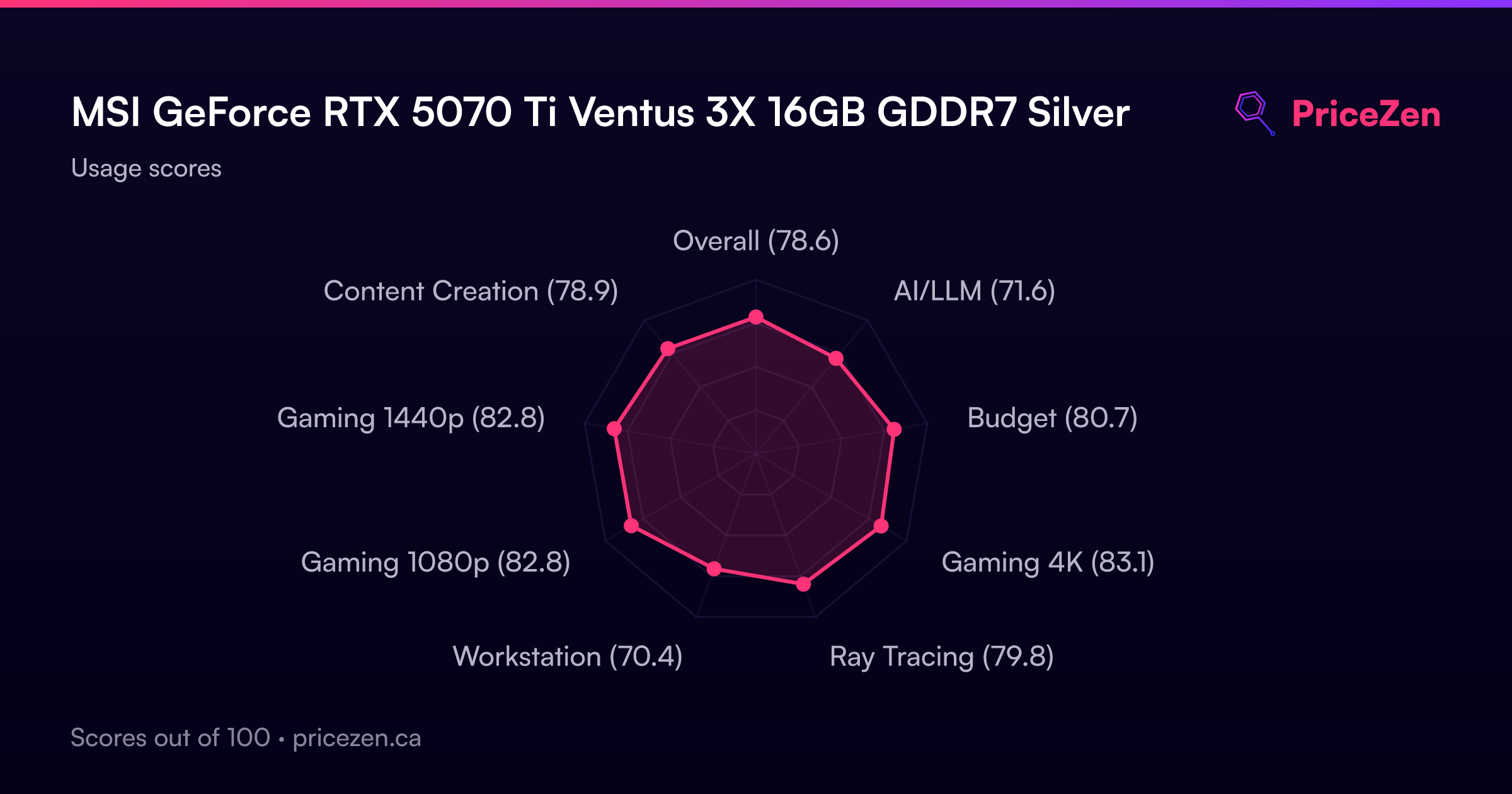
- Overall78.6
- AI/LLM71.6
- Budget80.7
- Gaming 4K83.1
- Ray Tracing79.8
- Workstation70.4
- Gaming 1080p82.8
- Gaming 1440p82.8
- Content Creation78.9