MSI GeForce GTX 1050 Ti 4GB GDDR5
The dual-fan cooler and 6-pin power connector on this Pascal-based card enable higher clock speeds up to a 1455 MHz boost, providing reliable 1080p gaming from its 768 CUDA cores and 4GB of GDDR5 memory. Its military class 4 components and tailored 4-phase PCB design offer stable overclocking potential in a compact, power-efficient package. This card is best for budget-conscious PC builders needing a dependable entry-level GPU for esports titles and older AAA games at medium settings.

No current retailer price




Snapshot
The 30-Second Version
The GTX 1050 Ti scores 6,366 on PassMark, putting it in the 17th percentile for raster performance. It's got 4GB of VRAM and 1.86 TFLOPS of compute, which is in the 8th percentile. At USD 340, it's a terrible buy unless you're desperate and your PSU can't handle anything better.
Pros & Cons
Pros
- 75W TDP runs on almost any 250W PSU 69th
- Dual-fan cooler keeps thermals in check
- 6-pin connector allows some overclocking headroom
- 4GB GDDR5 at 112 GB/s is enough for older esports titles
- HDMI 2.0b supports 4K@60Hz for desktop use
Cons
- 6,366 PassMark score lands in the 17th percentile for raster
- 1.86 TFLOPS compute is in the 8th percentile
- 4GB VRAM is a hard bottleneck for modern games
- Feature set ranks in the 23rd percentile
- USD 340 asking price is absurd for this performance tier
The proof
Performance
The headline number is 1.86 FP32 TFLOPS, which puts this card in the 8th percentile for compute. For context, that's less raw math than some integrated graphics solutions shipping in mid-range laptops today. The 768 CUDA cores at 1,455MHz boost clock were respectable for 1080p gaming in the Pascal era, but the 4GB GDDR5 frame buffer at 112 GB/s is a hard ceiling. Modern titles at 1080p will choke on texture streaming, and anything above medium settings is a slideshow.
The 6,366 PassMark score tells the same story. It's in the 17th percentile for raster, meaning 83% of the cards in our database render faster. The dual-fan cooler keeps things from melting down, but the thermal ranking sits at a middling 43rd percentile. It runs cool enough, but that's because there's not much heat to dissipate when the silicon is this old. The 6-pin power connector is a nice touch for overclocking headroom, but you're overclocking a card that's already near the bottom of the charts.
Specifications
Full Specifications
Chipset
| GPU Chipset | GeForce GTX 1050 Ti |
| Brand | NVIDIA |
| Architecture | Pascal |
| Class | consumer |
| Process | 14 |
Memory
| VRAM | 4 GB |
| Memory Type | GDDR5 |
| Memory Bus | 128 |
| Bandwidth | 112.1 |
Compute
| CUDA Cores | 768 |
| Base Clock | 1341 |
| Boost Clock | 1455 |
| FP32 TFLOPS | 1.862 |
Performance
| PassMark G3D | 6366 |
| GPU Compute | 2450 |
Power & Cooling
| TDP | 75 |
| Recommended PSU | 250 |
| Power Connectors | 6-pin |
| Cooler | Dual Fan |
| Fans | 2 |
Connectivity
| Interface | PCI Express x16 3.0 |
| DisplayPort | 1 |
| HDMI | 1 |
| Max Resolution | 7680 x 4320 |
Physical
| Weight | 0.8 kg / 1.7 lbs |
Features
| RGB | Yes |
vs Competition
Stacked against the current market, this card is in a different universe. The Gigabyte AORUS GV-N5080AORUS M-16GD and ASUS PRIME PRIME-RTX5070TI-O16G are the top competitors in our database, and they're not even playing the same sport. Those cards have 16GB of VRAM and modern architectures. The 1050 Ti has 4GB and a Pascal chip from 2016. Even the ZOTAC SOLID SFF OC and PNY OC cards, which are mid-range by today's standards, would run circles around this thing. The 1050 Ti's 6,366 PassMark score is roughly a quarter of what a modern mid-range card puts up. The only comparison where this card wins is power draw, and that's because it's barely doing any work.
| Spec | MSI GeForce GTX 1050 Ti | ASUS GeForce RTX 5090 TUF Gaming | Gigabyte GeForce RTX 5070 Ti Eagle Ice | ZOTAC GeForce RTX 5080 APOCALYPSE | PNY GeForce RTX 5080 ARGB OC | Sapphire Radeon RX 7900 XTX NITRO+ |
|---|---|---|---|---|---|---|
| Chipset | GeForce GTX 1050 Ti | GeForce RTX 5090 | GeForce RTX 5070 Ti | GeForce RTX 5080 | GeForce RTX 5080 | Radeon RX 7900 XTX |
| Vram | 4GB GDDR5 | 32GB GDDR7 | 16GB GDDR7 | 16GB GDDR7 | 16GB GDDR7 | 24GB GDDR6 |
| Boost Clock Mhz | 1455 | 2407 | 2542 | 2730 | 2620 | 2680 |
| Tdp W | 75 | 575 | 300 | 360 | 360 | 339 |
| Memory Bus Bits | 128 | 512 | 256 | 256 | 256 | 384 |
| Ray Tracing | - | Yes | Yes | Yes | Yes | Yes |
| GPU Class | consumer | consumer | consumer | consumer | consumer | consumer |
| Compare | Compare | Compare | Compare | Compare |
| Product | AI | Rt | Vram | Raster | Compute | Feature | Thermal | Efficiency | Connectivity | Social Proof | Affordability |
|---|---|---|---|---|---|---|---|---|---|---|---|
| MSI GeForce GTX 1050 Ti | 13.6 | 16.1 | 13.3 | 16.4 | 9.1 | 21.6 | 41.8 | 39.4 | 20 | 10.5 | 69.1 |
| ASUS GeForce RTX 5090 TUF Gaming Compare | 97.2 | 90.5 | 97.8 | 98.8 | 97.7 | 95.7 | 71.9 | 23.2 | 99.3 | 98.7 | 2.2 |
| Gigabyte GeForce RTX 5070 Ti Eagle Ice Compare | 79 | 88.7 | 86 | 89 | 87.9 | 95.7 | 91.8 | 71.7 | 94.2 | 93.4 | 22.8 |
| ZOTAC GeForce RTX 5080 APOCALYPSE Compare | 85.5 | 97.7 | 89.1 | 94.5 | 93.3 | 95.7 | 91.8 | 56.7 | 94.2 | 98.7 | 23.1 |
| PNY GeForce RTX 5080 ARGB OC Compare | 85.5 | 97.7 | 89.1 | 94.5 | 93.3 | 95.7 | 91.8 | 56.7 | 94.2 | 74.9 | 15.7 |
| Sapphire Radeon RX 7900 XTX NITRO+ Compare | 95.3 | 96.4 | 92.1 | 83.4 | 95.6 | 95.7 | 91.8 | 51.4 | 98.8 | 69.3 | 13.5 |
Price
Value & Pricing
Here's where things get uncomfortable. The only US listing we found is asking USD 340, which is roughly what you'd pay for a used RTX 3060 or a new RX 6600, both of which would absolutely demolish this card. The affordability score of 49.8 out of 100 reflects the fact that the card itself is cheap to run, not cheap to buy. At USD 340, you're paying a collector's premium for a card that delivers 17th percentile raster performance. The MXN 12,647 listing in Mexico tells the same story in a different currency. This is not a value play. It's a 'I need any GPU right now and this is what's available' play.
Read more
Overview
The MSI GeForce GTX 1050 Ti 4GT OC pulls a PassMark G3D score of 6,366, which lands it in the 17th percentile for raster performance in our database. That's a polite way of saying this card was a budget hero back in 2016, and in 2025 it's mostly a nostalgia piece or a desperate stopgap. The 4GB of GDDR5 on a 128-bit bus gives you 112 GB/s of bandwidth, and the 768 CUDA cores boost to 1,455MHz. It sips power at 75W TDP, which is genuinely nice if you're running an old office PC with a 250W PSU.
But let's be real about what this is. The total score of 19 out of 100 in our system isn't a typo. This card sits in the 8th percentile for compute and the 13th percentile for AI workloads. It's not a sleeper pick. It's a card that time forgot, and the only reason we're talking about it is because someone, somewhere, is still trying to squeeze life out of a decade-old build.
Common Questions
Q: Can this card run modern games at 1080p?
Not well. The 6,366 PassMark score puts it in the 17th percentile for raster performance, and the 4GB VRAM buffer is below the minimum for many 2024 and 2025 titles. You'll be limited to low settings and older games, and even then you'll hit stutters from the 112 GB/s memory bandwidth.
Q: Is the 75W TDP enough for my power supply?
Yes, and that's the one genuinely good thing about this card. The 75W TDP means it'll run on a 250W PSU, which is common in older office desktops. The 6-pin connector is there for overclocking headroom, but the card will run fine without it in most systems.
Q: How does this compare to integrated graphics?
It's better than most integrated graphics from its era, but the gap has narrowed significantly. The 1.86 TFLOPS of compute is in the 8th percentile of our database, and some modern laptop iGPUs are approaching or exceeding that number. You'd only buy this if you have a CPU with no integrated graphics at all.
Who Should Skip This
Skip this card if you have any other option. The 4GB VRAM is in the 14th percentile of our database, which means it's a hard bottleneck for anything beyond esports titles from five years ago. The feature set ranks in the 23rd percentile, so you're missing out on modern upscaling, better encoders, and newer display outputs. And at USD 340, you're paying more than the card is worth by a wide margin. If your PSU can handle a 75W card, it can probably handle a used GTX 1660 Super or RX 5600 XT, both of which would give you dramatically better performance for similar or less money.
Verdict
The MSI GTX 1050 Ti 4GT OC was a fine budget card when it launched. In 2025, it's a relic. The 6,366 PassMark score and 1.86 TFLOPS of compute put it firmly in the bottom fifth of our database, and the USD 340 asking price makes it actively bad advice. If you already own one and you're playing older games at 1080p low settings, it'll get you by. But nobody should be buying this card at this price. The 4GB VRAM ceiling alone disqualifies it from modern gaming, and the feature set is too thin for productivity work. This is a card for people who have no other choice, not a card anyone should seek out.
Usage Scores
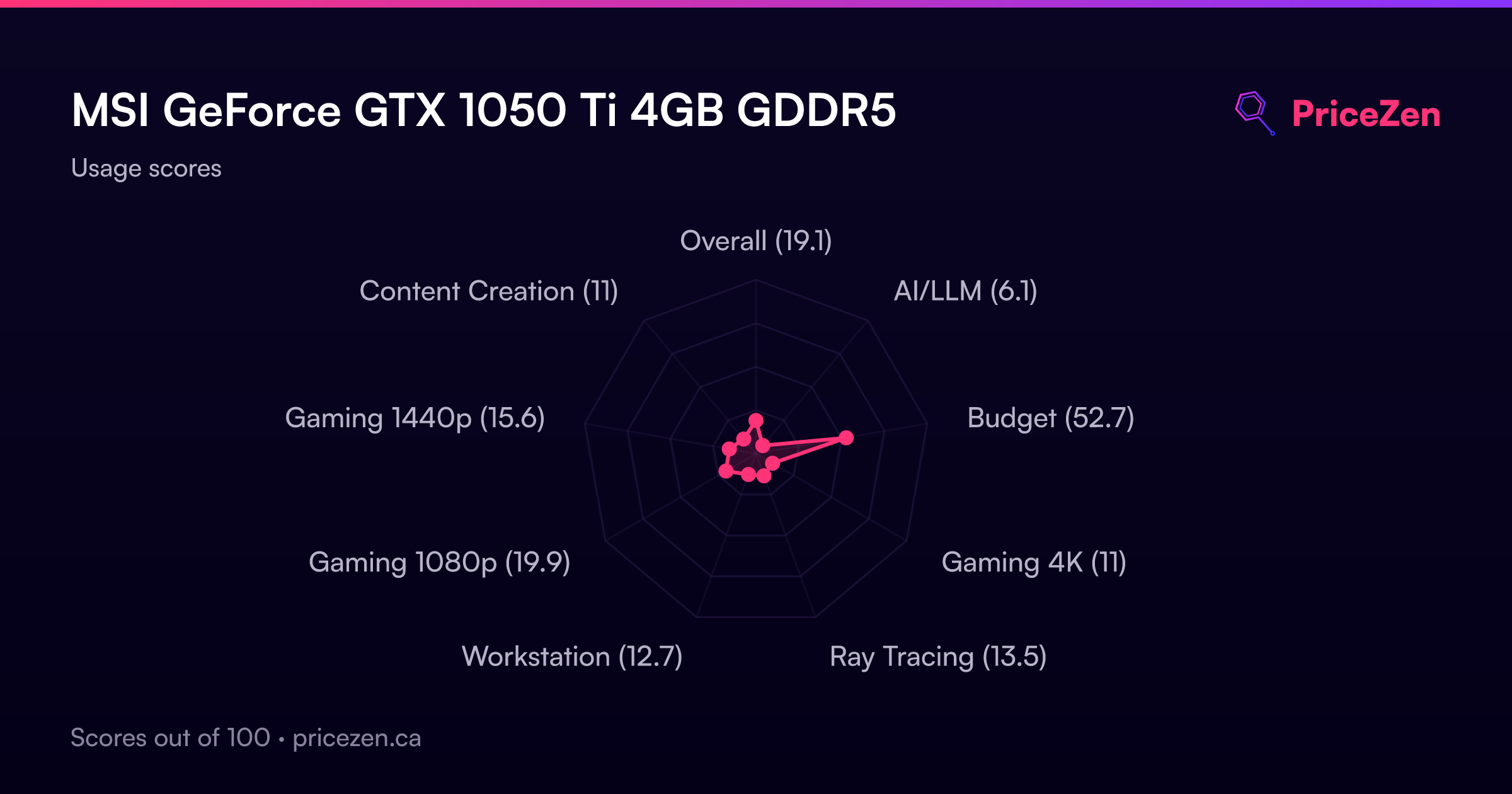
- Overall19.1
- AI/LLM6.1
- Budget52.7
- Gaming 4K11
- Ray Tracing13.5
- Workstation12.7
- Gaming 1080p19.9
- Gaming 1440p15.6
- Content Creation11