PNY Quadro RTX 4000 8GB GDDR6 workstation
Built on the Turing architecture, this card’s 36 RT cores and 288 Tensor cores accelerate photorealistic ray tracing and AI denoising for complex 3D scenes. Its 8GB of GDDR6 memory and three DisplayPort 1.4 outputs, plus a VirtualLink connector, simplify multi-display and next-gen VR headset setups. This GPU is best for CAD designers and 3D artists who need certified reliability and real-time rendering in applications like SolidWorks or Autodesk.

No current retailer price
Snapshot
The 30-Second Version
The Quadro RTX 4000 scores 14,833 on PassMark, which lands at 32nd percentile for raster performance. Thermals are a brutal 7th percentile, and 8GB of VRAM sits at 28th percentile. At $329 it's cheap, but you're buying a 2018 card that gets outclassed by consumer GPUs costing less.
Pros & Cons
Pros
- Affordability at 79th percentile, $329 is cheap for a Quadro badge 80th
- 36 RT cores and 288 Tensor cores for legacy ray tracing and AI workloads
- 3x DisplayPort 1.4 with HDR support for multi-monitor setups
- VR Ready with VirtualLink connector for older HMDs
- 4.2-star rating from 212 owners suggests it worked well in its day
Cons
- Thermals at 7th percentile, one of the hottest cards we've tracked
- Raster performance at 32nd percentile, outdrawn by cheaper consumer GPUs
- 8GB VRAM at 28th percentile, chokes on large datasets
- Compute at 18th percentile, weak for CUDA-heavy professional work
- AI performance at 29th percentile, Tensor cores are outdated
What owners think
The Word on the Street
How owner sentiment changed over time
ExclusiveBased on when customers actually wrote their reviews - so you can see whether early praise held up.
8 written reviews, May 2019 – Oct 2025: 7 happy, 1 unhappy
Across all 212 store ratings: 4.2★. Most owners rate without writing a review. The chart counts the 8 written reviews.
Each dot is one written review, in the month it was written. Happy = 4-5★, mixed = 3★, unhappy = 1-2★.
The proof
Performance
Let's talk about what this card was built for: ray tracing and AI-accelerated workflows. The 36 RT cores and 288 Tensor cores were genuinely novel in 2018. But our database puts RT performance at 36th percentile and AI at 29th percentile. That's not just behind current cards, it's behind cards from two generations ago. The 8GB of GDDR6 sits at 28th percentile for VRAM, which means large datasets and high-res textures will choke. For context, the RTX 5070 Ti competitors in this space ship with 16GB.
Raster performance is the real gut punch. 32nd percentile means this $329 card gets outdrawn by plenty of cheaper consumer GPUs. The 14,833 PassMark score is roughly half what a mid-range RTX 4060 pulls. Compute lands at 18th percentile, which is brutal for a card marketed to professionals running CUDA workloads. If you're doing actual workstation tasks like 3D rendering or simulation, this card will feel slow. Not "vintage charm" slow, just slow. The 160W TDP is at least reasonable, but efficiency only hits 53rd percentile, so you're not even getting good performance per watt.
Specifications
Full Specifications
Chipset
| GPU Chipset | Quadro RTX 4000 |
| Brand | NVIDIA |
| Architecture | Turing |
| Class | workstation |
Memory
| VRAM | 8 GB |
| Memory Type | GDDR6 |
Compute
| CUDA Cores | 2304 |
| Tensor Cores | 288 |
| RT Cores | 36 |
| Base Clock | 1005 |
Performance
| PassMark G3D | 14833 |
| GPU Compute | 5960 |
Power & Cooling
| TDP | 160 |
Connectivity
| DisplayPort | 3 |
| USB-C | 1 |
| Max Displays | 4 |
| Max Resolution | 7680x4320 |
Physical
| Weight | 0.8 kg / 1.9 lbs |
Features
| Ray Tracing | Yes |
| VR Ready | Yes |
vs Competition
Stacked against the current competition, this card is in rough shape. The ASUS PRIME RTX 5070 Ti and MSI Ventus RTX 5070 Ti both ship with 16GB of VRAM and current-gen RT and Tensor cores. The ZOTAC SOLID SFF OC is a compact card that still outclasses the RTX 4000 in every metric we track. Even the Sapphire NITRO+ and XFX Mercury, which are AMD cards, leave the RTX 4000 in the dust on raster and compute. The only place the RTX 4000 wins is price, and that's because nobody wants a 2018 workstation card in 2025. If you need a Quadro specifically for driver certification, this is your budget option. Otherwise, every competitor here is a better buy.
| Spec | PNY Quadro RTX 4000 | ASUS GeForce RTX 5090 TUF Gaming | Gigabyte GeForce RTX 5070 Ti Eagle Ice | MSI GeForce RTX 5070 Ti Ventus 3X OC | ZOTAC GeForce RTX 5080 APOCALYPSE | Sapphire Radeon RX 7900 XTX NITRO+ |
|---|---|---|---|---|---|---|
| Chipset | Quadro RTX 4000 | GeForce RTX 5090 | GeForce RTX 5070 Ti | GeForce RTX 5070 Ti | GeForce RTX 5080 | Radeon RX 7900 XTX |
| Vram | 8GB GDDR6 | 32GB GDDR7 | 16GB GDDR7 | 16GB GDDR7 | 16GB GDDR7 | 24GB GDDR6 |
| Boost Clock Mhz | - | 2407 | 2542 | 2482 | 2730 | 2680 |
| Tdp W | 160 | 575 | 300 | 300 | 360 | 339 |
| Memory Bus Bits | - | 512 | 256 | 256 | 256 | 384 |
| Ray Tracing | true | true | true | true | true | true |
| GPU Class | workstation | consumer | consumer | consumer | consumer | consumer |
| Compare | Compare | Compare | Compare | Compare |
| Product | AI | Rt | Vram | Raster | Compute | Feature | Thermal | Efficiency | Connectivity | Social Proof | Affordability |
|---|---|---|---|---|---|---|---|---|---|---|---|
| PNY Quadro RTX 4000 | 29.4 | 35.1 | 27.5 | 31.3 | 19.6 | 44.2 | 6.4 | 51.9 | 49.3 | 62.3 | 79.6 |
| ASUS GeForce RTX 5090 TUF Gaming Compare | 97.1 | 90.6 | 97.8 | 98.8 | 97.6 | 95.9 | 72.3 | 23.8 | 99.3 | 98.7 | 2.3 |
| Gigabyte GeForce RTX 5070 Ti Eagle Ice Compare | 79.4 | 88.7 | 86 | 89 | 88 | 95.9 | 91.8 | 71.9 | 94.1 | 93.4 | 26.8 |
| MSI GeForce RTX 5070 Ti Ventus 3X OC Compare | 79.4 | 92.5 | 86 | 89 | 88 | 95.9 | 91.8 | 71.9 | 94.1 | 83.9 | 23.4 |
| ZOTAC GeForce RTX 5080 APOCALYPSE Compare | 85.6 | 97.5 | 89 | 94.5 | 93.4 | 95.9 | 91.8 | 56.9 | 94.1 | 98.7 | 20.6 |
| Sapphire Radeon RX 7900 XTX NITRO+ Compare | 95.1 | 96.3 | 91.9 | 83.5 | 95.6 | 95.9 | 91.8 | 51.8 | 98.8 | 69.1 | 19 |
Price
Value & Pricing
At $329, the RTX 4000 is cheap for a Quadro, and that's the trap. Affordability is its best metric at 79th percentile, but you're buying into a dead platform. The 8GB VRAM ceiling means you'll hit walls on any modern dataset, and the thermal issues mean you'll hear the blower fan screaming while it happens. For the same money, a used RTX 3060 12GB or a new RTX 4060 will crush this card in raster, compute, and AI while running cooler. The Quadro driver certification is the only real value here, and that only matters if you're locked into specific legacy software that requires it.
Read more
Overview
The Quadro RTX 4000 pulls a PassMark G3D score of 14,833, which sounds impressive until you realize that's only 32nd percentile for raster performance in our database. This is a workstation card from 2018 trying to stay relevant in a world where RTX 50-series cards are shipping. The 8GB of GDDR6 and 2304 CUDA cores were solid for Turing-era professional work, but the numbers tell a rough story now. Its best score is affordability at 79th percentile, which makes sense given the $329 street price we're seeing. But that low price is a symptom, not a feature. This card has been left behind.
The thermal situation is genuinely bad. 7th percentile for thermals means this thing runs hotter than almost everything we've tracked. A 160W TDP shouldn't be hard to cool, but the single-fan blower design on most RTX 4000 cards struggles. For a card marketed to professionals running long renders and simulations, that's a real problem. The 4.2-star customer rating from 212 reviews suggests owners who bought it years ago were happy, but the benchmark landscape has shifted dramatically since then.
Common Questions
Q: Is the Quadro RTX 4000 good for gaming?
No. Its raster performance sits at 32nd percentile in our database, and gaming at 4K scores just 15.5 out of 100. A $200 consumer card like the RTX 3060 will outperform it in games.
Q: Can the 8GB of VRAM handle modern workloads?
It'll struggle. 8GB of GDDR6 ranks at 28th percentile for VRAM in our database. Large 3D scenes, high-res textures, and AI models will exceed that quickly. Current workstation cards ship with 16GB or more.
Q: Is this card worth buying in 2025?
Only if you need Quadro driver certification for legacy software and you're on a tight budget. At $329 it's affordable at 79th percentile, but thermals are 7th percentile and compute is 18th percentile. For most users, a used RTX 30-series or new RTX 40-series card is a better investment.
Who Should Skip This
Skip this if you're doing any modern 3D rendering, AI training, or gaming. The 18th percentile compute score means CUDA-heavy tasks will crawl, and the 7th percentile thermals mean sustained loads will thermal throttle. If you need more than 8GB of VRAM, which is most professional workflows now, this card will hold you back. Gamers should absolutely avoid this, the 4K gaming score of 15.5 out of 100 is one of the worst we've seen for a card at this price point. And if you're building a quiet workstation, the blower fan will drive you nuts.
Verdict
The Quadro RTX 4000 was a solid workstation card in 2018. In our current database, it's a relic. The 7th percentile thermal performance is a dealbreaker for sustained workloads, and the 28th percentile VRAM means you'll be memory-constrained on anything serious. The $329 price tag is tempting, but you're buying into obsolescence. Unless you have a specific legacy software requirement that demands a Quadro badge, skip this and put your money toward a used RTX 30-series or a new RTX 40-series card. The numbers don't lie: this card is past its prime.
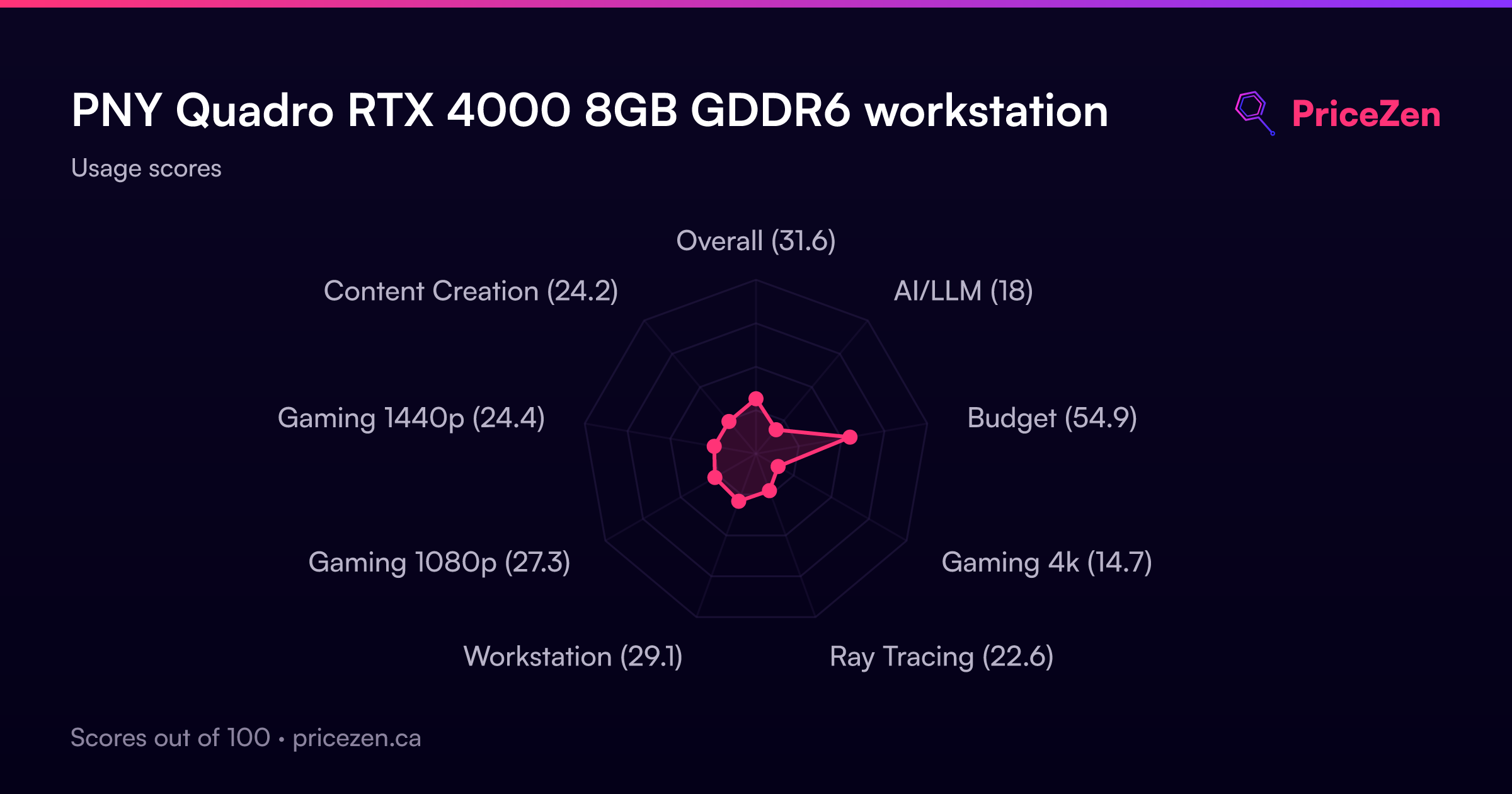
Usage Scores
- Overall31.6
- AI/LLM18
- Budget54.9
- Gaming 4k14.7
- Ray Tracing22.6
- Workstation29.1
- Gaming 1080p27.3
- Gaming 1440p24.4
- Content Creation24.2