SRhonyra GeForce GTX 1060 3GB GDDR5
The Pascal-based GTX 1060 with 3GB of GDDR5 memory and 1280 CUDA cores delivers a consistent 60+ FPS at 1080p on mid settings for AAA titles. Its compact 210mm dual-fan design and 120W TDP allow for easy installation in smaller builds without sacrificing thermal stability. This card is best for budget-conscious gamers building a first PC who need reliable 1080p performance in esports and older titles.

No current retailer price
Where we saw it before. Check the store for today's price.











Snapshot
The 30-Second Version
The SRhonyra GTX 1060 3GB is a budget card that still handles 1080p medium at 60+ FPS, but the 3GB VRAM is a real limitation. It's cheap at around $124 USD and supports triple monitors, which is nice. But with bottom-quarter performance scores and limited reliability data, it's only worth it if you're desperate for a cheap GPU right now.
Pros & Cons
Pros
- Still hits 60+ FPS at 1080p medium in most games 90th
- Supports up to 3 monitors via 2x DisplayPort and 1x HDMI
- Only needs a 400W PSU and a single 6-pin connector
- Compact 210mm length fits in most cases
Cons
- 3GB VRAM is a serious bottleneck in 2025
- Bottom-quarter raster and compute performance
- Dual fans are mediocre, thermal percentile is below average
- Limited review data makes long-term reliability a gamble
What owners think
The Word on the Street
How owner sentiment changed over time
ExclusiveBased on when customers actually wrote their reviews - so you can see whether early praise held up.
Across all 3 store ratings: 4.6★. Most owners rate without writing a review.
The proof
Performance
The GTX 1060 3GB hits 10,058 on PassMark G3D, which lands it in the bottom quarter of cards we track. That 1506MHz boost clock and 4.375 TFLOPS of FP32 compute were respectable in 2016, but modern titles will make this thing sweat. The 3GB VRAM is the real killer here. At 1080p medium settings, you'll hover around 70 FPS in most games, but anything texture-heavy will stutter when that VRAM fills up. The 192-bit memory bus helps bandwidth at 192 GB/s, but it's not enough to save the limited capacity. Thermal performance sits at the 43rd percentile, so the dual fans do an okay job, but nothing to write home about.
Specifications
Full Specifications
Chipset
| GPU Chipset | GeForce GTX 1060 |
| Brand | NVIDIA |
| Architecture | Pascal |
| Class | consumer |
| Process | 16 |
Memory
| VRAM | 3 GB |
| Memory Type | GDDR5 |
| Memory Bus | 196 |
| Bandwidth | 192.2 |
Compute
| CUDA Cores | 1280 |
| Base Clock | 1506 |
| Boost Clock | 1506 |
| FP32 TFLOPS | 4.375 |
Performance
| PassMark G3D | 10058 |
| GPU Compute | 4264 |
Power & Cooling
| TDP | 120 |
| Recommended PSU | 400 |
| Power Connectors | 6-Pin |
| Cooler | Dual Fan |
| Fans | 2 |
Connectivity
| Interface | PCI Express 3.0 x16 |
| DisplayPort | 2 |
| HDMI | 1 |
| Max Displays | 3 |
| Max Resolution | 7680 x 4320 |
Physical
| Length | 210 |
| Slot Width | 2 |
| Form Factor | Full Height |
| Weight | 0.8 kg / 1.8 lbs |
Features
| DirectX | 12 |
vs Competition
Stacked against the MSI SHADOW RTX 5060, PNY Dual Fan OC, or Gigabyte WINDFORCE, this SRhonyra card looks ancient. Those RTX 5060 cards are in a completely different league with 8GB of VRAM and modern architecture. The ASUS Dual RTX 4060 also crushes it. Even the XFX Speedster RX-76TQICKBP, which is a budget AMD option, offers way more headroom. The only reason to pick this SRhonyra over any of those is if you're on a super tight budget and just need something functional right now.
| Spec | SRhonyra GeForce GTX 1060 | ASUS GeForce RTX 4070 Dual OC | XFX Radeon RX 7800 XT SPEEDSTER MERC319 | Sapphire Radeon RX 7900 GRE PULSE | Gigabyte GeForce RTX 5060 Ti Gaming OC | MSI GeForce RTX 5060 SHADOW |
|---|---|---|---|---|---|---|
| Chipset | GeForce GTX 1060 | GeForce RTX 4070 | Radeon RX 7800 XT | Radeon RX 7900 GRE | GeForce RTX 5060 Ti | GeForce RTX 5060 |
| Vram | 3GB GDDR5 | 12GB GDDR6X | 16GB GDDR6 | 16GB GDDR6 | 8GB GDDR7 | 8GB GDDR7 |
| Boost Clock Mhz | 1506 | 2505 | 2565 | 2290 | 2647 | 2527 |
| Tdp W | 120 | 200 | 236 | 268 | 180 | 145 |
| Memory Bus Bits | 196 | 192 | 256 | 256 | 128 | 128 |
| Ray Tracing | - | Yes | Yes | Yes | Yes | Yes |
| GPU Class | consumer | consumer | consumer | consumer | consumer | consumer |
| Compare | Compare | Compare | Compare | Compare |
| Product | AI | Rt | Vram | Raster | Compute | Feature | Thermal | User Sentiment | Efficiency | Connectivity | Social Proof | Affordability |
|---|---|---|---|---|---|---|---|---|---|---|---|---|
| SRhonyra GeForce GTX 1060 | 11.7 | 21.9 | 10.5 | 23.6 | 15.4 | 10.7 | 42 | 57.8 | 36.7 | 30.4 | 21 | 89.6 |
| ASUS GeForce RTX 4070 Dual OC Compare | 56.9 | 70.3 | 58.3 | 72.4 | 64.8 | 95.8 | 54.7 | 96 | 89.6 | 68.9 | 93.3 | 44.7 |
| XFX Radeon RX 7800 XT SPEEDSTER MERC319 Compare | 83 | 78.3 | 72.3 | 63.4 | 80.4 | 88.6 | 91.9 | 0 | 65 | 87.3 | 83.8 | 56 |
| Sapphire Radeon RX 7900 GRE PULSE Compare | 88.7 | 89.8 | 71.5 | 76.9 | 90.4 | 71.6 | 72.1 | 0 | 64.1 | 86 | 0 | 57.2 |
| Gigabyte GeForce RTX 5060 Ti Gaming OC Compare | 39.6 | 59.8 | 46.5 | 51.6 | 50 | 95.8 | 72.1 | 0 | 81.6 | 94.2 | 93.3 | 62.9 |
| MSI GeForce RTX 5060 SHADOW Compare | 39.6 | 58.8 | 46.5 | 50 | 46.2 | 71.6 | 54.7 | 71.2 | 95.3 | 94.2 | 93.3 | 64.2 |
Price
Value & Pricing
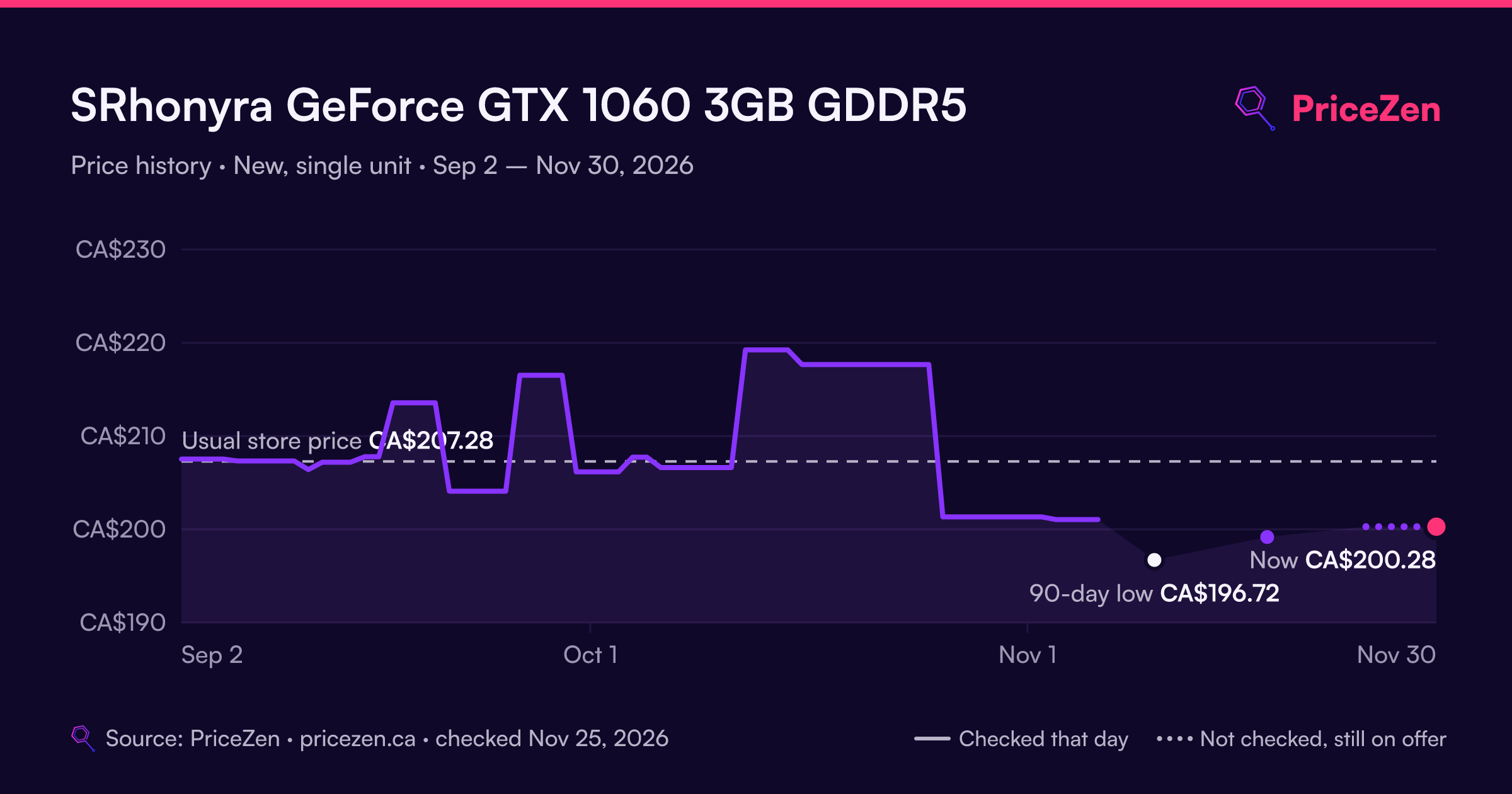
At $124 USD, this card is cheap. But cheap doesn't always mean good value. You're getting 2016 performance in a market where used RX 580s and GTX 1660s often sell for similar money with more VRAM. The 89th percentile affordability score is nice, but that's because the card is old, not because it's a steal. If you're in a pinch and need something to drive a display or play older games, it'll do the job. For anything modern, save your cash for something with at least 6GB of VRAM.
Price history
Read more
Overview
The SRhonyra GTX 1060 3GB is a budget card that's been around the block. It's a Pascal-era GPU with 1280 CUDA cores and 3GB of GDDR5, which was a solid 1080p card back in 2016. In 2025, it's more of a 'keep your old rig alive' option than a serious upgrade path.
Our database puts this thing at the 25th percentile for raster performance and 11th for VRAM. That's not great. But the price is right if you can find one around $124 USD, and it'll still push 60+ FPS at 1080p medium in most games. Just don't expect miracles.
Common Questions
Q: Can this card handle modern games at 1080p?
Yes, but only at medium settings. Expect around 70 FPS average in most titles, though the 3GB VRAM will cause stuttering in texture-heavy games.
Q: What power supply do I need for this card?
A minimum 400W PSU with a single 6-pin PCIe power connector. The card draws 120W under load, so most decent 400W units will handle it fine.
Q: How many monitors can I connect?
Up to 3 monitors simultaneously using the 2 DisplayPort and 1 HDMI outputs. It supports 8K resolution via DisplayPort, though gaming at that res is out of the question.
Who Should Skip This
Skip this if you want to play anything from the last 3-4 years at high settings. The 3GB VRAM will choke on modern textures, and the compute performance is in the bottom 14th percentile. If you need a card for 1440p, VR, or any kind of AI/ML work, look elsewhere. Also skip it if you're building a new system, you'd be better off spending a bit more on a used GTX 1660 Super or RX 5600 XT with more VRAM.
Verdict
This card is for people with old systems who need a cheap replacement GPU and aren't picky about settings. If you're still rocking a 1080p monitor and mostly play esports titles or older AAA games, the GTX 1060 3GB will keep you going. But if you're building a new system or want to play anything from the last few years at decent settings, this isn't the card for you. The 3GB VRAM is a ticking time bomb for modern games.
Usage Scores
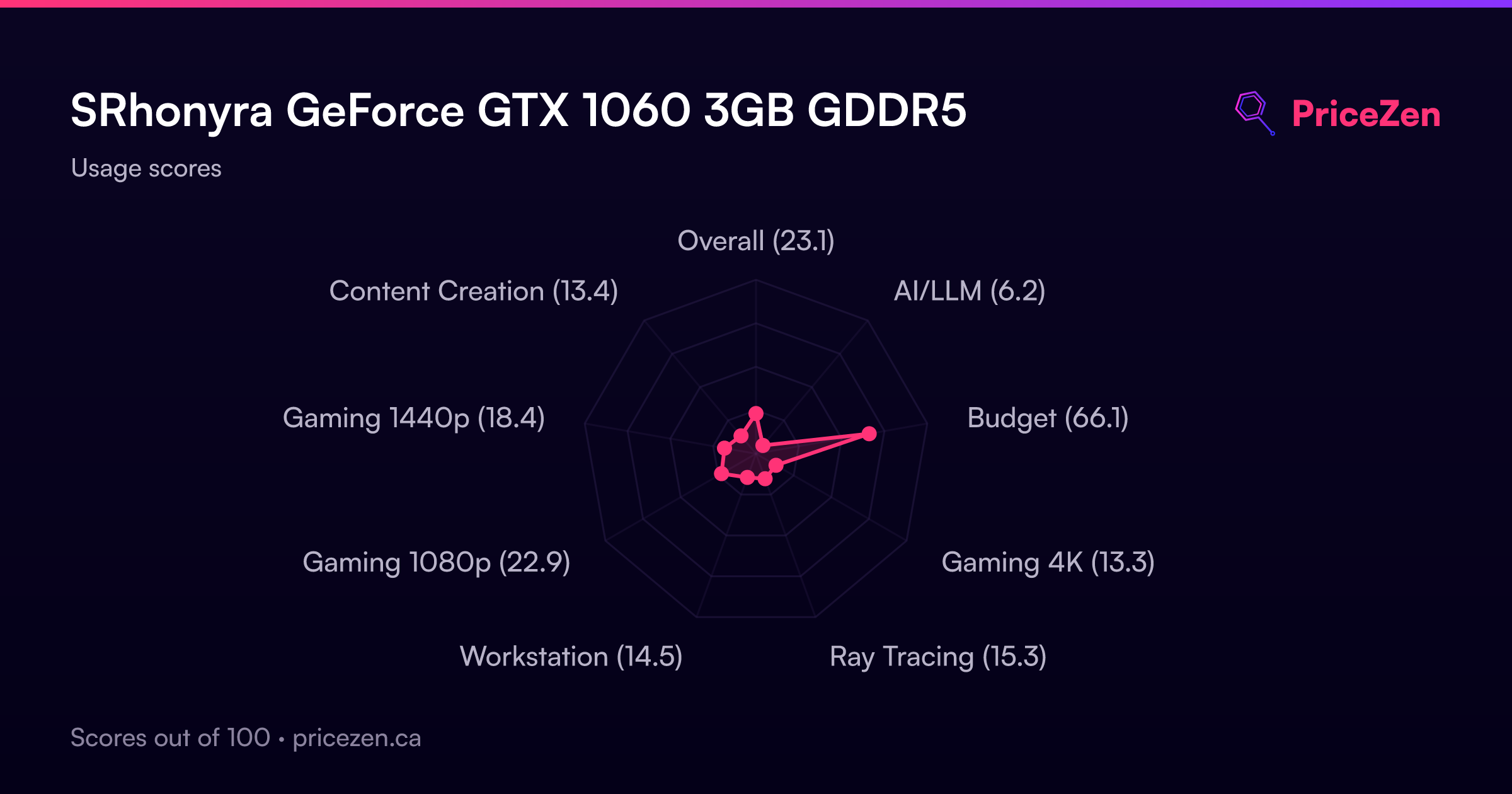
- Overall23.1
- AI/LLM6.2
- Budget66.1
- Gaming 4K13.3
- Ray Tracing15.3
- Workstation14.5
- Gaming 1080p22.9
- Gaming 1440p18.4
- Content Creation13.4