ASUS GeForce RTX 3050 Dual OC 8GB GDDR6 Black
The 8GB of GDDR6 VRAM and 1852MHz boost clock on this compact card provide a buffer for modern textures that the 6GB variant lacks, making it a standout at its entry-level tier. Its 200mm, 2-slot design with dual Axial-tech fans and 0dB technology delivers broad small-form-factor compatibility and quiet operation. This GPU is best for budget-conscious builders assembling compact 1080p gaming rigs who need ray tracing and DLSS support without a bulky card.

No current retailer price











Snapshot
The 30-Second Version
The ASUS Dual GeForce RTX 3050 is a compact, quiet budget GPU that handles 1080p gaming at 60 fps in most titles. Its 8GB of VRAM and low 130W power draw make it a solid choice for small form factor builds. But at $360 USD, the price is steep for the performance, and most buyers with a standard case can find better value elsewhere.
Pros & Cons
Pros
- Solid 1080p gaming at 60 fps in most titles 84th
- 8GB VRAM is more than typical budget cards 83rd
- Quiet operation with 0 dB fan mode 69th
- Compact 200mm, 2-slot design fits small cases 67th
- Only 130W TDP, easy on power supplies
Cons
- Ray tracing performance is weak
- 128-bit memory bus limits bandwidth
- Price is high for the performance tier
- Fans not spinning at idle can alarm new builders
- Driver updates come from NVIDIA, not ASUS
What owners think
The Word on the Street
How owner sentiment changed over time
ExclusiveBased on when customers actually wrote their reviews - so you can see whether early praise held up.
34 written reviews, Feb 2022 – Mar 2026: 32 happy, 1 unhappy, 1 without stars
Across all 167 store ratings: 4.6★. Most owners rate without writing a review. The chart counts the 34 written reviews.
Each dot is one written review, in the month it was written. Happy = 4-5★, mixed = 3★, unhappy = 1-2★.
The proof
Performance
In our database, the RTX 3050 posts a PassMark G3D score of 12,487. That puts it well above average for budget cards but nowhere near the mid-range heavyweights. In practice, you're looking at smooth 1080p gaming in most titles. One owner benchmarked it against a GTX 1660 and found the 3050 matched the 1660's high-settings score while running ultra settings with 4x anti-aliasing. That's a solid generational jump, even if it's not earth-shattering.
The card runs at a 1852 MHz boost clock in OC mode, with 2560 CUDA cores doing the heavy lifting. Ray tracing performance is mediocre at best, landing in the 35th percentile for RT workloads. You can technically turn on ray tracing in games like Cyberpunk 2077, but you'll want DLSS enabled and expectations lowered. The 16 RT cores just aren't built for heavy ray tracing. Compute and AI workloads are also weak spots, so don't buy this for machine learning or rendering. This is a gaming card first, and a budget one at that.
Specifications
Full Specifications
Chipset
| GPU Chipset | GeForce RTX 3050 |
| Brand | NVIDIA |
| Architecture | Ampere |
| Class | consumer |
| Process | 8 |
Memory
| VRAM | 8 GB |
| Memory Type | GDDR6 |
| Memory Bus | 128 |
| Bandwidth | 192 |
Compute
| CUDA Cores | 2560 |
| Tensor Cores | 64 |
| RT Cores | 16 |
| Base Clock | 1552 |
| Boost Clock | 1852 |
| FP16 TFLOPS | 4.813 |
| FP32 TFLOPS | 4.813 |
Performance
| PassMark G3D | 12487 |
| GPU Compute | 6442 |
Power & Cooling
| TDP | 130 |
| Recommended PSU | 550 |
| Power Connectors | 8-Pin |
| Cooler | Dual Fan |
| Fans | 2 |
Connectivity
| Interface | PCI Express 4.0 |
| DisplayPort | 3 |
| HDMI | 1 |
| Max Displays | 4 |
| Max Resolution | 7680 x 4320 |
Physical
| Length | 200 |
| Slot Width | 2 |
| Weight | 0.5 kg / 1.2 lbs |
Features
| Ray Tracing | Yes |
| Upscaling | DLSS |
| AV1 Encode | Yes |
| DirectX | 12 Ultimate |
| RGB | Yes |
vs Competition
Stacked against the competition, the ASUS Dual RTX 3050 has a clear niche but also clear limits. The Gigabyte AORUS RTX 5080 and MSI Suprim RTX 5080 are in a completely different universe, those are flagship cards that cost several times more and deliver several times the performance. Even the ZOTAC SOLID RTX 5070 and PNY VERTO RTX 4070 Ti Super blow the 3050 out of the water, but they also demand bigger power supplies and more case space. The XFX Mercury RX 9070 XT is another strong alternative if you're open to AMD, offering much better rasterization for not much more money.
Where the ASUS Dual RTX 3050 wins is in size and power draw. At 200mm long and 130W TDP, it fits in small form factor builds where those bigger cards simply won't go. If you're building a compact PC or upgrading an older prebuilt with a modest power supply, this card is one of the few modern options that will actually fit and run. But if you have a standard ATX case and a 650W or better PSU, you should probably spend your money elsewhere.
| Spec | ASUS GeForce RTX 3050 Dual OC | Gigabyte GeForce RTX 5070 Ti Eagle Ice | MSI GeForce RTX 5070 Ti Ventus 3X OC | ZOTAC GeForce RTX 5080 APOCALYPSE | Sapphire Radeon RX 7900 XTX NITRO+ | PNY GeForce RTX 5070 Ti OC |
|---|---|---|---|---|---|---|
| Chipset | GeForce RTX 3050 | GeForce RTX 5070 Ti | GeForce RTX 5070 Ti | GeForce RTX 5080 | Radeon RX 7900 XTX | GeForce RTX 5070 Ti |
| Vram | 8GB GDDR6 | 16GB GDDR7 | 16GB GDDR7 | 16GB GDDR7 | 24GB GDDR6 | 16GB GDDR7 |
| Boost Clock Mhz | 1852 | 2542 | 2482 | 2730 | 2680 | 2450 |
| Tdp W | 130 | 300 | 300 | 360 | 339 | 300 |
| Memory Bus Bits | 128 | 256 | 256 | 256 | 384 | 256 |
| Ray Tracing | Yes | Yes | Yes | Yes | Yes | Yes |
| GPU Class | consumer | consumer | consumer | consumer | consumer | consumer |
| Compare | Compare | Compare | Compare | Compare |
| Product | AI | Rt | Vram | Raster | Compute | Feature | Thermal | User Sentiment | Efficiency | Connectivity | Social Proof | Affordability |
|---|---|---|---|---|---|---|---|---|---|---|---|---|
| ASUS GeForce RTX 3050 Dual OC | 24.6 | 33.2 | 28.5 | 25.2 | 20.4 | 83 | 54.6 | 27.4 | 53.8 | 68.8 | 83.8 | 67 |
| Gigabyte GeForce RTX 5070 Ti Eagle Ice Compare | 79.1 | 88.7 | 85.9 | 89 | 88 | 95.8 | 91.8 | 85.3 | 71.7 | 94.1 | 93.3 | 24.2 |
| MSI GeForce RTX 5070 Ti Ventus 3X OC Compare | 79.1 | 92.4 | 85.9 | 89 | 88 | 95.8 | 91.8 | 85.3 | 71.7 | 94.1 | 83.8 | 23.7 |
| ZOTAC GeForce RTX 5080 APOCALYPSE Compare | 85.4 | 97.6 | 89 | 94.5 | 93.4 | 95.8 | 91.8 | 99.5 | 56.7 | 94.1 | 98.7 | 21.1 |
| Sapphire Radeon RX 7900 XTX NITRO+ Compare | 95.2 | 96.3 | 92 | 83.4 | 95.7 | 95.8 | 91.8 | 85.3 | 51.5 | 98.8 | 69.1 | 19.1 |
| PNY GeForce RTX 5070 Ti OC Compare | 79.1 | 92.4 | 85.9 | 89 | 88 | 65.8 | 91.8 | 58 | 71.7 | 81.5 | 93.3 | 26.2 |
Price
Value & Pricing
At $360 USD, the RTX 3050 is a tough sell in today's market. You're paying a premium for the ASUS build quality and the compact dual-fan design, but the raw performance doesn't quite justify the price when faster cards like the RTX 3060 or AMD's RX 6600 often show up at similar or slightly higher prices. The 8GB of VRAM helps future-proof things a bit, but the 128-bit bus holds it back. If you can find this card on sale or used for under $250, it becomes a much more compelling budget option. At full retail, you're paying for the form factor and the ASUS name as much as the silicon.
We started tracking prices for this product on Nov 3, 2026. The chart appears once we have more data.
Read more
Overview
The ASUS Dual GeForce RTX 3050 OC Edition sits in that budget GPU bracket where you're just trying to get playable frame rates without selling a kidney. It's an 8GB GDDR6 card built on NVIDIA's Ampere architecture, and ASUS packed it into a compact 200mm, 2-slot design with dual Axial-tech fans. If you're wondering whether the RTX 3050 is good for 1080p gaming, the short answer is yes, mostly. It handles esports titles and older AAA games at 60 fps without breaking a sweat, though newer heavy hitters will need some settings dialed back.
At around $360 USD these days, this card is in a weird spot. The GPU market has moved on, and you can often find faster options for similar money. But if you need something small, quiet, and power-efficient for a compact build or an older system, the ASUS Dual RTX 3050 still makes a case for itself. The 0 dB fan mode means the fans don't even spin during light loads, which is nice if you do a lot of desktop work or play lighter indie games.
One thing to know upfront: this card has 8GB of VRAM, which is more than the 6GB you'd get on a GTX 1660, and that matters for texture-heavy games. But the memory bus is only 128-bit, so bandwidth tops out at 192 GB/s. That's fine for 1080p, but it's one reason this card struggles at 1440p.
Common Questions
Q: Is the ASUS Dual RTX 3050 good for 1080p gaming?
Yes, the RTX 3050 handles 1080p gaming at 60 fps in most titles, including esports games and older AAA releases. For newer demanding games, you may need to lower some settings from ultra to high.
Q: How much power does the ASUS Dual RTX 3050 need?
The card has a 130W TDP and requires a single 8-pin power connector. ASUS recommends a 550W power supply, though some users suggest 600W for extra headroom.
Q: Can the RTX 3050 run ray tracing?
Technically yes, the RTX 3050 has 16 RT cores and supports ray tracing, but performance is limited. You'll want DLSS enabled and modest ray tracing settings for playable frame rates.
Q: Does the ASUS Dual RTX 3050 fit in a small case?
Yes, at 200mm long and 2 slots thick, this is one of the more compact RTX 3050 cards available. It's a good fit for small form factor builds and compact prebuilt systems.
Who Should Skip This
Skip this card if you have a standard ATX case and a 650W or better power supply. You can get significantly more performance from cards like the RTX 3060, RX 6600, or even used RTX 3060 Ti for similar money. Also skip it if you care about ray tracing or plan to game at 1440p, the 3050 just doesn't have the muscle for either. And if you're doing AI work, rendering, or any compute-heavy tasks, this card's 20th percentile compute performance will frustrate you. This is a 1080p gaming card for compact builds, nothing more.
Verdict
Should you buy the ASUS Dual GeForce RTX 3050? If you need a compact, low-power card for 1080p gaming and you can find it at a discount, sure. It's quiet, it's well-built, and it handles the most popular games at 60 fps without drama. The 8GB of VRAM gives it a bit more longevity than older budget cards, and the 0 dB fan mode is genuinely nice for quiet builds.
But at $360 USD, it's hard to recommend without caveats. The performance per dollar just isn't there compared to what else is on the market. If you have a standard case and a decent power supply, you can get significantly more performance for not much more money. This card makes the most sense for small form factor builds and prebuilt upgrades where space and power are the limiting factors. For everyone else, shop around first.
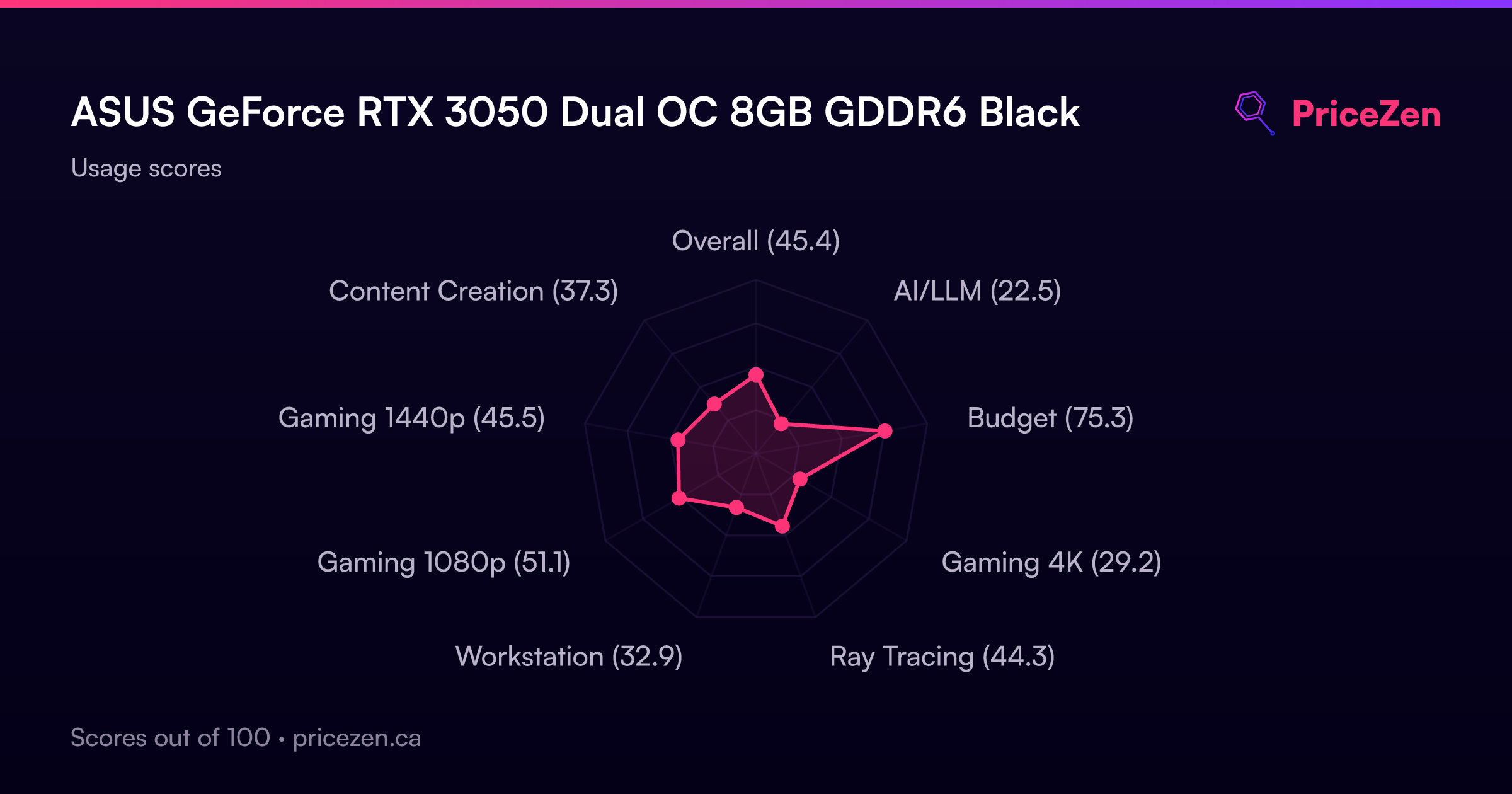
Usage Scores
- Overall45.4
- AI/LLM22.5
- Budget75.3
- Gaming 4K29.2
- Ray Tracing44.3
- Workstation32.9
- Gaming 1080p51.1
- Gaming 1440p45.5
- Content Creation37.3