MSI GeForce RTX 3050 Ventus 2X OC 6GB GDDR6 Black
The 2304 CUDA cores and 1492 MHz boost clock on the Ampere architecture handle Full HD 1080p gaming with ray tracing and DLSS 2, while the 70W TDP keeps power draw low. The 189mm dual-fan design fits compact builds, and the 6GB GDDR6 memory with HDMI 2.1 outputs supports modern displays. This card suits budget-conscious gamers upgrading from older GPUs who want entry-level ray tracing without a PSU upgrade beyond 300W.












Snapshot
The 30-Second Version
A 70W miracle for old prebuilts, but a weak performer for everyone else. Buy it only if your power supply can't handle anything better.
Pros & Cons
Pros
- 70W TDP means no extra power cables, just plug it in and go 93rd
- Small 189mm length fits in almost any case 91st
- Runs cool and quiet with the dual fan design 82nd
- Great drop-in upgrade for older PCIe 3.0 systems
Cons
- 6GB VRAM on a 96-bit bus is a serious bottleneck
- Ray tracing performance is basically unusable
- Raster performance lands in the bottom quarter of our database
- No 8-pin power connector limits any overclocking headroom
What owners think
The Word on the Street
How owner sentiment changed over time
ExclusiveBased on when customers actually wrote their reviews - so you can see whether early praise held up.
Happy owners: 90% lately, 90% in Apr 2024 – Sep 2025
Too few reviews to call that a change.
Across all 286 store ratings: 4.7★. Most owners rate without writing a review. The chart counts the 20 written reviews with stars and their own date.
20 reviews from months with approximate dates (the day we first saw a review) are left out of the trend.
3 written reviews without stars are left out of the trend.
Show the numbers
| Period | Reviews | Happy | Mixed | Unhappy | Happy share |
|---|---|---|---|---|---|
| Apr 2024 – Sep 2025 | 10 | 9 | 1 | 0 | 90% |
| Jan – Sep 2026 | 10 | 9 | 0 | 1 | 90% |
- Apr – Jun 202615 of 18 happy · 4 without stars
Buyers in Q2 2026 praised the card's value, Linux compatibility, and low power draw, but one reported a dual-HDMI issue where connecting two monitors via HDMI yields no output.
- Good value for the price, offering solid performance without needing a PSU upgrade.
- Works well on Linux systems, making it a great choice for Linux users.
- Dual HDMI ports fail to output video when both are used; only HDMI+DisplayPort works, and DP defaults as primary.
- MSI brand generally trusted, but the specific dual-HDMI limitation disappoints some users.
- Jan – Mar 20265 of 6 happy · 1 without stars
One buyer praised the budget price for a first PC build, another found it great for Photoshop, but a third reported a dead GPU with no refund, calling it a paperweight.
- GPU arrived with no video signal and no refund, leaving buyer out $200.
- Budget price makes it a good entry point for first-time tower PC builders.
- Works well for Photoshop denoise, about 10x faster than old card.
Each column joins calendar quarters until it holds at least 10 reviews with stars and their own date. Happy = 4-5★, mixed = 3★, unhappy = 1-2★. Period summaries are in English.
The proof
Performance
The PassMark G3D score of 9498 tells the real story here. That's enough for esports titles and older AAA games at 1080p medium settings, but it's not going to impress anyone who's seen a modern mid-range card. The 2304 CUDA cores sound decent on paper, but the 96-bit memory bus chokes the 6GB of GDDR6, leaving you with 192 GB/s of bandwidth. That's a real bottleneck. The 4.8 TFLOPS of FP32 compute lands in the bottom fifth of our database, so don't expect much from anything beyond light gaming and basic productivity. The dual fan cooler keeps the 70W chip in check, but thermal performance is still just average. Ray tracing is technically here, but with only 16 RT cores, it's more of a checkbox than a feature you'll actually want to use.
Specifications
Full Specifications
Chipset
| GPU Chipset | GeForce RTX 3050 |
| Brand | NVIDIA |
| Architecture | Ampere |
| Class | consumer |
| Process | 8 |
Memory
| VRAM | 6 GB |
| Memory Type | GDDR6 |
| Memory Bus | 96 |
| Bandwidth | 192 |
Compute
| CUDA Cores | 2304 |
| Tensor Cores | 64 |
| RT Cores | 16 |
| Base Clock | 1042 |
| Boost Clock | 1492 |
| FP16 TFLOPS | 4.813 |
| FP32 TFLOPS | 4.813 |
Performance
| PassMark G3D | 9498 |
| GPU Compute | 6442 |
Power & Cooling
| TDP | 70 |
| Recommended PSU | 300 |
| Power Connectors | No |
| Cooler | Dual Fan |
| Fans | 2 |
Connectivity
| Interface | PCI Express 4.0 x8 |
| DisplayPort | 1 |
| HDMI | 2 |
| USB-C | 0 |
| Max Displays | 3 |
| Max Resolution | 7680 x 4320 |
Physical
| Length | 189 |
| Slot Width | 2 |
| Form Factor | ATX |
| Weight | 0.6 kg / 1.3 lbs |
Features
| Ray Tracing | Yes |
| Upscaling | DLSS 2 |
| AV1 Encode | No |
| DirectX | 12 Ultimate |
| RGB | No |
vs Competition
The RTX 3050 6GB sits in an awkward spot. The older GTX 1650 Super it replaces was already a weak card, and this is only a modest step up from it. Against the RX 6600 from AMD, the 3050 loses on raw raster performance while costing about the same. The RTX 3060 12GB is the card you actually want if you can stretch your budget, with double the VRAM and a proper 192-bit bus. And if you're looking at the newer RTX 5070 cards from ASUS, PNY, or ZOTAC, well, those are in a completely different league, but they also cost three to four times as much. The 3050's only real advantage is that 70W power draw, which no modern competitor can match.
| Spec | MSI GeForce RTX 3050 Ventus 2X OC | ASUS GeForce RTX 5070 PRIME | Sapphire Radeon RX 9070 XT PULSE | Gigabyte Radeon RX 9070 XT Gaming OC | PowerColor Radeon RX 9070 XT Hellhound OC | ZOTAC GeForce RTX 5070 Solid OC |
|---|---|---|---|---|---|---|
| Chipset | GeForce RTX 3050 | GeForce RTX 5070 | Radeon RX 9070 XT | Radeon RX 9070 XT | Radeon RX 9070 XT | GeForce RTX 5070 |
| Vram | 6GB GDDR6 | 12GB GDDR7 | 16GB GDDR6 | 16GB GDDR6 | 16GB GDDR6 | 12GB GDDR7 |
| Boost Clock Mhz | 1492 | 2512 | 2970 | 3060 | 3010 | 2542 |
| Tdp W | 70 | 250 | 304 | 424 | 304 | 250 |
| Memory Bus Bits | 96 | 192 | 256 | 256 | 256 | 192 |
| Ray Tracing | Yes | Yes | Yes | Yes | Yes | Yes |
| GPU Class | consumer | consumer | consumer | consumer | consumer | consumer |
| Compare | Compare | Compare | Compare | Compare |
| Product | AI | Rt | Vram | Raster | Compute | Feature | Thermal | Efficiency | Connectivity | Social Proof | Affordability |
|---|---|---|---|---|---|---|---|---|---|---|---|
| MSI GeForce RTX 3050 Ventus 2X OC | 18.2 | 28.7 | 21.7 | 21.4 | 19.8 | 52.3 | 42 | 90.9 | 36 | 93.3 | 82 |
| ASUS GeForce RTX 5070 PRIME Compare | 61.1 | 82.9 | 65.2 | 79 | 70.8 | 95.8 | 91.9 | 78.8 | 94.2 | 93.3 | 38.3 |
| Sapphire Radeon RX 9070 XT PULSE Compare | 89.3 | 84.7 | 73.6 | 74.9 | 90 | 95.8 | 72.1 | 44.9 | 88.9 | 93.3 | 40.1 |
| Gigabyte Radeon RX 9070 XT Gaming OC Compare | 89.1 | 77.9 | 73.6 | 74.9 | 90.8 | 95.8 | 91.9 | 20.3 | 88.9 | 83.8 | 33.5 |
| PowerColor Radeon RX 9070 XT Hellhound OC Compare | 89.7 | 84.7 | 75.1 | 74.9 | 95.1 | 88.6 | 91.9 | 44.9 | 94.2 | 47.9 | 38.3 |
| ZOTAC GeForce RTX 5070 Solid OC Compare | 61.1 | 82.9 | 65.2 | 79 | 70.8 | 95.8 | 91.9 | 78.8 | 94.2 | 83.8 | 41.9 |
Price
Value & Pricing
Pricing is all over the place right now. In the US you'll see this card listed anywhere from USD 210 to USD 260 depending on the vendor, and that USD 50 spread matters a lot at this price point. Amazon has the best deal at the low end of that range, and that's where you should buy if you're set on this card. In Canada the spread is even worse, CAD 294 to CAD 660, which is frankly absurd. If you're paying anywhere near the top of that range, stop. You're getting ripped off. At USD 210 this is a reasonable budget pick. At USD 260 or above, you're better off saving a bit more for something with actual performance.
Amazon 1 offer From CA$361
Newegg 1 offer From CA$380
Price history
Read more
Overview
The MSI GeForce RTX 3050 Ventus 2X 6G OC is a budget card that knows exactly what it is, a low-power 1080p starter GPU that won't ask your power supply for anything extra. The headline here is the 70W TDP. That's low enough to run entirely off the PCIe slot, no 6-pin or 8-pin connector needed, which makes this a drop-in upgrade for older office PCs and prebuilts with weak power supplies. But that efficiency comes at a cost. The 6GB of VRAM on a 96-bit bus and a 1492MHz boost clock put this card's raw performance in the bottom quarter of our database for raster and compute. It's a card for people who need a GPU that just works, not one that wins benchmarks.
Common Questions
Q: Will this card work in my old PC with a 300W power supply?
Yes, that's the whole point of this card. It draws 70W max, which the PCIe slot can provide on its own. No 6-pin or 8-pin power connector needed. Just make sure your motherboard has a PCIe x16 slot, even a PCIe 3.0 one works fine.
Q: Can this card run modern games at 1080p?
Yes, but don't expect high settings. Esports titles like Valorant, CS2, and Fortnite will run great. Newer AAA games will need medium or low settings to hit 60fps. The 6GB VRAM is the limiting factor, and it's already tight for some 2024 and 2025 releases.
Q: Is the ray tracing on this card worth using?
No. With only 16 RT cores, enabling ray tracing will tank your frame rates. DLSS 2 helps a bit, but this card is really a raster-only GPU. Treat ray tracing as a feature that exists on paper, not something you'll actually turn on.
Who Should Skip This
If you're building a new gaming PC from scratch, skip this. The 6GB VRAM and 96-bit bus will frustrate you within a year. Save up for an RTX 3060 12GB or an RX 6600 instead. And if you're hoping to do any AI work or LLM inference, forget it. This card's AI score is one of the worst in our database. Go get something with more VRAM and a wider memory bus.
Verdict
The MSI RTX 3050 Ventus 2X 6G OC is a niche card. If you have an old prebuilt with a 300W power supply and no PCIe power cables, this is one of the few modern GPUs that will actually work. For that specific use case, it's a solid buy at the right price. For everyone else, it's a compromise you probably don't need to make. The 6GB VRAM and 96-bit bus will age poorly, and the ray tracing feature is marketing fluff. Buy it for the efficiency, not the performance.
Usage Scores
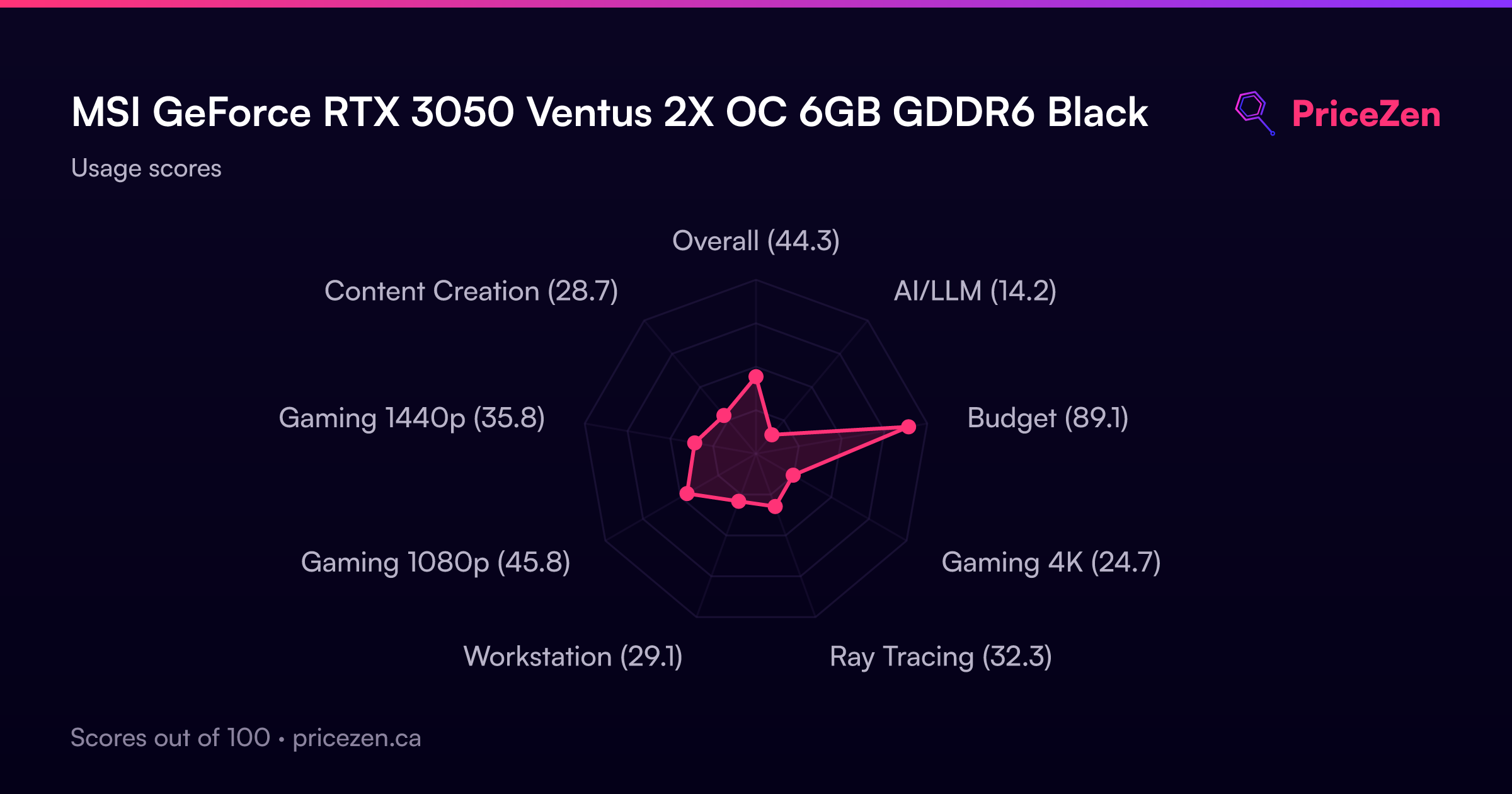
- Overall44.3
- AI/LLM14.2
- Budget89.1
- Gaming 4K24.7
- Ray Tracing32.3
- Workstation29.1
- Gaming 1080p45.8
- Gaming 1440p35.8
- Content Creation28.7