ZOTAC GeForce RTX 5060 Ti Twin Edge 16GB GDDR7 Black

DLSS 4 for higher frame rates verified Nov 29
67/100 overall score 4.7 average from 79 owner ratings
- GPU
- GeForce RTX 5060 Ti
- VRAM
- 16GB GDDR7
- Boost clock
- 2572 MHz
- TDP
- 180 W
- Memory bus
- 128 bit
- Ray tracing
- Yes
- Class
- consumer
Compare prices at 1 store
Cheapest first. New, refurbished and bundled offers are kept apart, so you compare like with like.
| Store | Sold by | Colour and condition | Price | vs lowest | Last checked | Link |
|---|---|---|---|---|---|---|
| New1 offerSingle unit | ||||||
| Out of stock when last checked | ||||||
| Canada Computers | Canada Computers | Not listed | No price | Out of stock | Not known | Go to store |
 Source: PriceZen
A price counts as current when we checked it in the last 7 days. “Marketplace seller” means a third-party seller on that store, not the store itself.


Snapshot
The 30-Second Version
16GB of GDDR7 and a 180W TDP make this one of the most efficient compact cards in our rankings, with a 22,099 PassMark G3D score that's solidly mid-pack. Owners rate it 4.7/5, but the USD 710 to USD 870 price spread means your wallet's happiness depends on where you shop.
Pros & Cons
Pros
- 16GB GDDR7 at 448 GB/s, well above average VRAM for this class 86th
- 180W TDP with a single 8-pin, one of the most efficient cards we rank 83rd
- 221mm long and 2 slots thick, genuinely compact 81st
- 3x DisplayPort 2.1b plus HDMI 2.1b, strong connectivity with 8K output support 69th
- 4.7/5 from 79 owner reviews
Cons
- Affordability ranks mediocre, with listings up to USD 870
- Thermal ranking sits slightly below average for the dual-fan design
- Raster and ray tracing performance are only mid-pack (22,099 G3D)
- Workstation is its weakest score at 56.3/100
- 128-bit memory bus limits bandwidth despite the fast GDDR7
What owners think
The Word on the Street
- Multiple owners praise the combination of generous memory, compact size and modest power needs, with several calling it a satisfying upgrade from older cards like the RTX 3060.
- Buyers broadly agree the card is worth it at a fair price, but sentiment sours when they pay above what they consider reasonable, which matches the wide USD 710 to USD 870 listing spread we track.
- A common complaint involves bundled game reward promotions, with at least one buyer reporting the redemption key didn't deliver what was advertised.
How owner sentiment changed over time
ExclusiveBased on when customers actually wrote their reviews - so you can see whether early praise held up.
9 written reviews, Feb – Aug 2026: 8 happy, 1 unhappy
Across all 79 store ratings: 4.7★. Most owners rate without writing a review. The chart counts the 9 written reviews.
- Apr – Jun 20264 of 5 happy
Most buyers are satisfied with performance, value, and quiet operation, including LLM use on Ubuntu. One buyer strongly complains that the bundled game reward was misleading and hard to redeem.
- Buyers report strong performance and good value as an upgrade from older GPUs.
- Bundled game reward called bogus; redemption cumbersome and card not detected as eligible.
- Quiet operation and no issues running LLM inference on an Ubuntu machine.
- Praise for ample memory, reasonable size, power requirements, and price.
- Jan – Mar 20263 of 3 happy
Buyers in this period were largely satisfied, citing strong gaming and AI performance, compact size, and light weight. One user reported a screen freeze resolved by a driver update.
- Strong gaming performance, including high settings and ray tracing
- Compact, lightweight design fits small builds and secondary use
- One screen freeze occurred but was fixed with a driver update
- Works well as a secondary card for AI workloads alongside an RTX 3090
Each dot is one written review, in the month it was written. Happy = 4-5★, mixed = 3★, unhappy = 1-2★. Period summaries are in English.
The proof
Performance
Let's start with the silicon: Blackwell on 5nm, 4608 CUDA cores, 120 Tensor cores and 30 RT cores, boosting to 2572MHz. That nets 23.7 FP32 TFLOPS and a 22,099 PassMark G3D benchmark score. In our rankings, raw raster performance lands mid-pack (55th percentile), ray tracing is about the same at 54, and compute sits at 55. Translation: this thing is quick for its class, but it's not punching above its weight against bigger GPUs. DLSS 4 support helps close that gap in supported titles, and the 16GB of GDDR7 on a 128-bit bus gives you well above average VRAM headroom, so texture-heavy games at 1440p shouldn't choke.
Where it genuinely shines is efficiency: 180W TDP lands it among the best on the market, and the 650W PSU requirement plus one 8-pin connector means most existing builds can swallow it without a power supply upgrade. The trade-off shows up in thermals, where our ranking puts it slightly below average at 42. A dual-fan cooler on a 221mm, two-slot card is a compromise, and owners upgrading from older cards like the RTX 3060 report a big jump in speed, which tracks with the specs.
Specifications
Full Specifications
Chipset
| GPU Chipset | GeForce RTX 5060 Ti |
| Brand | NVIDIA |
| Architecture | Blackwell |
| Class | consumer |
| Process | 5 |
Memory
| VRAM | 16 GB |
| Memory Type | GDDR7 |
| Memory Bus | 128 |
| Bandwidth | 448 |
Compute
| CUDA Cores | 4608 |
| Tensor Cores | 120 |
| RT Cores | 30 |
| Base Clock | 2572 |
| Boost Clock | 2572 |
| FP16 TFLOPS | 23.7 |
| FP32 TFLOPS | 23.7 |
Performance
| PassMark G3D | 22099 |
| GPU Compute | 11371 |
Power & Cooling
| TDP | 180 |
| Recommended PSU | 650 |
| Power Connectors | 1 x 8-pin |
| Cooler | Dual Fan |
| Fans | 2 |
Connectivity
| Interface | PCIe 5.0 x8 |
| DisplayPort | 3 |
| HDMI | 1 |
| Max Displays | 4 |
| Max Resolution | 7680 x 4320 |
Physical
| Length | 221 |
| Slot Width | 2 |
| Form Factor | Full Height |
Features
| Ray Tracing | Yes |
| Upscaling | DLSS 4 |
| VR Ready | Yes |
| DirectX | 12 |
| RGB | No |
vs Competition
Against the ASUS GeForce RTX 5080 PRIME EVO OC and PNY GeForce RTX 5080 ARGB OC, the ZOTAC's mid-pack raster ranking and 22,099 G3D score make it clear those cards play in a heavier league, so cross-shop them only if your budget stretches well past USD 870. The Gigabyte GeForce RTX 5070 Ti Eagle Ice and MSI GeForce RTX 5070 Ti Ventus 3X OC are the more interesting rivals: if raw framerate is your priority, our rankings suggest this card's 55th percentile raster position leaves room above it. And the Sapphire Radeon RX 7900 XTX NITRO+ is worth a look for pure raster buyers. Where the ZOTAC fights back is efficiency (among the best we rank), its 16GB VRAM buffer, and that 221mm footprint, none of which the bigger cards can match on paper.
| Spec | ZOTAC GeForce RTX 5060 Ti Twin Edge | Gigabyte GeForce RTX 5070 Ti Eagle Ice | ASUS GeForce RTX 5080 PRIME EVO OC | MSI GeForce RTX 5070 Ti Ventus 3X OC | PNY GeForce RTX 5080 ARGB OC | Sapphire Radeon RX 7900 XTX NITRO+ |
|---|---|---|---|---|---|---|
| Chipset | GeForce RTX 5060 Ti | GeForce RTX 5070 Ti | GeForce RTX 5080 | GeForce RTX 5070 Ti | GeForce RTX 5080 | Radeon RX 7900 XTX |
| Vram | 16GB GDDR7 | 16GB GDDR7 | 16GB GDDR7 | 16GB GDDR7 | 16GB GDDR7 | 24GB GDDR6 |
| Boost Clock Mhz | 2572 | 2542 | 2685 | 2482 | 2620 | 2680 |
| Tdp W | 180 | 300 | 360 | 300 | 360 | 339 |
| Memory Bus Bits | 128 | 256 | 256 | 256 | 256 | 384 |
| Ray Tracing | Yes | Yes | Yes | Yes | Yes | Yes |
| GPU Class | consumer | consumer | consumer | consumer | consumer | consumer |
| Compare | Compare | Compare | Compare | Compare |
| Product | AI | Rt | Vram | Raster | Compute | Feature | Thermal | Efficiency | Connectivity | Social Proof | Affordability |
|---|---|---|---|---|---|---|---|---|---|---|---|
| ZOTAC GeForce RTX 5060 Ti Twin Edge | 68.8 | 54.3 | 82.9 | 55.2 | 55.1 | 65.6 | 41.6 | 85.6 | 81.3 | 63.7 | 35 |
| Gigabyte GeForce RTX 5070 Ti Eagle Ice Compare | 78.9 | 88.6 | 85.9 | 88.9 | 87.8 | 95.7 | 91.8 | 71.6 | 94.2 | 93.7 | 23 |
| ASUS GeForce RTX 5080 PRIME EVO OC Compare | 85.5 | 97.7 | 89.1 | 94.5 | 93.3 | 88.4 | 91.8 | 56.6 | 94.2 | 93.7 | 19.4 |
| MSI GeForce RTX 5070 Ti Ventus 3X OC Compare | 78.9 | 92.4 | 85.9 | 88.9 | 87.8 | 95.7 | 91.8 | 71.6 | 94.2 | 84.1 | 21.1 |
| PNY GeForce RTX 5080 ARGB OC Compare | 85.5 | 97.7 | 89.1 | 94.5 | 93.3 | 95.7 | 91.8 | 56.6 | 94.2 | 75.1 | 16.1 |
| Sapphire Radeon RX 7900 XTX NITRO+ Compare | 95.3 | 96.4 | 92 | 83.4 | 95.6 | 95.7 | 91.8 | 51.3 | 98.8 | 69.5 | 13.6 |
Price
Value & Pricing
At USD 710 you're getting 16GB of GDDR7, DLSS 4, PCIe 5.0 and top-tier efficiency in a card that fits almost any case. At USD 870, which is what Micro Center currently lists it for, the math gets uglier: that's a USD 160 spread across listings, and our affordability ranking already flags this card as poor value relative to the field. We track prices over time, partly through our community browser extension, and our advice is simple: hunt for the low end of that range. Several owners say the same thing, that it's worth it at a reasonable price and much less so above it.
We started tracking prices for this product on Apr 24, 2026. The chart appears once we have more data.
Read more
Overview
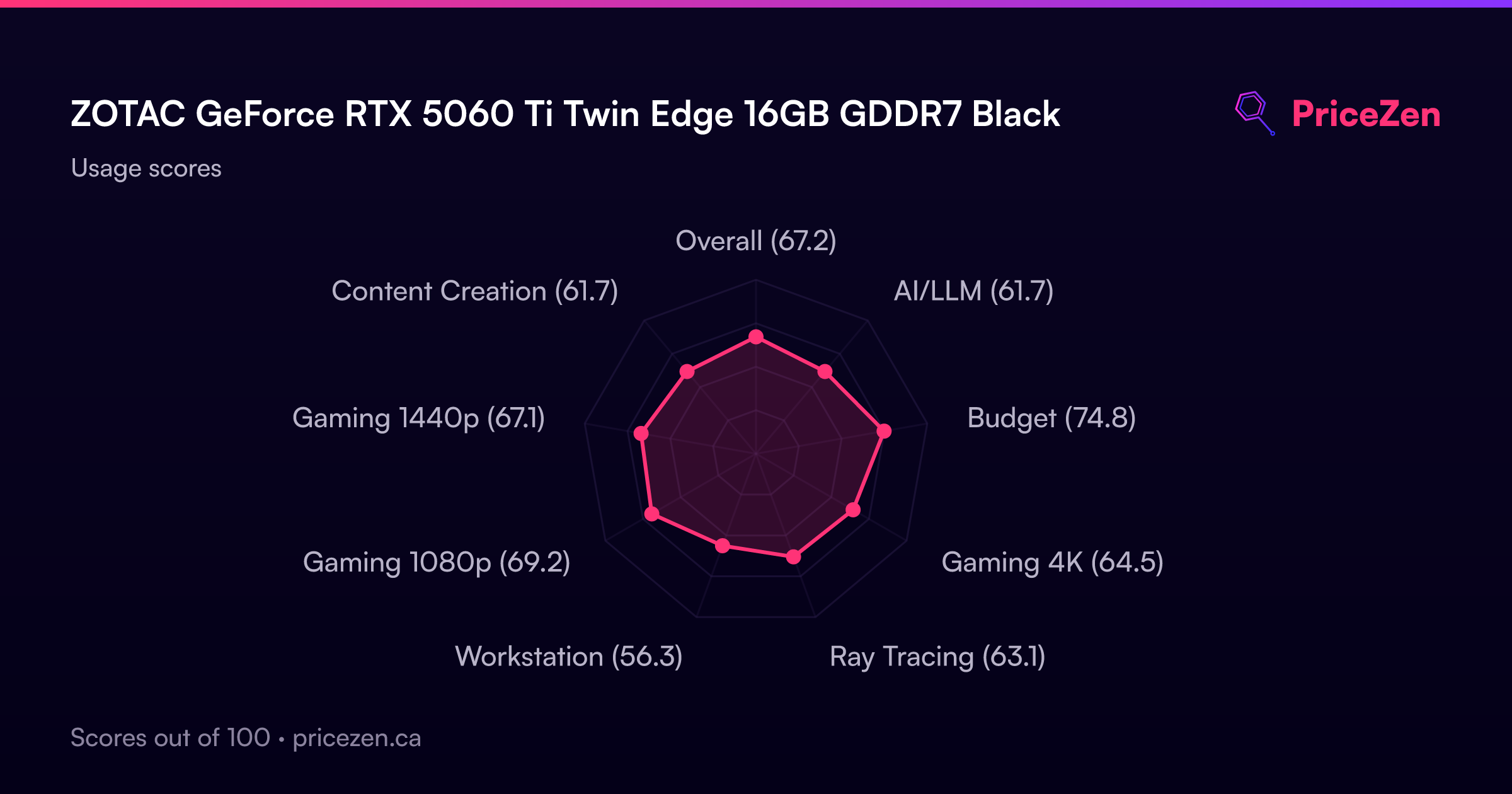
22,099 in PassMark G3D, 16GB of GDDR7 pushing 448 GB/s, and a 180W TDP that sips from a single 8-pin. That's the ZOTAC RTX 5060 Ti Twin Edge in three numbers, and they tell you most of the story: this is a compact, efficient card built for 1080p and 1440p, not a monster. Our scoring puts it at 69.3/100 for 1080p gaming and 67.1/100 for 1440p, with budget value at 74.8/100 as its strongest suit.
The catch is price. Listings run USD 710 to USD 870, and our affordability ranking sits at just the 35th percentile, which is mediocre for a card in this tier. Owners seem happy though: 4.7/5 across 79 reviews. So the hardware is solid, the memory config is generous, and the wallet damage depends entirely on where you buy.
Common Questions
Q: Will this fit in a small case and work with my current power supply?
Very likely yes on both counts. It's 221mm long, takes 2 slots, draws 180W and needs just one 8-pin connector, with a 650W PSU recommendation. That efficiency is one of the best in our rankings, so most mid-range builds won't need any other upgrades.
Q: Is 16GB of VRAM overkill for 1080p and 1440p gaming?
It's more than most cards in this tier carry, and our VRAM ranking puts it well above average. The 16GB of GDDR7 runs at 448 GB/s on a 128-bit bus, so you get capacity headroom for texture-heavy titles at 1440p, where our scoring gives it 67.1/100. Not overkill, just insurance.
Q: Can I use this for AI or content creation work?
Light workloads, sure. You get 120 Tensor cores, 23.7 FP16 TFLOPS and 16GB of memory, but our AI ranking puts it around the middle of the pack and workstation is its weakest area at 56.3/100. For serious compute work, look higher up the stack.
Who Should Skip This
Skip this if you're chasing maximum framerates or heavy productivity work. Raster and ray tracing both sit mid-pack in our rankings, workstation is the card's weakest score at 56.3/100, and the thermal ranking is slightly below average, so sustained heavy loads aren't its happy place. And if the only price you can find is USD 870, the mediocre affordability ranking says your money works harder elsewhere, likely on one of the 5070 Ti cards in the comparison.
Verdict
We'd recommend this card to 1080p and 1440p gamers who want 16GB of future-proof memory, low power draw and a compact fit, provided you can find it near USD 710. The 69.3/100 1080p score, standout efficiency and 4.7/5 owner rating back that up. At USD 870, though, the mediocre affordability ranking becomes hard to ignore, and you should seriously compare the 5070 Ti options before pulling the trigger. Good card, price-sensitive recommendation.
Usage Scores
- Overall67.2
- AI/LLM61.7
- Budget74.8
- Gaming 4K64.5
- Ray Tracing63.1
- Workstation56.3
- Gaming 1080p69.2
- Gaming 1440p67.1
- Content Creation61.7