ASUS GeForce RTX 3070 TUF Gaming OC 8GB GDDR6

Fans stop at idle for a silent desktop verified Nov 28
63/100 overall score 4.4 average from 332 owner ratings
- GPU
- GeForce RTX 3070
- VRAM
- 8GB GDDR6
- Boost clock
- 1845 MHz
- TDP
- 220 W
- Memory bus
- 256 bit
- Ray tracing
- Yes
- Class
- consumer
Compare prices at 2 stores
Cheapest first. New, refurbished and bundled offers are kept apart, so you compare like with like.
| Store | Sold by | Colour and condition | Price | vs lowest | Last checked | Link |
|---|---|---|---|---|---|---|
| New1 offerSingle unit | ||||||
| Out of stock when last checked | ||||||
| Amazon | Not known | Not listed | No price | Out of stock | Nov 20 | Go to store |
| Refurbished and renewed1 offerNot new: condition and warranty vary by seller | ||||||
| Out of stock when last checked | ||||||
| Newegg | Newegg | Refurbished | No price | Out of stock | Oct 26 | Go to store |
 Source: PriceZen, checked Nov 20, 2026
A price counts as current when we checked it in the last 7 days. “Marketplace seller” means a third-party seller on that store, not the store itself.











Snapshot
The 30-Second Version
The ASUS TUF RTX 3070 OC is a well-built card with exceptional cooling and solid 1080p and 1440p gaming performance. The 8GB VRAM is the main limitation, especially for newer titles and higher resolutions. US prices range from USD 290 to USD 795, so shop carefully. At the low end it's a great budget buy; at the high end, skip it and get a current-gen card instead.
Pros & Cons
Pros
- Excellent cooling with a 92nd percentile thermal score 92nd
- Runs quiet thanks to the triple-fan axial-tech design 78th
- Strong 1080p and 1440p gaming performance 69th
- Dual HDMI 2.1 ports plus three DisplayPort 1.4a outputs
- Dual ball fan bearings rated for longer lifespan
Cons
- 8GB VRAM is limiting for newer titles at higher resolutions
- 220W TDP needs a 750W PSU and two 8-pin connectors
- AI and compute scores are underwhelming at 38th and 45th percentile
- Price spread is huge, from USD 290 to USD 795
- 2.7-slot design won't fit in compact cases
What owners think
The Word on the Street
- A recurring theme is that the card runs remarkably cool and quiet, with multiple owners noting the triple-fan design keeps temperatures low even under sustained load.
- Several buyers mention the core clock boosting beyond the advertised 1845MHz out of the box, which is a nice bonus for a factory OC card.
- Some owners note the card's size and 2.7-slot width can be a tight fit in smaller cases, though this is expected for a triple-fan design.
- A few reviewers mention the 8GB VRAM becoming a limitation in newer games at higher resolutions, with texture settings needing to be dialed back.
How owner sentiment changed over time
ExclusiveBased on when customers actually wrote their reviews - so you can see whether early praise held up.
11 written reviews, Dec 2020 – Jun 2024: 11 happy
Across all 332 store ratings: 4.4★. Most owners rate without writing a review. The chart counts the 11 written reviews.
Each dot is one written review, in the month it was written. Happy = 4-5★, mixed = 3★, unhappy = 1-2★.
The proof
Performance
The PassMark G3D score of 22099 puts this card in the middle of the pack for raster performance, around the 57th percentile. That's solid but not spectacular by today's standards. In real terms, it means 1080p gaming is a breeze and 1440p is comfortable in most titles. Our database scores it 71.5 out of 100 for 1080p gaming and 64.9 for 1440p. You'll hit high refresh rates in esports titles and stay above 60fps in most AAA games at 1440p with settings dialed in sensibly.
The ray tracing story is a bit more nuanced. The 40 RT cores put this at the 61st percentile for RT performance, which is about average. DLSS helps a lot here, and the 160 Tensor cores handle that upscaling work well. But the 8GB VRAM is the real constraint. At 39th percentile for VRAM, it's mediocre by current standards. Newer games at 1440p with ray tracing enabled and high texture settings can push past that 8GB buffer, and when that happens you'll see stutters or texture pop-in. For 1080p ray tracing, you're fine. For 1440p with RT on, you'll need to be selective about settings.
Specifications
Full Specifications
Chipset
| GPU Chipset | GeForce RTX 3070 |
| Brand | NVIDIA |
| Architecture | Ampere |
| Class | consumer |
| Process | 8 |
Memory
| VRAM | 8 GB |
| Memory Type | GDDR6 |
| Memory Bus | 256 |
| Bandwidth | 448 |
Compute
| CUDA Cores | 5888 |
| Tensor Cores | 160 |
| RT Cores | 40 |
| Base Clock | 1845 |
| Boost Clock | 1845 |
| FP16 TFLOPS | 15.97 |
| FP32 TFLOPS | 15.97 |
Performance
| PassMark G3D | 22099 |
| GPU Compute | 11026 |
Power & Cooling
| TDP | 220 |
| Recommended PSU | 750 |
| Power Connectors | 2 x 8-Pin |
| Cooler | Triple Fan |
| Fans | 3 |
Connectivity
| Interface | PCI Express 4.0 |
| DisplayPort | 3 |
| HDMI | 2 |
| Max Displays | 4 |
| Max Resolution | 7680 x 4320 |
Physical
| Length | 300 |
| Slot Width | 2.7 |
| Form Factor | Full Height |
| Weight | 1.7 kg / 3.7 lbs |
Features
| Ray Tracing | Yes |
| Upscaling | DLSS |
| VR Ready | Yes |
| DirectX | 12 |
| RGB | Yes |
vs Competition
The competitive landscape has shifted a lot since this card launched. The PNY OC VCG5070T16TFXPB1-O and MSI SHADOW G5070-12S2C are both RTX 5070 variants with more VRAM and newer architecture. The PNY card has 16GB, which is double what this ASUS offers, and that matters for 1440p and 4K gaming. The MSI Shadow has 12GB, still a meaningful step up. Both will outperform this 3070 in raster and ray tracing, but they'll also cost more at retail. If you can find this ASUS at the USD 290 end, the value argument flips in its favor.
The XFX Mercury RX-97TRGBBB9 and Sapphire PULSE 11348-03-20G are AMD options with even more VRAM, 16GB and 20GB respectively. The Sapphire's 20GB is overkill for most gaming scenarios, but it's there if you're doing productivity work or playing heavily modded games. The Gigabyte Gaming GV-R9070XTGAMING-16GD is another 16GB card worth considering. The trade-off is clear: this ASUS wins on price at the low end and on cooling, but loses on VRAM capacity and raw performance to every one of these competitors. If you're playing at 1080p and don't care about future-proofing, the ASUS is fine. If you're eyeing 1440p long-term or want to dabble in 4K, the newer cards with more VRAM are the safer bet.
| Spec | ASUS GeForce RTX 3070 TUF Gaming OC | Gigabyte GeForce RTX 5070 Ti Eagle Ice | MSI GeForce RTX 5070 Ti GAMING TRIO | PNY GeForce RTX 5070 Ti OC | Sapphire Radeon RX 9070 XT PULSE | XFX Radeon RX 9070 XT Mercury |
|---|---|---|---|---|---|---|
| Chipset | GeForce RTX 3070 | GeForce RTX 5070 Ti | GeForce RTX 5070 Ti | GeForce RTX 5070 Ti | Radeon RX 9070 XT | Radeon RX 9070 XT |
| Vram | 8GB GDDR6 | 16GB GDDR7 | 16GB GDDR7 | 16GB GDDR7 | 16GB GDDR6 | 16GB GDDR6 |
| Boost Clock Mhz | 1845 | 2542 | 2000 | 2450 | 2970 | 3100 |
| Tdp W | 220 | 300 | 300 | 300 | 304 | 304 |
| Memory Bus Bits | 256 | 256 | 256 | 256 | 256 | 256 |
| Ray Tracing | Yes | Yes | Yes | Yes | Yes | Yes |
| GPU Class | consumer | consumer | consumer | consumer | consumer | consumer |
| Compare | Compare | Compare | Compare | Compare |
| Product | AI | Rt | Vram | Raster | Compute | Feature | Thermal | Efficiency | Connectivity | Social Proof | Affordability |
|---|---|---|---|---|---|---|---|---|---|---|---|
| ASUS GeForce RTX 3070 TUF Gaming OC | 36 | 60.9 | 37.4 | 55.3 | 44 | 77.7 | 91.8 | 60.9 | 63.6 | 69.3 | 53.6 |
| Gigabyte GeForce RTX 5070 Ti Eagle Ice Compare | 78.9 | 88.6 | 86 | 88.9 | 87.9 | 95.7 | 91.8 | 71.6 | 94.2 | 93.4 | 23 |
| MSI GeForce RTX 5070 Ti GAMING TRIO Compare | 78.9 | 92.4 | 86 | 88.9 | 87.9 | 95.7 | 91.8 | 71.6 | 94.2 | 99.9 | 19 |
| PNY GeForce RTX 5070 Ti OC Compare | 78.9 | 92.4 | 86 | 88.9 | 87.9 | 65.6 | 91.8 | 71.6 | 81.3 | 93.4 | 26.4 |
| Sapphire Radeon RX 9070 XT PULSE Compare | 89.4 | 84.7 | 73.6 | 74.6 | 89.9 | 95.7 | 71.8 | 44.6 | 89 | 93.4 | 41.2 |
| XFX Radeon RX 9070 XT Mercury Compare | 89.6 | 84.7 | 75.2 | 74.6 | 90.8 | 95.7 | 71.8 | 44.6 | 94.2 | 93.4 | 30.8 |
Price
Value & Pricing
Here's where things get interesting. The US listings for this card span USD 290 to USD 795, a USD 505 spread. That's not a typo. The same GPU, depending on where you buy it, can cost nearly three times as much. If you're shopping in the US, the low end of that range is genuinely compelling. You're getting a card that still handles 1440p gaming well for under USD 300. The high end is a trap. At USD 795, you're within spitting distance of current-gen cards that outperform this one significantly.
European buyers face a similar situation with EUR 1,150 to EUR 1,665 across three listings. That's a EUR 515 spread, and honestly, even the low end feels steep for an RTX 3070 in 2025. The CAD 450 listing in Canada is more reasonable, and the GBP 980 price in the UK is hard to justify. The takeaway: shop around. This card's value proposition depends entirely on which listing you land on. Newegg has the refurbished listings at the lower end of the US range, and that's where the real value is if you're comfortable with refurbished hardware.
We started tracking prices for this product on Jun 9, 2026. The chart appears once we have more data.
Read more
Overview
The ASUS TUF Gaming RTX 3070 OC Edition is one of those cards that aged better than most of its Ampere siblings. It's a triple-fan, all-metal shroud version of NVIDIA's 3070, and ASUS clearly spent time on the cooling side. The TUF line has a reputation for running cool and quiet, and this card backs that up with a 92nd percentile thermal score in our database. That's the absolute best right now for this class of card, and it matters more than you'd think when you're gaming for hours.
Who's this for? Someone building or upgrading a 1080p or 1440p rig who wants ray tracing and DLSS without paying current-gen prices. The 5888 CUDA cores and 1845MHz boost clock put out 15.97 TFLOPS of FP32 compute, which was a big deal when this launched and still holds up fine today. The 8GB of GDDR6 on a 256-bit bus gives you 448 GB/s of memory bandwidth. That's the spec that's starting to show its age in newer titles, but we'll get into that.
What makes this card interesting in 2025 is the price spread. US listings run from USD 290 to USD 795, which is a wild range for the same GPU. If you can find one at the low end, you're getting a lot of card for the money. At the high end, you're paying current-gen money for last-gen performance, and that's a much harder sell.
Common Questions
Q: Can I upgrade the 8GB of VRAM on this card?
No. The 8GB of GDDR6 memory is soldered directly onto the graphics card and cannot be expanded or replaced. If you need more VRAM, you'll need to look at a different card entirely, like the 12GB or 16GB options from the current generation.
Q: What power supply do I need for this card?
ASUS recommends a 750W power supply for this card. The GPU itself has a 220W TDP and requires two 8-pin PCIe power connectors. Make sure your PSU has both connectors available before buying.
Q: Is this card good for 1440p gaming?
Yes, for most current titles. Our database scores it 64.9 out of 100 for 1440p gaming, which means it handles the resolution well in most games. However, the 8GB VRAM can become a bottleneck in newer AAA titles with high texture settings, so you may need to dial some settings back.
Q: How does this compare to the newer RTX 5070 cards?
The newer RTX 5070 cards like the PNY OC and MSI Shadow offer more VRAM (12GB to 16GB) and better ray tracing and raster performance. They also cost more. If you can find this ASUS 3070 at the low end of its price range, it's a better value for 1080p gaming. For 1440p long-term, the newer cards are the safer investment.
Who Should Skip This
If you're planning to game at 4K or want to keep your card for more than a couple of years, this isn't the one. The 8GB VRAM is already a constraint in some 1440p titles, and 4K gaming with ray tracing will push it past its limits quickly. Look at the Sapphire PULSE with 20GB or the PNY OC with 16GB instead.
AI enthusiasts and content creators should also look elsewhere. The 38th percentile AI score and 45th percentile compute score mean this card will struggle with local LLM inference, stable diffusion workloads, and heavy rendering tasks. If that's your use case, a card with more VRAM and better compute performance is worth the extra money. And if you're building in a small form factor case, the 300mm length and 2.7-slot width might not fit. Check your case clearance before committing.
Verdict
For 1080p gamers on a budget, this card is still a genuinely good buy if you can find it at the low end of that USD 290 to USD 795 range. The cooling is best-in-class, it runs quiet, and it'll push high frame rates in esports titles without breaking a sweat. The 8GB VRAM is less of an issue at 1080p, and DLSS extends the card's useful life in supported titles. If you're building a budget rig and spot this under USD 350, grab it.
For 1440p gamers, it's a more conditional recommendation. The card handles 1440p fine in most current titles, but the 8GB VRAM is already a constraint in some newer games, and that's only going to get worse. If you're planning to keep this card for two or three years, you'll likely find yourself turning down texture settings sooner than you'd like. In that case, one of the 12GB or 16GB competitors is worth the extra money. And if you're doing AI work or heavy compute, look elsewhere. The 38th percentile AI score and 45th percentile compute score tell you everything you need to know. This is a gaming card, not a workstation card.
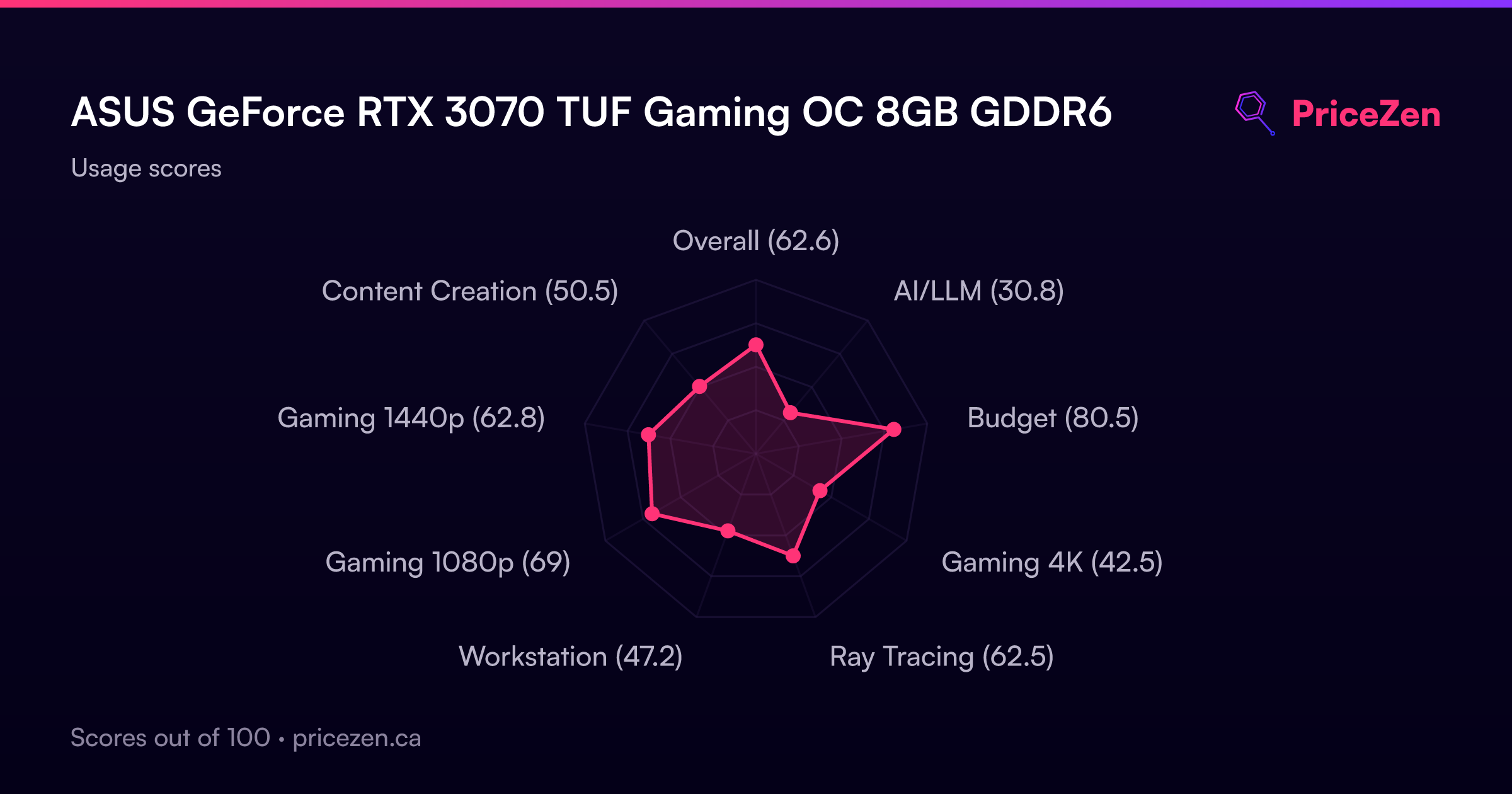
Usage Scores
- Overall62.6
- AI/LLM30.8
- Budget80.5
- Gaming 4K42.5
- Ray Tracing62.5
- Workstation47.2
- Gaming 1080p69
- Gaming 1440p62.8
- Content Creation50.5