PNY Quadro NVS 450 1GB workstation
Driving four displays from a single PCIe Gen 2 x16 slot with passive cooling makes this card a silent, dedicated multi-monitor solution for legacy systems. Its 512MB GDDR3 memory and Quadro NVS 450 chipset prioritize 2D image quality and rock-solid driver stability over raw 3D performance. This board is best for financial traders or network operations staff who need to extend their desktop across four older DVI or DisplayPort screens without active fan noise.

No current retailer price
Snapshot
The 30-Second Version
A PassMark G3D score of 67 lands this card in the bottom few percent of GPUs we rank, so forget gaming or creative work. But 10W, passive cooling and four DisplayPort outputs make it a genuinely useful quad-monitor board for a quiet office PC. At CAD 275 from Newegg, you're paying for the ports, nothing else.
Pros & Cons
Pros
- Four DisplayPort outputs from one card, connectivity ranks about average for the category 90th
- 10W TDP, so it sips power and needs no dedicated cooling fan
- Passive design means zero fan noise in a quiet office build
- Standard PCI Express Gen 2 x16 interface drops into older business desktops
- Affordability ranks near the top of our chart at the 89th percentile
Cons
- PassMark G3D of 67 puts raw 3D performance in the bottom few percent of GPUs we track
- Ray tracing scores 1.5/100, one of the worst results in our data
- Memory is listed as 1GB while the retailer says 512MB GDDR3, and either figure is near the bottom for VRAM
- Feature set ranks at the 11th percentile, so modern GPU features are basically absent
- Only 4 owner reviews behind the 4.2/5 rating, weak social proof at the 22nd percentile
What owners think
The Word on the Street
The proof
Performance
Let's start with the number that matters: 67 on PassMark G3D. That puts it in the bottom handful of every GPU we rank, and our raster score is one of the worst. Ray tracing is worse, 1.5/100 and effectively dead last, and AI workloads land near the very bottom. There's no pretending here. If your workload involves rendering frames, denoising, or anything with a neural net in it, this card isn't in the conversation.
What it does have is a 10W TDP and a passive heatsink, so no fan noise and no extra power connector to think about. Four DisplayPort outputs (the retail listing also mentions DVI-D SL support) mean you can drive a quad-monitor trading desk or a wall of dashboards from one slot. Connectivity ranks about average, which makes sense: plenty of outputs, older Gen 2 interface. One oddity in our data: despite the tiny power draw, efficiency scores near the bottom and thermals sit at the 20th percentile, because our model weighs performance per watt and passive cooling under load, not raw consumption alone. Low watts don't automatically mean a good efficiency score when the output is this small.
Specifications
Full Specifications
Chipset
| GPU Chipset | Quadro NVS 450 |
| Brand | NVIDIA |
| Class | workstation |
Memory
| VRAM | 512 MB |
Compute
| Base Clock | 500 |
Performance
| PassMark G3D | 67 |
Power & Cooling
| TDP | 10 |
| Cooler | Passive |
| Fans | 0 |
Connectivity
| Interface | PCI Express Gen 2 x16 |
| DisplayPort | 4 |
| HDMI | 0 |
| Max Displays | 4 |
Physical
| Form Factor | Low Profile |
Features
| Ray Tracing | No |
| DirectX | 12 |
vs Competition
Here's the uncomfortable part. The cards buyers cross-shop against this one include the ASUS GeForce RTX 5070 PRIME, the Sapphire Radeon RX 9070 XT NITRO+ and the ZOTAC GeForce RTX 5070 Solid OC, plus XFX's Radeon RX 9070 XT Mercury and Gigabyte's Radeon RX 9070 XT Gaming. Those are modern gaming and creator cards, and the NVS 450's bottom-of-the-pack raster score, near-last AI score and 1.5/100 ray tracing rating mean it isn't competing with any of them on compute. Not close. The only column where this PNY board wins is the one those cards can't touch: four DisplayPort outputs at 10W with no fan. If you're deciding between this and an RTX 5070 or RX 9070 XT variant, you're really deciding between two different jobs. Multi-screen business output versus actual graphics work. Pick the job first, then the card.
| Spec | PNY Quadro NVS 450 | ASUS GeForce RTX 5070 PRIME | Sapphire Radeon RX 9070 XT PULSE | XFX Radeon RX 9070 XT Mercury | Gigabyte Radeon RX 9070 XT Gaming | ZOTAC GeForce RTX 5070 Solid OC |
|---|---|---|---|---|---|---|
| Chipset | Quadro NVS 450 | GeForce RTX 5070 | Radeon RX 9070 XT | Radeon RX 9070 XT | Radeon RX 9070 XT | GeForce RTX 5070 |
| Vram | 1GB | 12GB GDDR7 | 16GB GDDR6 | 16GB GDDR6 | 16GB GDDR6 | 12GB GDDR7 |
| Boost Clock Mhz | - | 2512 | 2970 | 3100 | 2970 | 2542 |
| Tdp W | 10 | 250 | 304 | 304 | 304 | 250 |
| Memory Bus Bits | - | 192 | 256 | 256 | 256 | 192 |
| Ray Tracing | false | true | true | true | true | true |
| GPU Class | workstation | consumer | consumer | consumer | consumer | consumer |
| Compare | Compare | Compare | Compare | Compare |
| Product | AI | Rt | Vram | Raster | Feature | Thermal | Efficiency | Connectivity | Affordability |
|---|---|---|---|---|---|---|---|---|---|
| PNY Quadro NVS 450 | 1.6 | 4.8 | 3.1 | 5.1 | 10.9 | 19.8 | 7.5 | 48.3 | 89.9 |
| ASUS GeForce RTX 5070 PRIME Compare | 61.7 | 82.8 | 65.4 | 79.2 | 95.9 | 91.7 | 79.1 | 94.1 | 44.6 |
| Sapphire Radeon RX 9070 XT PULSE Compare | 89.2 | 84.7 | 73.7 | 75.2 | 95.9 | 72.4 | 45.6 | 88.8 | 43.3 |
| XFX Radeon RX 9070 XT Mercury Compare | 89.4 | 84.7 | 75.3 | 75.2 | 95.9 | 72.4 | 45.6 | 94.1 | 41.9 |
| Gigabyte Radeon RX 9070 XT Gaming Compare | 89.5 | 77.7 | 73.7 | 75.2 | 95.9 | 91.7 | 45.6 | 88.8 | 26.6 |
| ZOTAC GeForce RTX 5070 Solid OC Compare | 61.7 | 82.8 | 65.4 | 79.2 | 95.9 | 91.7 | 79.1 | 94.1 | 38.6 |
Price
Value & Pricing
We track CAD 275 at Newegg, and that's the only listing in our data right now, so there's no store-to-store shopping to do. For that money you get four display outputs, a 10W power budget and silent passive cooling. What you don't get is performance: 67 G3D and a 15.7/100 workstation score mean CAD 275 buys you connectivity, not horsepower. Our affordability ranking is high at the 89th percentile, but read that as "cheap within its niche," not "great deal per frame." If your job is lighting up four monitors with spreadsheets, the math works. For anything else, it doesn't.
We started tracking prices for this product on Jun 10, 2026. The chart appears once we have more data.
Read more
Overview
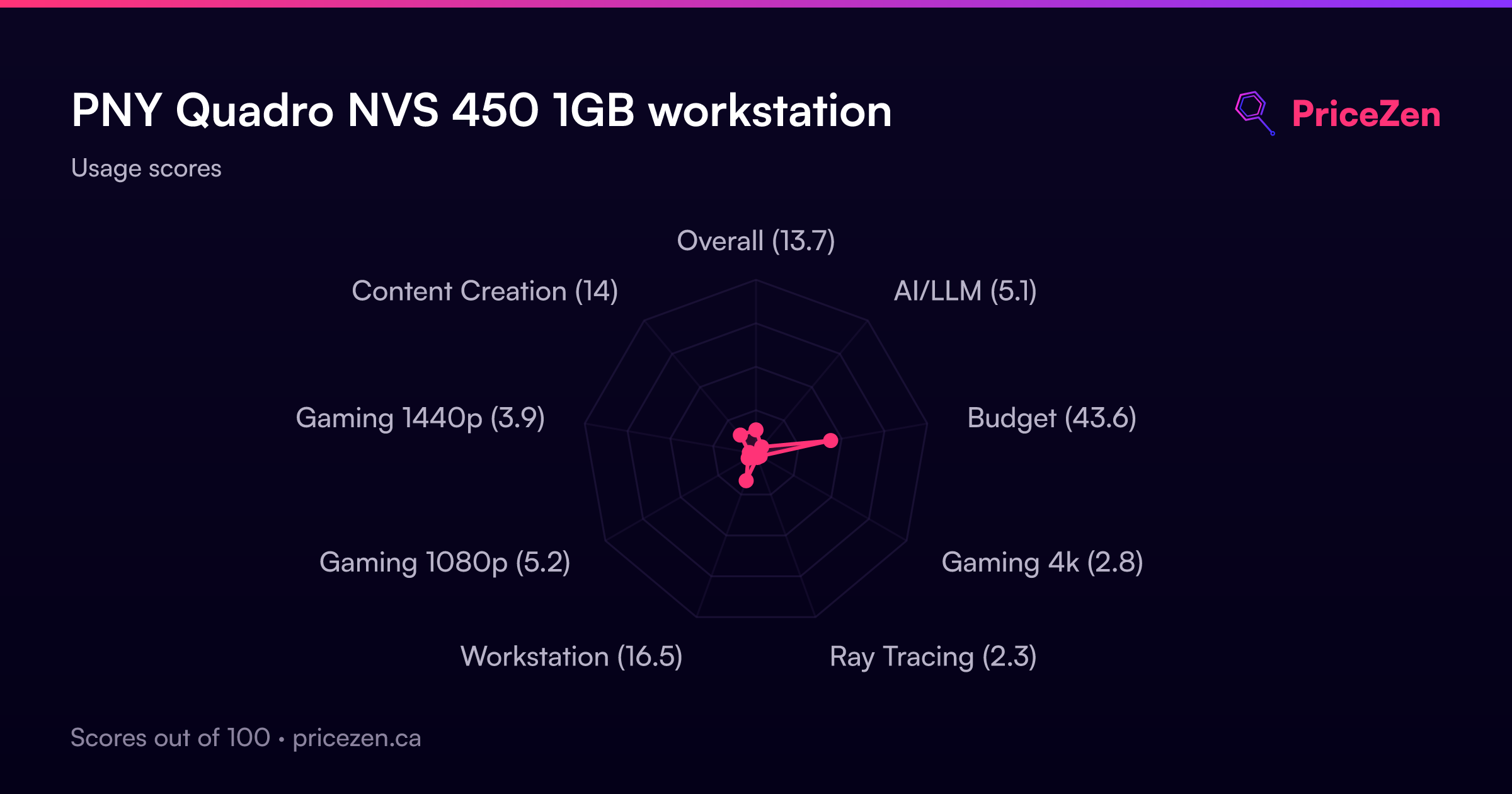
A PassMark G3D score of 67 and a ray tracing rating of 1.5 out of 100 tell you most of what you need to know about the PNY Quadro NVS 450. This is not a card that competes on speed. It's a 10W, passively cooled business board built around one idea: four DisplayPort outputs from a single PCI Express Gen 2 x16 slot. Our scoring model gives it 38/100 for budget use, 15.7/100 as a workstation card and 13.5/100 for content creation, which lines up with what the hardware actually is.
The other thing worth flagging early: our spec sheet lists 1GB of memory while the Newegg listing describes a 512MB GDDR3 board (VCQ450NVS-X16-DVI-PB). Either way you're in the bottom few percent for VRAM against everything else we track in this category. And at CAD 275 from Newegg, "budget" here means cheap to run, not cheap to buy.
Common Questions
Q: Can this card run four monitors at once?
Yes, that's its whole reason for existing. It has four DisplayPort outputs on a PCI Express Gen 2 x16 interface, and the Newegg listing also describes DVI-D SL support. Connectivity ranks about average in our data, which reflects lots of outputs on an older interface rather than modern bandwidth.
Q: Is it any good for gaming or video editing?
No. Its PassMark G3D benchmark score is 67, raster performance sits in the bottom few percent of GPUs we track, and content creation scores 13.5/100 in our model. Ray tracing is 1.5/100. This is a display-output card, not a rendering card.
Q: Does it need a power connector or extra cooling?
It's a 10W TDP board with a passive heatsink, so there's no fan and no meaningful power budget to plan around. Just note that our efficiency ranking is still low at the 8th percentile, because the performance it delivers per watt is tiny even though the wattage itself is tiny.
Who Should Skip This
Gamers, video editors, 3D artists and anyone dabbling in AI should walk away. A 67 G3D score, bottom-of-the-pack raster performance, near-last AI ranking and a 1.5/100 ray tracing score mean this card will bottleneck basically every modern workload you throw at it. The VRAM situation (1GB in our specs, 512MB GDDR3 per the retailer) is near the bottom of the category either way, and the feature score at the 11th percentile tells you modern GPU capabilities just aren't here. If you need fewer than four displays, even the one thing this card is good at stops being a reason to buy it.
Verdict
We'd only recommend the Quadro NVS 450 for one specific buyer: someone who needs four monitors driven from a single PCIe slot in a low-power, silent business machine, and who does nothing graphically demanding. For that person, the 10W passive design and quad DisplayPort layout do exactly what's needed. For everyone else, the numbers are brutal: 67 G3D, 13.5/100 for content creation, 1.5/100 for ray tracing. At CAD 275, that's a lot to pay for a card whose only real talent is plugging in screens. Buy it for the ports or not at all.
Usage Scores
- Overall13.7
- AI/LLM5.1
- Budget43.6
- Gaming 4k2.8
- Ray Tracing2.3
- Workstation16.5
- Gaming 1080p5.2
- Gaming 1440p3.9
- Content Creation14