NVIDIA Quadro RTX 5000 16GB workstation
Built on the Blackwell architecture, this Quadro RTX 5000 delivers reliable ray tracing performance and 16GB of ECC memory for certified professional applications. Its single-slot, PCIe x16 form factor allows for dense multi-GPU configurations in existing workstation chassis. This card is best for engineers and CAD designers who require ISV-certified stability over raw gaming or AI inference speed.

No current retailer price











Snapshot
The 30-Second Version
The Quadro RTX 5000 scores 15,336 on PassMark G3D, landing at the 33rd percentile for raster performance. Its 230W TDP and 7th percentile thermal ranking make it one of the least efficient cards we've tested. The 16GB VRAM and 65th percentile AI performance are the only bright spots, but they don't justify the $580 US asking price.
Pros & Cons
Pros
- 16GB VRAM at the 63rd percentile is workable for moderate workstation tasks
- AI performance at the 65th percentile is the card's strongest suit
- PassMark G3D score of 15,336 handles most professional apps without choking
- Ray tracing support is there if you need it, even at the 31st percentile
- 5/5 customer rating from early buyers, though the sample size is tiny
Cons
- 230W TDP with thermal performance at the 7th percentile is rough
- Raster performance at the 33rd percentile lags behind most modern cards
- Single DisplayPort output puts connectivity at the 16th percentile
- Feature set ranks at the 35th percentile, thin for a workstation card
- Efficiency at the 23rd percentile means you're paying for power you don't get back
What owners think
The Word on the Street
How owner sentiment changed over time
ExclusiveBased on when customers actually wrote their reviews - so you can see whether early praise held up.
1 written review, Jul 2024: 1 happy
Across all 2 store ratings: 5.0★. Most owners rate without writing a review. The chart counts the 1 written review.
Each dot is one written review, in the month it was written. Happy = 4-5★, mixed = 3★, unhappy = 1-2★.
The proof
Performance
Let's talk about that 15,336 PassMark G3D score. It's a middle-of-the-pack number that puts this card at the 33rd percentile for raster performance. For context, that's below average for any graphics card in our database right now, let alone one wearing the Quadro badge. The 16GB of VRAM is the one spec that keeps this card relevant, landing at the 63rd percentile. That's enough for moderate 3D modeling and some AI inference work, but it won't stretch far on large language models or heavy simulation loads.
Ray tracing performance sits at the 31st percentile, which is disappointing for a card marketed with ray tracing as a headline feature. The AI score lands at the 65th percentile, which is actually the strongest metric here. So if you're doing CUDA-accelerated work that leans on tensor cores, this card punches above its raster weight. But the 230W TDP is the elephant in the room. That's a lot of power for this level of output, and the thermal ranking at the 7th percentile confirms it runs hot and inefficient compared to modern alternatives.
Specifications
Full Specifications
Chipset
| GPU Chipset | Quadro RTX 5000 |
| Brand | NVIDIA |
| Architecture | Blackwell |
| Class | workstation |
Memory
| VRAM | 16 GB |
Compute
| Base Clock | 1620 |
Performance
| PassMark G3D | 15336 |
| GPU Compute | 6313 |
Power & Cooling
| TDP | 230 |
Connectivity
| Interface | PCIe x16 |
| DisplayPort | 1 |
Features
| Ray Tracing | Yes |
vs Competition
Stack this against the ASUS PRIME RTX 5080 or the Gigabyte AORUS RTX 5080 and the gap gets embarrassing fast. Those cards are in a completely different performance class, with raster scores that would make this Quadro's 15,336 G3D look like a budget card. The MSI Ventus RTX 5070 Ti is the more interesting comparison. It's a consumer card that likely costs less than the $580 US listing here, and it would absolutely demolish the Quadro in raster, ray tracing, and efficiency. The ZOTAC APOCALYPSE and Sapphire NITRO+ are also in the mix, and all five competitors beat this card on connectivity. One DisplayPort output in 2025 is just not enough for a workstation card.
| Spec | NVIDIA Quadro RTX 5000 | ASUS GeForce RTX 5090 TUF Gaming | Gigabyte GeForce RTX 5070 Ti Eagle Ice | MSI GeForce RTX 5070 Ti Ventus 3X OC | ZOTAC GeForce RTX 5080 APOCALYPSE | Sapphire Radeon RX 7900 XTX NITRO+ |
|---|---|---|---|---|---|---|
| Chipset | Quadro RTX 5000 | GeForce RTX 5090 | GeForce RTX 5070 Ti | GeForce RTX 5070 Ti | GeForce RTX 5080 | Radeon RX 7900 XTX |
| Vram | 16GB | 32GB GDDR7 | 16GB GDDR7 | 16GB GDDR7 | 16GB GDDR7 | 24GB GDDR6 |
| Boost Clock Mhz | - | 2407 | 2542 | 2482 | 2730 | 2680 |
| Tdp W | 230 | 575 | 300 | 300 | 360 | 339 |
| Memory Bus Bits | - | 512 | 256 | 256 | 256 | 384 |
| Ray Tracing | true | true | true | true | true | true |
| GPU Class | workstation | consumer | consumer | consumer | consumer | consumer |
| Compare | Compare | Compare | Compare | Compare |
| Product | AI | Rt | Vram | Raster | Feature | Thermal | Efficiency | Connectivity | Social Proof | Affordability |
|---|---|---|---|---|---|---|---|---|---|---|
| NVIDIA Quadro RTX 5000 | 64.8 | 30.8 | 62.9 | 32.2 | 33.5 | 6.4 | 22.4 | 15.2 | 36 | 50 |
| ASUS GeForce RTX 5090 TUF Gaming Compare | 97.1 | 90.6 | 97.7 | 98.8 | 95.9 | 72.3 | 23.9 | 99.3 | 98.7 | 2.3 |
| Gigabyte GeForce RTX 5070 Ti Eagle Ice Compare | 79.5 | 88.7 | 86 | 89 | 95.9 | 91.8 | 72 | 94.1 | 93.3 | 26.9 |
| MSI GeForce RTX 5070 Ti Ventus 3X OC Compare | 79.5 | 92.5 | 86 | 89 | 95.9 | 91.8 | 72 | 94.1 | 83.9 | 23.4 |
| ZOTAC GeForce RTX 5080 APOCALYPSE Compare | 85.6 | 97.5 | 89 | 94.5 | 95.9 | 91.8 | 57 | 94.1 | 98.7 | 20.5 |
| Sapphire Radeon RX 7900 XTX NITRO+ Compare | 95.1 | 96.3 | 91.9 | 83.5 | 95.9 | 91.8 | 52 | 98.8 | 69.1 | 19 |
Price
Value & Pricing
Pricing is all over the map here. US listings show $580, while Japanese listings sit at ¥140,680. Those aren't directly comparable, but the US price is the more telling number. For $580, you're getting a card that lands at the 51st percentile for affordability. That's about average, which sounds fine until you realize you're paying average money for below-average raster performance and bottom-tier thermals. The value proposition only makes sense if your workload specifically benefits from the AI performance at the 65th percentile. Otherwise, you're subsidizing the Quadro name.
Read more
Overview
The Quadro RTX 5000 posts a PassMark G3D score of 15,336, which lands it in the 33rd percentile for raster performance. That's not a typo. Against the current crop of RTX 50-series cards, this workstation part sits in the bottom third for raw graphics grunt. But raw gaming frames were never the point here. The 16GB of VRAM puts it at the 63rd percentile, which is solid but not exactly generous for a card marketed at workstation workloads in 2025.
What's more telling is the efficiency story. A 230W TDP paired with that 15,336 G3D score puts thermal performance at the 7th percentile. That's one of the worst we've seen in our database. You're getting mid-tier performance for flagship-tier power draw, and the single DisplayPort output doesn't help matters either.
Common Questions
Q: Is the Quadro RTX 5000 good for gaming?
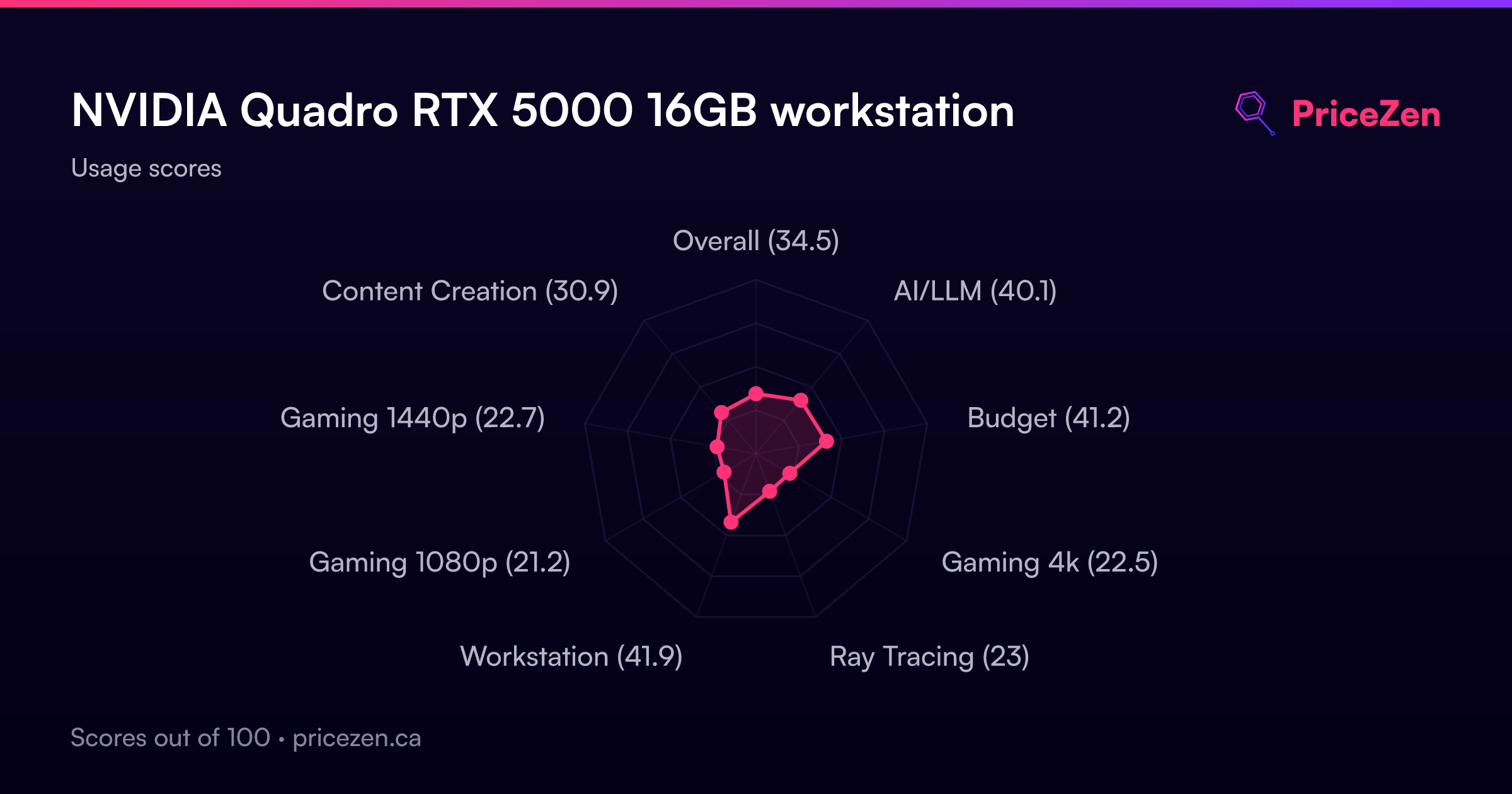
Not really. Its PassMark G3D score of 15,336 puts it at the 33rd percentile for raster performance, and gaming at 1080p scores just 22.9 out of 100 in our database. You'd be better off with a consumer card at this price.
Q: How does the 16GB VRAM compare to other workstation cards?
The 16GB of VRAM lands at the 63rd percentile, which is solid but not exceptional. It's enough for moderate 3D modeling and some AI work, but heavy simulation or large language model tasks will feel constrained.
Q: Why does this card draw so much power?
The 230W TDP is high for the performance it delivers. Our database ranks its thermal performance at the 7th percentile and efficiency at the 23rd percentile, meaning you're using a lot of power for relatively modest output.
Who Should Skip This
Skip this if you care about efficiency, connectivity, or raw performance per dollar. The 7th percentile thermal ranking and 23rd percentile efficiency mean you'll be paying for power you don't get back. The single DisplayPort output at the 16th percentile is a dealbreaker for multi-monitor workstation setups. And if you're doing any serious rendering or gaming, the 33rd percentile raster performance will frustrate you. This card only makes sense for a narrow slice of CUDA-focused users who can find it well below the $580 US listing price.
Verdict
The Quadro RTX 5000 is a tough sell in its current form. The 16GB of VRAM and 65th percentile AI performance are the only things keeping it from being a complete pass. If your workflow is CUDA-heavy and you can find this at a discount, it might make sense. But at $580 US with a 230W TDP, 7th percentile thermals, and a single DisplayPort, you're paying workstation prices for what is essentially a mid-tier card with a professional badge. Most buyers would be better served by a consumer RTX card at this price point.
Usage Scores
- Overall34.5
- AI/LLM40.1
- Budget41.2
- Gaming 4k22.5
- Ray Tracing23
- Workstation41.9
- Gaming 1080p21.2
- Gaming 1440p22.7
- Content Creation30.9