PNY Quadro P2000 5GB GDDR5 workstation
Equipped with 5GB of GDDR5 memory and a 160-bit interface, this card drives four 5K displays at 60Hz or dual 8K displays from its four DisplayPort connectors. Its 75-watt power envelope eliminates the need for external power connectors, simplifying integration into compact workstations. This card is best for financial analysts and digital signage operators running multi-monitor setups who need certified drivers and high display density, not 3D rendering or AI workloads.












Snapshot
The 30-Second Version
The Quadro P2000 is a 2017 workstation card that's still great for Plex transcoding and multi-monitor setups thanks to its 75W TDP and solid HEVC support. But its raster and AI performance are near the bottom of our database. At USD 115 it's a niche bargain, at EUR 300 it's a ripoff.
Pros & Cons
Pros
- 75W TDP means no extra power connector needed 86th
- Excellent HEVC encode and decode for Plex transcoding 84th
- Four DisplayPort 1.4 outputs support up to four 5K monitors
- Runs cool and quiet with a single fan
Cons
- Raster performance is in the 17th percentile, it's slow for anything modern
- 5GB of VRAM is a real limitation in 2025
- AI and compute scores are near the bottom of our database
- No ray tracing support at all
What owners think
The Word on the Street
How owner sentiment changed over time
ExclusiveBased on when customers actually wrote their reviews - so you can see whether early praise held up.
4 written reviews, Jan 2024 – Oct 2025: 3 happy, 1 mixed
Across all 150 store ratings: 4.6★. Most owners rate without writing a review. The chart counts the 4 written reviews.
Each dot is one written review, in the month it was written. Happy = 4-5★, mixed = 3★, unhappy = 1-2★.
The proof
Performance
The P2000's 1024 CUDA cores at 2000MHz boost sound okay until you realize this is Pascal architecture from 2017. PassMark G3D comes in at 6987, which lands it in the 17th percentile for raster performance. That's not just old, it's behind budget cards from three generations ago. The 5GB of GDDR5 on a 160-bit bus is another weak spot, sitting in the 16th percentile for VRAM. Where this card actually shines is media work. It supports 4x 5K monitors at 60Hz, dual 8K displays, and HDR color for 4K HEVC decode and encode. The 75W TDP means it runs cool and quiet without extra power cables, which is exactly what you want in a server that runs 24/7.
Specifications
Full Specifications
Chipset
| GPU Chipset | Quadro P2000 |
| Brand | NVIDIA |
| Architecture | Pascal |
| Class | workstation |
Memory
| VRAM | 5 GB |
| Memory Type | GDDR5 |
| Memory Bus | 160 |
Compute
| CUDA Cores | 1024 |
| Base Clock | 2000 |
| Boost Clock | 2000 |
Performance
| PassMark G3D | 6987 |
| GPU Compute | 2938 |
Power & Cooling
| TDP | 75 |
| Cooler | Single Fan |
Connectivity
| Interface | PCI Express 3.0 x16 |
| DisplayPort | 4 |
| HDMI | 0 |
| USB-C | 0 |
| Max Displays | 4 |
| Max Resolution | 5120 x 2880 |
Physical
| Slot Width | 2 |
| Form Factor | Full Height |
| Weight | 0.3 kg / 0.6 lbs |
Features
| Ray Tracing | No |
| DirectX | 12 |
vs Competition
Stacked against the MSI RTX 5060, Gigabyte RTX 3070, or ASUS RTX 4060, the P2000 gets embarrassed in raw performance. Those cards are 3 to 5 times faster in raster workloads and have actual ray tracing cores. The ASRock RX 7600 is also a much better value if you need any gaming capability. But here's the thing, none of those cards run at 75W without external power. The P2000's niche is low-power, always-on media servers where you don't want to upgrade your PSU or deal with heat. For that specific job, it beats the modern cards on efficiency and simplicity.
| Spec | PNY Quadro P2000 | ASUS GeForce RTX 5070 Ti PRIME | MSI GeForce RTX 5070 Gaming Trio | Sapphire Radeon RX 9070 XT PULSE | XFX Radeon RX 9070 XT Mercury | PowerColor Radeon RX 9070 XT Hellhound OC |
|---|---|---|---|---|---|---|
| Chipset | Quadro P2000 | GeForce RTX 5070 Ti | GeForce RTX 5070 | Radeon RX 9070 XT | Radeon RX 9070 XT | Radeon RX 9070 XT |
| Vram | 5GB GDDR5 | 16GB GDDR7 | 12GB GDDR7 | 16GB GDDR6 | 16GB GDDR6 | 16GB GDDR6 |
| Boost Clock Mhz | 2000 | 2482 | 2610 | 2970 | 3100 | 3010 |
| Tdp W | 75 | 300 | 250 | 304 | 304 | 304 |
| Memory Bus Bits | 160 | 256 | 192 | 256 | 256 | 256 |
| Ray Tracing | false | true | true | true | true | true |
| GPU Class | workstation | consumer | consumer | consumer | consumer | consumer |
| Compare | Compare | Compare | Compare | Compare |
| Product | AI | Rt | Vram | Raster | Compute | Feature | Thermal | Efficiency | Connectivity | Social Proof | Affordability |
|---|---|---|---|---|---|---|---|---|---|---|---|
| PNY Quadro P2000 | 17.6 | 17.2 | 15.8 | 17.6 | 14.4 | 11 | 16.6 | 53.1 | 48.6 | 83.8 | 86.2 |
| ASUS GeForce RTX 5070 Ti PRIME Compare | 79.6 | 92.5 | 86 | 89 | 88.2 | 89 | 91.7 | 72.2 | 94.1 | 93.3 | 20.8 |
| MSI GeForce RTX 5070 Gaming Trio Compare | 61.8 | 82.9 | 65.5 | 79.3 | 71.8 | 96 | 91.7 | 79.1 | 94.1 | 93.3 | 30.8 |
| Sapphire Radeon RX 9070 XT PULSE Compare | 89.3 | 84.7 | 73.8 | 75.3 | 90.2 | 96 | 72.3 | 45.7 | 88.8 | 93.3 | 43.3 |
| XFX Radeon RX 9070 XT Mercury Compare | 89.5 | 84.7 | 75.4 | 75.3 | 91.2 | 96 | 72.3 | 45.7 | 94.1 | 93.3 | 41.9 |
| PowerColor Radeon RX 9070 XT Hellhound OC Compare | 89.7 | 84.7 | 75.4 | 75.3 | 95.1 | 89 | 91.7 | 45.7 | 94.1 | 47.6 | 41.8 |
Price
Value & Pricing
Pricing is all over the place. In the US you'll find it between USD 115 and USD 150, with Amazon having the best deal at the lower end. In Europe it's a different story, EUR 204 to EUR 309 across four countries, which is a lot harder to justify. At USD 115 this is a solid buy for a dedicated Plex transcoding card. At EUR 309 you're getting into used RTX 3060 territory, which would absolutely destroy this thing in every metric except power draw. Know what you're paying for.
Amazon 1 offer From CA$301
Price history
Read more
Overview
The PNY Quadro P2000 is a workstation card from 2017 that refuses to die, mostly because it sips power and handles media transcoding like a champ. It's got 5GB of GDDR5, 1024 CUDA cores, and a 75W TDP that doesn't even need a power connector. That last part is huge for server builds and small form factor rigs.
But let's be real. This thing is ancient by GPU standards. Our database puts its raster performance in the 17th percentile, VRAM in the 16th, and AI capability at a brutal 9.7 out of 100. If you're buying this for gaming or modern workloads, you're going to have a bad time. If you're buying it for Plex, you're going to be very happy.
Common Questions
Q: Does the Quadro P2000 need an external power connector?
No. It draws all 75W from the PCIe slot, so you don't need any extra cables from your power supply.
Q: Can this card handle 4K Plex transcoding?
Yes. Multiple owners report smooth transcoding of several simultaneous 4K streams, and the card supports 10/12-bit HEVC decode and 10-bit HEVC encode at 4K 60Hz.
Q: Is the P2000 good for gaming?
Not really. Its PassMark G3D score of 6987 puts it in the 17th percentile for raster performance, so it'll struggle with anything beyond older or less demanding titles.
Who Should Skip This
Skip this if you need any modern gaming performance, AI acceleration, or ray tracing. The 5GB of VRAM and Pascal architecture will choke on current creative apps and games. If you're building a workstation for 3D rendering or video editing in 2025, spend a bit more on a used RTX 3060 or 4060 instead. You'll get dramatically better performance for not much more money.
Verdict
Buy this if you run a Plex server or need a cheap, low-power card for multi-monitor productivity. The HEVC encode and decode support is genuinely good, and the 75W TDP is a gift for small builds. Skip it if you want to game, do AI work, or run any modern creative software that needs real GPU horsepower. This is a specialist card for a specific job, and it does that job well.
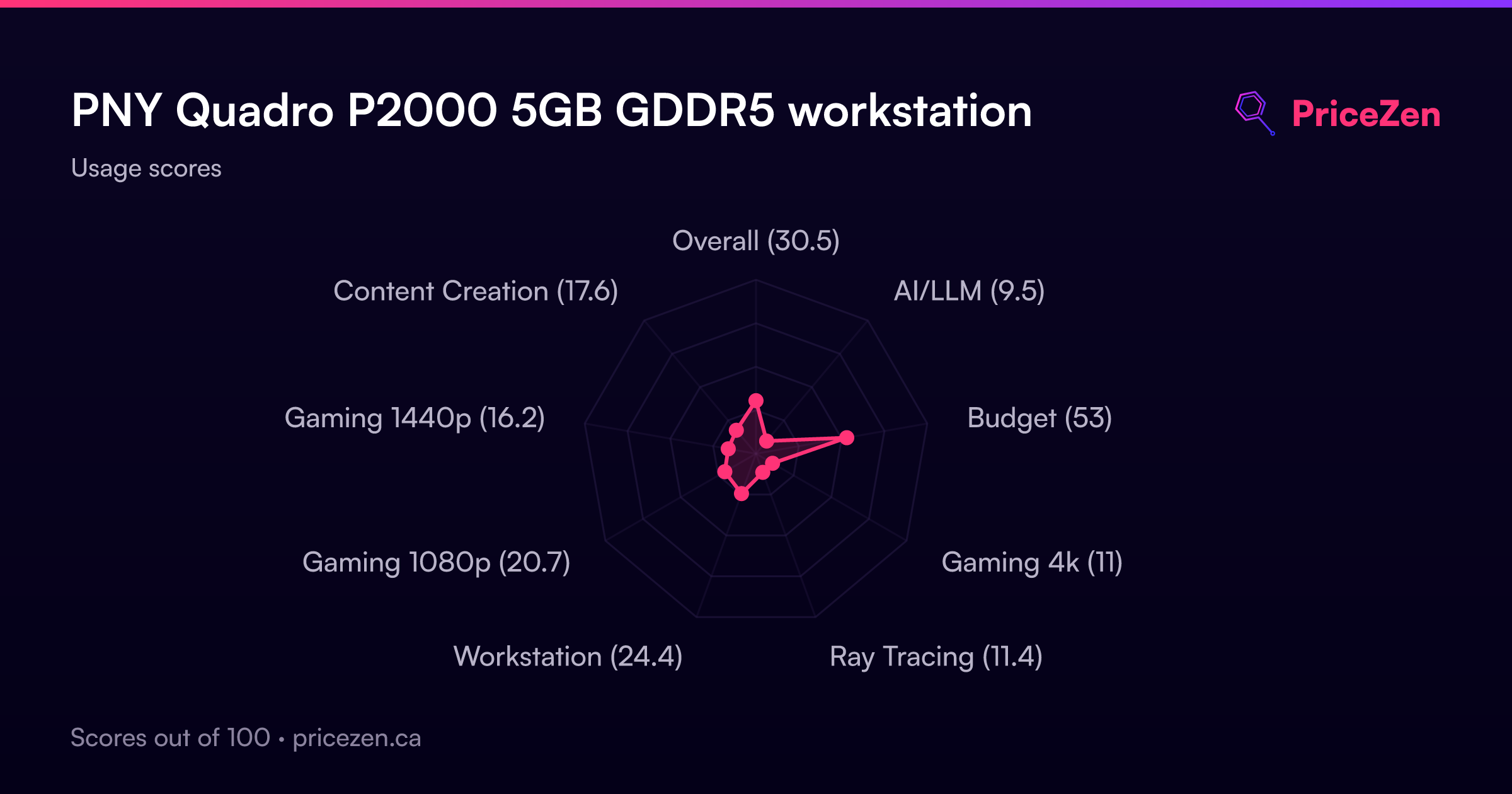
Usage Scores
- Overall30.5
- AI/LLM9.5
- Budget53
- Gaming 4k11
- Ray Tracing11.4
- Workstation24.4
- Gaming 1080p20.7
- Gaming 1440p16.2
- Content Creation17.6