ASRock Arc A750 Challenger 8GB GDDR6

Great 1080p gaming for budget builds verified Nov 24
40/100 overall score 4.1 average from 52 owner ratings
Prices checked on 1 days so far, too few to say what is usual.
- GPU
- Arc A750
- VRAM
- 8GB GDDR6
- Boost clock
- 2200 MHz
- TDP
- 225 W
- Memory bus
- 256 bit
- Ray tracing
- Yes
- Class
- consumer
Compare prices at 1 store
Cheapest first. New, refurbished and bundled offers are kept apart, so you compare like with like.
| Store | Sold by | Colour and condition | Price | vs lowest | Last checked | Link |
|---|---|---|---|---|---|---|
| New1 offerSingle unit | ||||||
| Newegg | Newegg | Not listed | CA$299.99 | Lowest price | 3 days ago | Go to store |
 Source: PriceZen, checked Nov 25, 2026
A price counts as current when we checked it in the last 7 days. “Marketplace seller” means a third-party seller on that store, not the store itself.


Snapshot
The 30-Second Version
At around 200 USD, the Arc A750 sits at the 86th percentile for affordability and delivers excellent AV1 encoding plus solid 1080p gaming. The 12631 PassMark score is nothing special, but the value proposition is hard to beat for budget builders. Just be ready for first-gen driver quirks and idle temps that run warm because the fans don't spin until you're actually working the card.
Pros & Cons
Pros
- 86th percentile affordability at around 200 USD 86th
- AV1 encoding and excellent media performance for the price 73rd
- 8GB GDDR6 on a 256-bit bus, solid for 1080p gaming 71st
- 2x DisplayPort 2.0 and 1x HDMI 2.1, 75th percentile connectivity
- Quiet when idle thanks to fanless operation
Cons
- 28th percentile raster performance, 12631 PassMark G3D
- 225W TDP puts efficiency at the 20th percentile
- Ray tracing at the 32nd percentile, barely usable
- Fans don't spin at idle, causing high idle temperatures
- First-gen driver quirks and occasional coil whine
What owners think
The Word on the Street
- Owners consistently praise the media encoding and decoding performance, with several calling it excellent for the price.
- Budget builders report solid 1080p gaming performance and consider it a great value upgrade from older GPUs.
- A recurring complaint is that the fans don't spin at idle, leading to high idle temperatures that make some owners uncomfortable.
- Driver stability is a common theme, with early adopter pains and tinkering required for some games, though most say it stabilizes after initial setup.
How owner sentiment changed over time
ExclusiveBased on when customers actually wrote their reviews - so you can see whether early praise held up.
8 written reviews, Nov 2022 – Jul 2024: 8 happy
Across all 52 store ratings: 4.1★. Most owners rate without writing a review. The chart counts the 8 written reviews.
Each dot is one written review, in the month it was written. Happy = 4-5★, mixed = 3★, unhappy = 1-2★.
The proof
Performance
Let's talk about that 12631 PassMark score first. It's not going to win any awards, sitting at the 28th percentile for raster performance. But here's the thing: at 1080p, this card is genuinely fine. The 2200MHz boost clock and 8GB of GDDR6 on a 256-bit bus give it enough bandwidth to handle most modern titles at medium to high settings without falling apart. The 1080p gaming score of 40.7 out of 100 sounds mediocre until you remember this is a 200 USD card competing against GPUs that cost two to three times as much.
The real star here is the media engine. AV1 encoding on a card this cheap is almost unheard of, and owners who use this as a media machine rave about it. The 2x DisplayPort 2.0 and 1x HDMI 2.1 outputs give you solid connectivity at the 75th percentile. Ray tracing is technically there, but at the 32nd percentile it's more of a checkbox than a feature you'll actually want to use. And the AI performance is rough, sitting at the 26th percentile with an ai_llm score of 24.2 out of 100. This is not the card for local LLM tinkering. The 225W TDP also means efficiency is a weak spot at the 20th percentile, so your power bill will notice it more than a comparable AMD card.
Specifications
Full Specifications
Chipset
| GPU Chipset | Arc A750 |
| Brand | Intel |
| Architecture | Xe-HPG (Alchemist) |
| Class | consumer |
Memory
| VRAM | 8 GB |
| Memory Type | GDDR6 |
| Memory Bus | 256 |
Compute
| Base Clock | 2200 |
| Boost Clock | 2200 |
Performance
| PassMark G3D | 12631 |
| GPU Compute | 5301 |
Power & Cooling
| TDP | 225 |
| Recommended PSU | 650 |
| Power Connectors | 2 x 8-Pin |
| Cooler | Dual Fan |
| Fans | 2 |
Connectivity
| Interface | PCI Express 4.0 x16 |
| DisplayPort | 2 |
| HDMI | 1 |
| Max Displays | 4 |
| Max Resolution | 7680 x 4320 |
Physical
| Length | 271 |
| Slot Width | 2.4 |
| Form Factor | ATX |
Features
| Ray Tracing | Yes |
| Upscaling | XeSS |
| AV1 Encode | Yes |
| DirectX | 12 Ultimate |
vs Competition
Stacked against the competition, the Arc A750 is playing a different game entirely. The ASUS PRIME RTX 5070 and ZOTAC Twin Edge RTX 5070 absolutely demolish it in raw performance, but they also cost several times more. The MSI GeForce RTX 5060 Ti 8G is probably the closest NVIDIA comparison in terms of VRAM, and it'll beat the A750 in most gaming scenarios while costing significantly more. The XFX RX 7900 GRE and Gigabyte RX 7800 XT are in another league for raster performance, but again, you're paying for it. Where the A750 wins is pure price-to-performance for 1080p and media workloads. If your budget is tight and you don't need 1440p or 4K gaming, none of those competitors can touch the A750's value. If you have more money to spend, every single one of them is a better gaming card.
| Spec | ASRock Arc A750 Challenger | MSI GeForce RTX 5070 Gaming Trio | XFX Radeon RX 7900 XT Gaming | PNY GeForce RTX 5070 OC | Gigabyte GeForce RTX 5060 Ti AERO OC | ASUS GeForce RTX 5060 Ti PRIME |
|---|---|---|---|---|---|---|
| Chipset | Arc A750 | GeForce RTX 5070 | Radeon RX 7900 XT | GeForce RTX 5070 | GeForce RTX 5060 Ti | GeForce RTX 5060 Ti |
| Vram | 8GB GDDR6 | 12GB GDDR7 | 20GB GDDR6 | 12GB GDDR7 | 16GB GDDR7 | 16GB GDDR7 |
| Boost Clock Mhz | 2200 | 2610 | 2400 | 2587 | 2647 | 2602 |
| Tdp W | 225 | 250 | 257 | 250 | 180 | 250 |
| Memory Bus Bits | 256 | 192 | 320 | 192 | 128 | 128 |
| Ray Tracing | Yes | Yes | Yes | Yes | Yes | Yes |
| GPU Class | consumer | consumer | consumer | consumer | consumer | consumer |
| Compare | Compare | Compare | Compare | Compare |
| Product | AI | Rt | Vram | Raster | Feature | Thermal | User Sentiment | Efficiency | Connectivity | Social Proof | Affordability |
|---|---|---|---|---|---|---|---|---|---|---|---|
| ASRock Arc A750 Challenger | 24.6 | 30.4 | 39.5 | 26 | 71.3 | 54.3 | 45 | 18.1 | 73.2 | 50.3 | 85.8 |
| MSI GeForce RTX 5070 Gaming Trio Compare | 60.7 | 82.9 | 65.2 | 78.8 | 95.7 | 91.8 | 78.7 | 78.7 | 94.2 | 93.4 | 32.1 |
| XFX Radeon RX 7900 XT Gaming Compare | 87.9 | 86 | 81 | 80.6 | 62.4 | 71.8 | 85 | 76.8 | 88.2 | 75 | 35.2 |
| PNY GeForce RTX 5070 OC Compare | 60.7 | 82.9 | 65.2 | 78.8 | 88.4 | 71.8 | 57.6 | 78.7 | 94.2 | 93.4 | 35.9 |
| Gigabyte GeForce RTX 5060 Ti AERO OC Compare | 67.9 | 54.2 | 82.9 | 55.3 | 95.7 | 91.8 | 85 | 85.6 | 94.2 | 83.9 | 32.7 |
| ASUS GeForce RTX 5060 Ti PRIME Compare | 67.9 | 64.9 | 82.9 | 55.3 | 88.4 | 91.8 | 57.6 | 43.5 | 94.2 | 99.9 | 45.1 |
Price
Value & Pricing
At 200 USD in the US and 280 CAD in Canada, this card is sitting at the 86th percentile for affordability. That's the whole pitch. You're getting 8GB of GDDR6, AV1 encoding, and playable 1080p performance for less than half the price of most current-gen mid-range cards. The value proposition gets even better if you're primarily a media creator or streamer, since the encoding hardware punches way above its price class. Just remember that the low price comes with trade-offs: you'll spend more time in driver settings, you'll deal with higher idle temps, and you'll need a 650W PSU with two 8-pin connectors. For budget builders who know their way around a PC, this is one of the best deals in our database right now.
Price history
Read more
Overview
The ASRock Arc A750 Challenger lands at 12631 in PassMark G3D, which puts it in the bottom third for raw raster performance against every GPU in our database. But that number doesn't tell the whole story. This card is sitting at the 86th percentile for affordability, and at around 200 USD it's one of the cheapest ways to get 8GB of GDDR6 on a 256-bit bus with AV1 encoding and ray tracing hardware. You're not buying this for benchmark glory. You're buying it because it does specific things well for very little money.
And those specific things are media work and 1080p gaming. Owners consistently praise the encoding and decoding chops, and the 1080p gaming score of 40.7 out of 100 is honestly better than the overall 41.9 suggests once you factor in the price. The catch is that this is a first-gen Intel product with first-gen quirks. Drivers have improved a lot, but you'll still find yourself tinkering more than you would with an NVIDIA or AMD card. If you're the type who enjoys a good spreadsheet and doesn't mind occasional troubleshooting, this card rewards you. If you want plug-and-play perfection, keep scrolling.
Common Questions
Q: Does the Arc A750 run hot when idle?
Yes, this is a known behavior. The fans are designed to stay off at idle to keep things quiet, which means the card runs warmer than you might expect when you're not gaming or encoding. It's not dangerous, but if you're used to cards that keep fans spinning at low RPM, it'll feel unusual. You can adjust fan curves in software if it bothers you.
Q: Is this card good for 1080p gaming?
For the price, yes. The 2200MHz boost clock and 8GB of GDDR6 on a 256-bit bus handle most modern titles at 1080p with medium to high settings. The PassMark G3D score of 12631 puts it at the 28th percentile overall, but at 200 USD it's competing against cards that cost much more. Don't expect high refresh rate 1440p gaming, but 1080p is very playable.
Q: Do I need Resizable BAR enabled for this card?
Yes, and this is non-negotiable. Intel Arc GPUs require Resizable BAR enabled in your BIOS for optimal performance. Without it, you'll see a significant performance drop in games. Most modern motherboards support it, but you'll need to dig into your BIOS settings to enable it. If your motherboard doesn't support ReBAR, this card is not a good choice.
Who Should Skip This
Skip this card if you want plug-and-play simplicity or if you're building a system for someone who doesn't enjoy troubleshooting. The 45th percentile user sentiment score reflects the reality that this is a first-gen product with driver quirks, occasional coil whine, and idle heat issues that require some patience. Skip it if you care about ray tracing, since the 32nd percentile RT performance means you'll be turning those features off in most games. Skip it if you're into AI workloads, because the ai_llm score of 24.2 out of 100 is one of the weakest in our database. And skip it if power efficiency matters to you, since the 225W TDP at the 20th percentile means you're paying more in electricity for less performance than a comparable AMD card. This is a card for budget-conscious tinkerers, not for people who want a set-it-and-forget-it experience.
Verdict
The ASRock Arc A750 Challenger is a budget card with a specific audience in mind, and for that audience it's a genuine winner. The 86th percentile affordability combined with excellent media encoding and solid 1080p performance makes it the best value play in our database for budget builders and media-focused users. The 4.1 out of 5 customer rating across 52 reviews backs that up, with owners consistently praising the value and media chops. But the 45th percentile user sentiment score tells the other side of the story: this card requires patience. Driver tinkering, idle heat, and occasional coil whine are part of the deal. If you're tech-savvy and budget-conscious, buy it without hesitation. If you want a card that just works out of the box, spend more elsewhere.
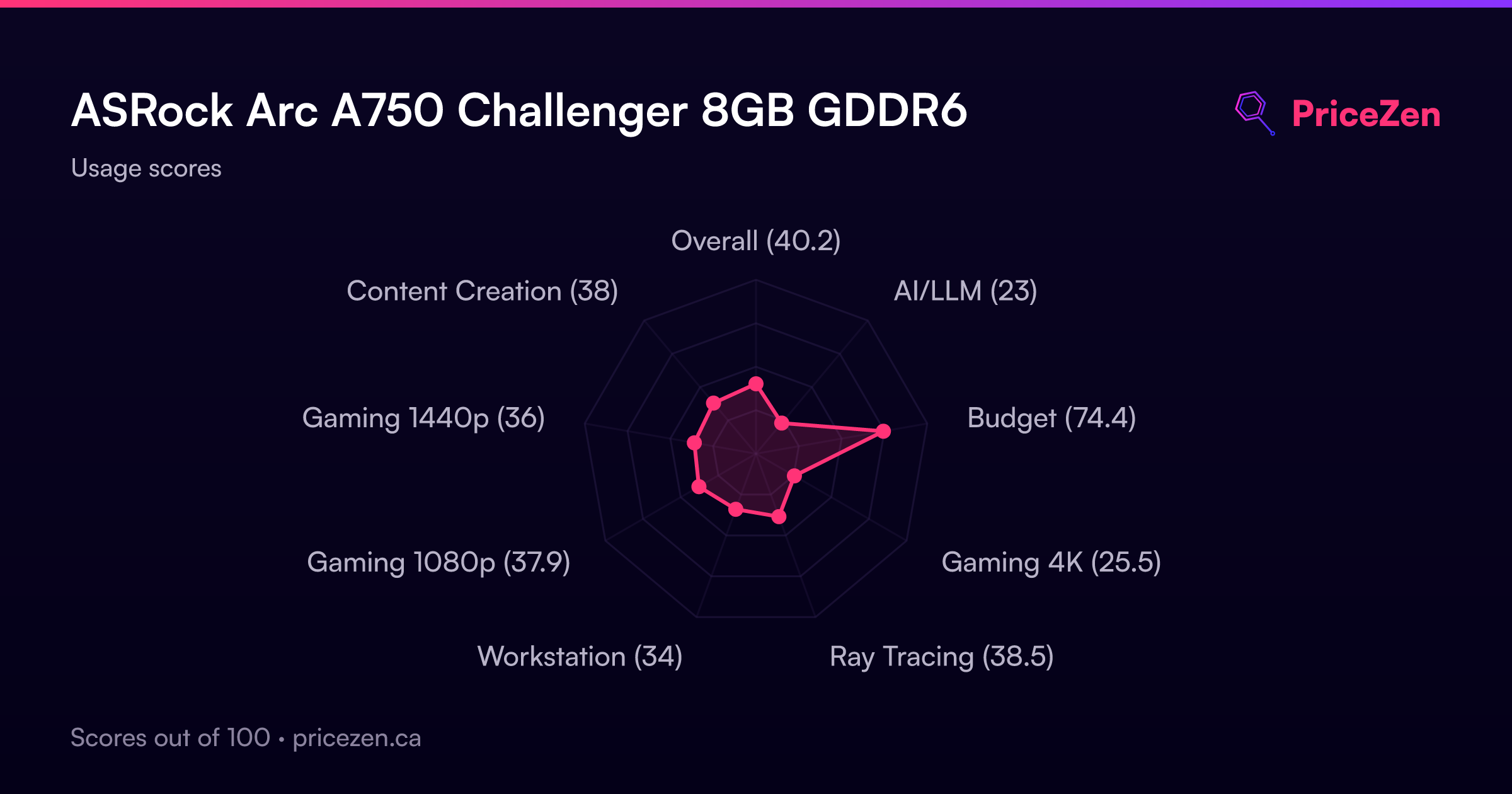
Usage Scores
- Overall40.2
- AI/LLM23
- Budget74.4
- Gaming 4K25.5
- Ray Tracing38.5
- Workstation34
- Gaming 1080p37.9
- Gaming 1440p36
- Content Creation38