XFX Radeon RX 6800 Speedster 16GB GDDR6
The 16GB GDDR6 frame buffer and 512 GB/s bandwidth on the RDNA 2 architecture provide ample headroom for high-resolution textures, making this card a strong 1440p performer. Its triple-fan SWFT319 cooler design keeps the 250W TDP in check while maintaining a standard 2-slot form factor for broad case compatibility. This GPU is best for 1440p gamers who prioritize high VRAM capacity and ray tracing over AI or compute workloads.

No current retailer price
Snapshot
The 30-Second Version
The RX 6800 Speedster SWFT319 delivers 16GB of GDDR6 and a 90th percentile feature set for USD 400 to USD 450. The 22,064 PassMark score is middle of the pack, but the VRAM and price make it a standout value. Thermal performance is the weak link at the 33rd percentile, so keep an eye on case airflow.
Pros & Cons
Pros
- 16GB GDDR6 with 512 GB/s bandwidth at the 70th percentile for VRAM 89th
- Feature set ranks at the 90th percentile with ray tracing, FSR, and AV1 encode 70th
- 2,190MHz boost clock and 3,840 stream processors handle 1440p gaming well 70th
- USD 400 to USD 450 price point is hard to beat for 16GB of VRAM 68th
- PCI Express 4.0 with 3x DisplayPort 1.4 and HDMI 2.1 for modern displays
Cons
- Thermal performance sits at the 33rd percentile, so expect some heat
- Efficiency is mediocre at the 45th percentile with a 250W TDP
- Ray tracing performance is underwhelming at the 67th percentile
- Workstation score of 49.5 out of 100 makes this a gaming-only card
- Social proof is nearly nonexistent at the 7th percentile with only 4 reviews
What owners think
The Word on the Street
How owner sentiment changed over time
ExclusiveBased on when customers actually wrote their reviews - so you can see whether early praise held up.
3 written reviews, Mar 2026: 3 happy
Each dot is one written review, in the month it was written. Happy = 4-5★, mixed = 3★, unhappy = 1-2★.
The proof
Performance
The 22,064 PassMark G3D score puts this card right around average for raw raster output, but the story gets more interesting when you look at the details. The 2,190MHz boost clock and 3,840 stream processors deliver 16.17 TFLOPS of FP32 compute, which is enough to push most modern titles at 1440p without breaking a sweat. The 16GB of GDDR6 with 512 GB/s of memory bandwidth is the real hero here, sitting at the 70th percentile for VRAM. That's more memory than a lot of cards in this price range, and it means you won't be texture-starved in games that eat VRAM for breakfast.
Ray tracing is where the RX 6800 shows its age. The 64.5 out of 100 ray tracing score and 67th percentile RT ranking mean it can do it, but it's not going to impress anyone coming from a newer RTX card. The 60 ray accelerators are first-gen RDNA 2 hardware, and it shows. Compute lands at the 53rd percentile with 32.33 FP16 TFLOPS, so this isn't a workstation card by any stretch. The 49.5 out of 100 workstation score is the weakest area here, and that's worth knowing before you try to use this for anything beyond gaming.
Specifications
Full Specifications
Chipset
| GPU Chipset | Radeon RX 6800 |
| Brand | AMD |
| Architecture | RDNA 2 |
| Class | consumer |
| Process | 7 |
Memory
| VRAM | 16 GB |
| Memory Type | GDDR6 |
| Memory Bus | 256 |
| Bandwidth | 512 |
Compute
| Stream Processors | 3840 |
| RT Cores | 60 |
| Base Clock | 1850 |
| Boost Clock | 2190 |
| FP16 TFLOPS | 32.33 |
| FP32 TFLOPS | 16.17 |
Performance
| PassMark G3D | 22064 |
| GPU Compute | 10777 |
Power & Cooling
| TDP | 250 |
| Recommended PSU | 850 |
| Power Connectors | 1 x 16-Pin |
| Cooler | Fan |
| Fans | 2 |
Connectivity
| Interface | PCI Express 4.0 |
| DisplayPort | 3 |
| HDMI | 1 |
| Max Displays | 3 |
| Max Resolution | Full HD (1080p) |
Physical
| Length | 320 |
| Slot Width | 2 |
| Form Factor | ATX |
| Weight | 1.4 kg / 3.0 lbs |
Features
| Ray Tracing | Yes |
| Upscaling | FSR |
| AV1 Encode | Yes |
| VR Ready | Yes |
vs Competition
Stacked against the Gigabyte AORUS GV-N5080AORUS M-16GD, the ASUS TUF Gaming TUF-RTX5070TI-O16G-WHITE-GAMING, and the MSI Suprim G5080-16SLS, the XFX RX 6800 is playing a different game entirely. Those cards are newer, faster, and dramatically more expensive. The RX 6800's 22,064 PassMark score doesn't touch what those RTX 50-series cards can do, but it also costs a fraction of the price. The ZOTAC SOLID SFF OC and Sapphire PULSE 11322-02-20G are closer in spirit, but the XFX still undercuts most of them on price while matching or beating them on VRAM. If you need raw performance, the newer cards win. If you need 16GB of VRAM without selling a kidney, the XFX is the pragmatic choice.
| Spec | XFX Radeon RX 6800 Speedster | ASUS GeForce RTX 5090 TUF Gaming | Gigabyte GeForce RTX 5070 Ti Eagle Ice | MSI GeForce RTX 5070 Ti Ventus 3X OC | ZOTAC GeForce RTX 5080 APOCALYPSE | Sapphire Radeon RX 7900 XTX NITRO+ |
|---|---|---|---|---|---|---|
| Chipset | Radeon RX 6800 | GeForce RTX 5090 | GeForce RTX 5070 Ti | GeForce RTX 5070 Ti | GeForce RTX 5080 | Radeon RX 7900 XTX |
| Vram | 16GB GDDR6 | 32GB GDDR7 | 16GB GDDR7 | 16GB GDDR7 | 16GB GDDR7 | 24GB GDDR6 |
| Boost Clock Mhz | 2190 | 2407 | 2542 | 2482 | 2730 | 2680 |
| Tdp W | 250 | 575 | 300 | 300 | 360 | 339 |
| Memory Bus Bits | 256 | 512 | 256 | 256 | 256 | 384 |
| Ray Tracing | Yes | Yes | Yes | Yes | Yes | Yes |
| GPU Class | consumer | consumer | consumer | consumer | consumer | consumer |
| Compare | Compare | Compare | Compare | Compare |
| Product | AI | Rt | Vram | Raster | Compute | Feature | Thermal | User Sentiment | Efficiency | Connectivity | Social Proof | Affordability |
|---|---|---|---|---|---|---|---|---|---|---|---|---|
| XFX Radeon RX 6800 Speedster | 70.1 | 67.6 | 70.1 | 53 | 51.7 | 88.6 | 31.4 | 57.8 | 43.5 | 62.6 | 22.2 | 66.7 |
| ASUS GeForce RTX 5090 TUF Gaming Compare | 97.2 | 90.5 | 97.8 | 98.8 | 97.7 | 95.8 | 72.1 | 85.1 | 23.5 | 99.3 | 98.7 | 2.1 |
| Gigabyte GeForce RTX 5070 Ti Eagle Ice Compare | 79.1 | 88.7 | 86 | 89 | 88 | 95.8 | 91.8 | 85.1 | 71.8 | 94.2 | 93.3 | 22.7 |
| MSI GeForce RTX 5070 Ti Ventus 3X OC Compare | 79.1 | 92.4 | 86 | 89 | 88 | 95.8 | 91.8 | 85.1 | 71.8 | 94.2 | 83.8 | 22.2 |
| ZOTAC GeForce RTX 5080 APOCALYPSE Compare | 85.4 | 97.6 | 89.1 | 94.5 | 93.4 | 95.8 | 91.8 | 99.5 | 56.8 | 94.2 | 98.7 | 22.5 |
| Sapphire Radeon RX 7900 XTX NITRO+ Compare | 95.2 | 96.4 | 92 | 83.4 | 95.7 | 95.8 | 91.8 | 85.1 | 51.6 | 98.8 | 69.1 | 13.5 |
Price
Value & Pricing
At USD 400 to USD 450 across two US listings, the RX 6800 Speedster SWFT319 is a value play that's hard to ignore. The affordability score of 65 out of 100 puts it above average, and when you factor in 16GB of VRAM at this price, the math gets compelling. The USD 50 spread between vendors means it's worth shopping around, and the lower end of that range is where this card makes the most sense. You're getting a 90th percentile feature set and 70th percentile VRAM for what amounts to budget-tier money in the current GPU market.
Read more
Overview
The XFX Radeon RX 6800 Speedster SWFT319 posts a PassMark G3D score of 22,064, which lands it in the middle of the pack for raster performance at the 55th percentile. That's not a headline-grabber in 2025, but the 16GB of GDDR6 on a 256-bit bus with 512 GB/s of bandwidth is what keeps this card relevant. You're getting a 7nm RDNA 2 chip with 3,840 stream processors and a 2,190MHz boost clock, and the feature set sits at the 90th percentile, which means ray tracing, FSR, AV1 encode, and VR Ready support are all here.
Where this card shines is the price-to-VRAM story. 16GB of memory at USD 400 to USD 450 is hard to argue with when newer cards at similar prices are shipping with less. The thermal performance is a weak spot at the 33rd percentile, and efficiency isn't much better at the 45th, so that 250W TDP is doing real work. But for 1440p gaming on a budget, the 58.3 out of 100 gaming score tells you this card is a solid, if not spectacular, choice.
Common Questions
Q: Is the RX 6800 good for 1440p gaming?
Yes, the 1440p gaming score of 58.3 out of 100 combined with 16GB of GDDR6 and a 2,190MHz boost clock makes this card a solid choice for 1440p. The 3,840 stream processors handle most modern titles at that resolution without struggling, and the 512 GB/s memory bandwidth keeps textures flowing.
Q: How much power does the XFX RX 6800 need?
The card has a 250W TDP and XFX recommends an 850W power supply. It uses a single 16-pin power connector. The efficiency ranking sits at the 45th percentile, so it's not the most power-frugal card out there, but it's manageable with the right PSU.
Q: Can this card handle ray tracing?
It can, but don't expect miracles. The ray tracing score is 64.5 out of 100, which puts it at the 67th percentile. The 60 ray accelerators are first-gen RDNA 2 hardware, so you'll get playable ray tracing in lighter titles, but heavy RT workloads will show the card's age compared to newer RTX cards.
Who Should Skip This
If you're doing any kind of serious workstation work, look elsewhere. The 49.5 out of 100 workstation score is the weakest area here, and the compute performance at the 53rd percentile won't do you any favors in rendering or productivity workloads. Ray tracing enthusiasts should also think twice, since the 67th percentile RT ranking means you're getting first-gen ray tracing that struggles with demanding RT titles. And if you're sensitive to noise, the thermal performance at the 33rd percentile combined with reports of coil whine might be a dealbreaker. This is a gaming card for budget-focused 1440p players, and that's about it.
Verdict
The XFX Radeon RX 6800 Speedster SWFT319 is a card that knows exactly what it is. It's not chasing benchmark records, and it's not pretending to be a workstation GPU. What it does is deliver 16GB of VRAM, a solid 1440p gaming experience, and a feature set that includes ray tracing and FSR at a price that makes sense. The thermal performance is a real concern at the 33rd percentile, and the efficiency isn't great, but owners seem happy with the cooling in practice. With a user sentiment score of 82 out of 100, people who buy this card tend to like it. For USD 400 to USD 450, this is a smart buy for budget-conscious 1440p gamers.
Usage Scores
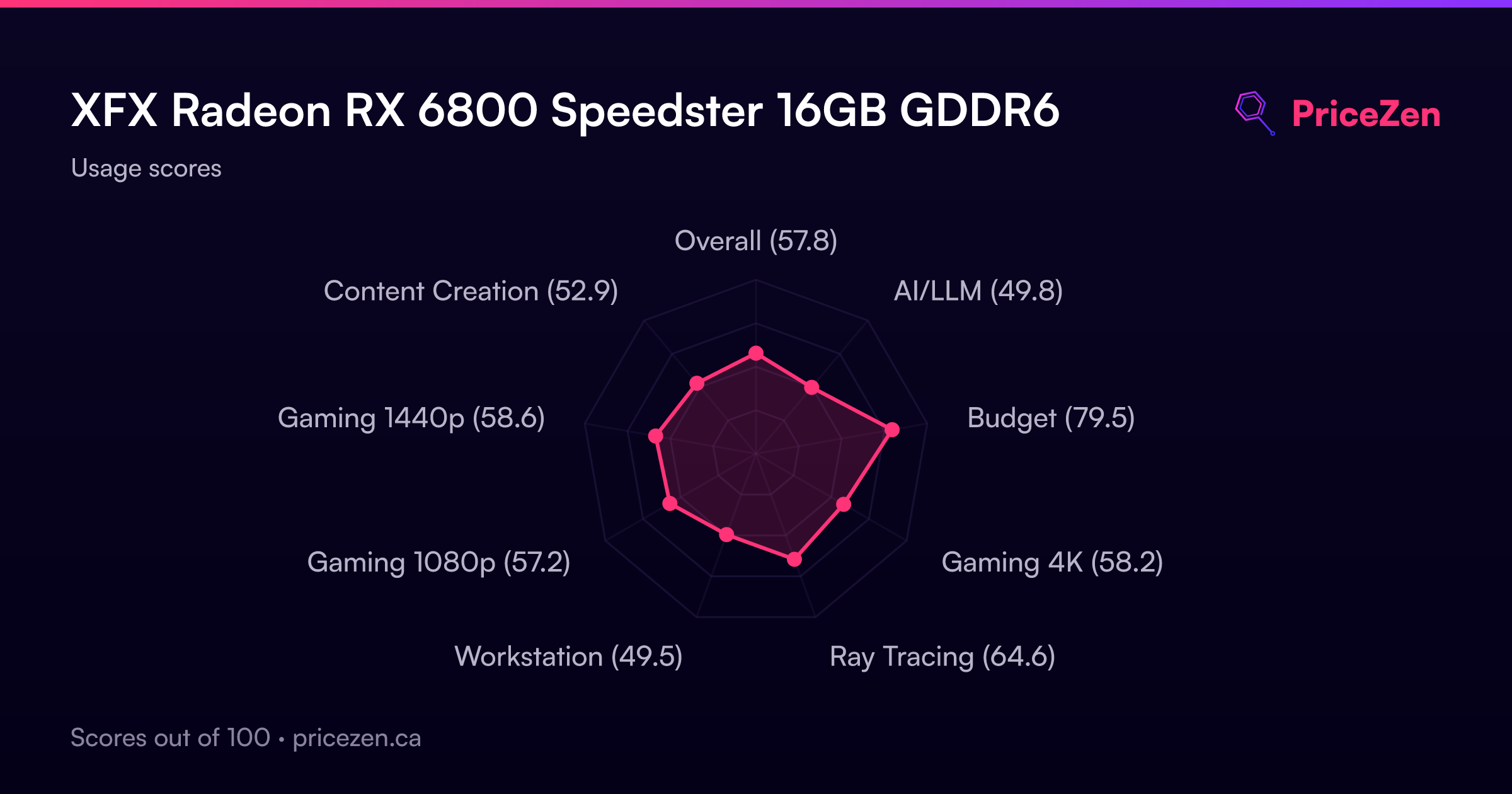
- Overall57.8
- AI/LLM49.8
- Budget79.5
- Gaming 4K58.2
- Ray Tracing64.6
- Workstation49.5
- Gaming 1080p57.2
- Gaming 1440p58.6
- Content Creation52.9