Gigabyte GeForce RTX 5050 Gaming OC 8GB GDDR6 Black

60/100 overall score 4.6 average from 47 owner ratings
Close to the usual price of CA$599.99.
90-day low CA$531.62High CA$599.50Usual CA$599.99
90-day low CA$531.62High CA$599.50Usual CA$599.99
Price over the last 90 days: low CA$531.62 on Oct 7, high CA$599.50. Usual price CA$599.99. Today CA$599.50.
- GPU
- GeForce RTX 5050
- VRAM
- 8GB GDDR6
- Boost clock
- 2632 MHz
- TDP
- 130 W
- Memory bus
- 128 bit
- Ray tracing
- Yes
- Class
- consumer
Compare prices at 4 stores
Cheapest first. New, refurbished and bundled offers are kept apart, so you compare like with like.
| Store | Sold by | Colour and condition | Price | vs lowest | Last checked | Link |
|---|---|---|---|---|---|---|
| New5 offersSingle unit | ||||||
| Amazon | Marketplace seller | Not listed | CA$599.50 | Lowest price | 6 days ago | Go to store |
| Memory Express | Memory Express | Black | CA$599.99 | +CA$0.49 | Yesterday | Go to store |
| Newegg | Marketplace seller | Black | CA$1,132.90 | +CA$533.40 | Nov 22 | Go to store |
| Not checked in the last 7 days, so these prices may have changed | ||||||
| Newegg | Newegg | Black | Price not confirmed | Not known | Go to store | |
| Out of stock when last checked | ||||||
| B&H Photo | B&H Photo | Not listed | No price | Out of stock | Not known | Go to store |
 Source: PriceZen, checked Nov 28, 2026
A price counts as current when we checked it in the last 7 days. “Marketplace seller” means a third-party seller on that store, not the store itself.
Price history
CA$599.50 is CA$0.49 under the usual store price, and only CA$67.88 above its 90-day low.
Checked that dayNot checked that day, still on offer
Source: PriceZen, checked Nov 28, 2026











Snapshot
The 30-Second Version
The RTX 5050 Gaming OC scores 16,985 in PassMark, which is solid for 1080p but nothing special. Its 8GB VRAM and mediocre ray tracing hold it back, while efficiency is genuinely impressive. The USD 310 to USD 586 price spread means this card is only a good deal at the low end.
Pros & Cons
Pros
- PassMark G3D score of 16,985 is solid for 1080p gaming 96th
- Efficiency ranks in the top 12% of all GPUs we track 89th
- Triple-fan WINDFORCE cooler keeps a 130W card running cool 88th
- DLSS 4 and AV1 encode support at a budget price point 72nd
- PCIe 5.0 x8 interface with dual HDMI 2.1b and dual DP 2.1b outputs
Cons
- 8GB VRAM on a 128-bit bus limits future-proofing
- Ray tracing performance is mediocre at 43rd percentile
- AI and compute scores are weak, bottom third of the database
- Price varies wildly from USD 310 to USD 586 across vendors
- 280mm length may not fit in compact cases
What owners think
The Word on the Street
- Buyers are impressed with the cooling performance, noting the card stays cool even under load thanks to the triple-fan design.
- Several owners report strong 1080p and even 1440p performance in esports titles like Fortnite, especially with settings dialed back.
- A recurring theme is that the card's value depends heavily on getting a discount, with some buyers feeling the normal retail price is too high for what you get.
How owner sentiment changed over time
ExclusiveBased on when customers actually wrote their reviews - so you can see whether early praise held up.
14 written reviews, Oct 2025 – May 2026: 12 happy, 1 mixed, 1 unhappy
Across all 47 store ratings: 4.6★. Most owners rate without writing a review. The chart counts the 14 written reviews.
Each dot is one written review, in the month it was written. Happy = 4-5★, mixed = 3★, unhappy = 1-2★.
The proof
Performance
The 16,985 PassMark score puts this card in the solid middle of our database. For 1080p gaming, that translates to comfortable frame rates in most titles without needing to crank every setting. The 2,632MHz boost clock and 2,560 CUDA cores do the heavy lifting, and the 320 GB/s memory bandwidth keeps things moving. But the 8GB VRAM buffer is the ceiling. At 36th percentile for VRAM capacity, this card will start sweating in newer titles that want more than 8GB, especially at higher texture settings.
Ray tracing is where the RTX 5050 shows its budget roots. The RT score sits at 43rd percentile, which is mediocre. You can enable ray tracing in lighter titles, but don't expect to max it out and keep smooth frame rates. DLSS 4 helps claw back some performance, and the AV1 encoder is a nice bonus for streamers. The compute numbers are underwhelming at 32nd percentile, and AI workloads are the weakest area at 30th percentile. This is a gaming card, not a mini workstation.
Specifications
Full Specifications
Chipset
| GPU Chipset | GeForce RTX 5050 |
| Brand | NVIDIA |
| Architecture | Blackwell |
| Class | consumer |
| Process | 5 |
Memory
| VRAM | 8 GB |
| Memory Type | GDDR6 |
| Memory Bus | 128 |
| Bandwidth | 320 |
Compute
| CUDA Cores | 2560 |
| Tensor Cores | 80 |
| RT Cores | 20 |
| Base Clock | 2572 |
| Boost Clock | 2632 |
| FP16 TFLOPS | 13.17 |
| FP32 TFLOPS | 13.17 |
Performance
| PassMark G3D | 16985 |
| GPU Compute | 8543 |
Power & Cooling
| TDP | 130 |
| Recommended PSU | 550 |
| Power Connectors | 8-Pin |
| Cooler | Triple Fan |
| Fans | 3 |
Connectivity
| Interface | PCI Express 5.0 x8 |
| DisplayPort | 2 |
| HDMI | 2 |
| Max Displays | 4 |
| Max Resolution | 7680 x 4320 |
Physical
| Length | 280 |
| Slot Width | 2 |
| Form Factor | Full Height |
| Weight | 1.1 kg / 2.4 lbs |
Features
| Ray Tracing | Yes |
| Upscaling | DLSS 4 |
| AV1 Encode | Yes |
| VR Ready | Yes |
| DirectX | 12 Ultimate |
| RGB | Yes |
vs Competition
Against the ASUS PRIME RTX 5070 Ti, this card gets absolutely smoked. The 5070 Ti has double the VRAM at 16GB and a much wider memory bus, which shows up in every benchmark that matters. The MSI GAMING TRIO RTX 5070 also outclasses it with 12GB of VRAM and significantly better ray tracing scores. The ZOTAC SOLID SFF OC sits in a similar performance tier but with a smaller footprint. On the AMD side, the XFX Mercury RX 9070 XT and Sapphire PULSE both offer more raw raster performance per dollar if you don't care about DLSS. The RTX 5050's only real advantage is efficiency and price, assuming you find it at the low end of that USD 310 to USD 586 range.
| Spec | Gigabyte GeForce RTX 5050 Gaming OC | ASUS GeForce RTX 5070 Ti TUF Gaming | PNY GeForce RTX 5070 Ti OC | MSI GeForce RTX 5070 Gaming Trio | Sapphire Radeon RX 9070 XT PULSE | XFX Radeon RX 9070 XT Mercury |
|---|---|---|---|---|---|---|
| Chipset | GeForce RTX 5050 | GeForce RTX 5070 Ti | GeForce RTX 5070 Ti | GeForce RTX 5070 | Radeon RX 9070 XT | Radeon RX 9070 XT |
| Vram | 8GB GDDR6 | 16GB GDDR7 | 16GB GDDR7 | 12GB GDDR7 | 16GB GDDR6 | 16GB GDDR6 |
| Boost Clock Mhz | 2632 | 2650 | 2450 | 2610 | 2970 | 3100 |
| Tdp W | 130 | 300 | 300 | 250 | 304 | 304 |
| Memory Bus Bits | 128 | 256 | 256 | 192 | 256 | 256 |
| Ray Tracing | Yes | Yes | Yes | Yes | Yes | Yes |
| GPU Class | consumer | consumer | consumer | consumer | consumer | consumer |
| Compare | Compare | Compare | Compare | Compare |
| Product | AI | Rt | Vram | Raster | Compute | Feature | Thermal | Efficiency | Connectivity | Social Proof | Affordability |
|---|---|---|---|---|---|---|---|---|---|---|---|
| Gigabyte GeForce RTX 5050 Gaming OC | 29.1 | 41.2 | 34.4 | 37.3 | 31.4 | 95.7 | 71.8 | 87.6 | 89 | 53.3 | 63.5 |
| ASUS GeForce RTX 5070 Ti TUF Gaming Compare | 78.9 | 92.4 | 85.9 | 88.9 | 87.8 | 82.8 | 49.5 | 71.6 | 99.3 | 93.4 | 22.5 |
| PNY GeForce RTX 5070 Ti OC Compare | 78.9 | 92.4 | 85.9 | 88.9 | 87.8 | 65.6 | 91.8 | 71.6 | 81.3 | 93.4 | 26.5 |
| MSI GeForce RTX 5070 Gaming Trio Compare | 60.7 | 82.9 | 65.2 | 78.8 | 70.5 | 95.7 | 91.8 | 78.6 | 94.2 | 93.4 | 32.2 |
| Sapphire Radeon RX 9070 XT PULSE Compare | 89.4 | 84.7 | 73.5 | 74.6 | 89.8 | 95.7 | 71.8 | 44.6 | 89 | 93.4 | 41.2 |
| XFX Radeon RX 9070 XT Mercury Compare | 89.5 | 84.7 | 75.1 | 74.6 | 90.8 | 95.7 | 71.8 | 44.6 | 94.2 | 93.4 | 30.9 |
Price
Value & Pricing
The value story here depends entirely on which listing you find. US prices swing from USD 310 to USD 586, a USD 276 spread that's frankly ridiculous for the same card. At the low end, this is a compelling budget pick. At the high end, you're dangerously close to cards with more VRAM and better ray tracing. The budget score of 82.2 out of 100 reflects the card's potential when priced correctly. Amazon and Newegg both carry it, but you'll want to shop around. If you're paying more than USD 350, stop and reconsider.
Read more
Overview
The Gigabyte RTX 5050 Gaming OC posts a PassMark G3D score of 16,985, which lands it right around the middle of the pack for current GPUs. That's a solid showing for a card aimed at 1080p gaming, but the 8GB of GDDR6 on a 128-bit bus is the spec that keeps it from climbing higher. Our database puts its budget score at 82.2 out of 100, which tells you this thing makes sense when the price is right, and gets harder to justify as the cost creeps up.
Gigabyte threw a triple-fan WINDFORCE cooler on a 130W card, which is honestly overkill in the best way. The efficiency ranking sits near the top of the charts, and thermals are well above average. You get DLSS 4, AV1 encode, and PCIe 5.0 x8 support. But the ray tracing score is mediocre, and the AI compute numbers are a weak spot. This is a raster-first budget card with some modern features bolted on.
Common Questions
Q: Is the RTX 5050 good for 1080p gaming?
Yes, the 16,985 PassMark score puts it in the solid middle of our database, which translates to smooth frame rates at 1080p in most titles. The gaming_1080p score of 67.7 out of 100 reflects decent but not exceptional performance. You'll be comfortable at high settings in most games, though the 8GB VRAM may force texture reductions in newer titles.
Q: Can the RTX 5050 handle ray tracing?
Technically yes, but don't expect much. The ray tracing score sits at 43rd percentile, which is mediocre. You can enable RT in lighter titles with DLSS 4 helping out, but heavy ray tracing workloads will tank frame rates. This card is really built for rasterized gaming first.
Q: How much power does the RTX 5050 need?
The card has a 130W TDP and requires a single 8-pin power connector. Gigabyte recommends a 550W power supply. The efficiency ranking is in the top 12% of all GPUs we track, so it's a very power-friendly card for the performance it delivers.
Who Should Skip This
Skip this card if you care about ray tracing or plan to keep it for more than a couple years. The 8GB VRAM is already a limitation in some current titles, and that problem only gets worse. The AI and compute scores are bottom-third, so content creators and anyone dabbling in local AI models should look elsewhere. And if you can't find it for under USD 350, the value proposition falls apart completely. The 280mm length also rules out most small form factor builds.
Verdict
The Gigabyte RTX 5050 Gaming OC is a decent 1080p card that lives or dies by its price tag. At USD 310, it's a reasonable entry point with modern features like DLSS 4 and AV1 encode. At USD 586, it's a trap. The 8GB VRAM and mediocre ray tracing performance mean this card won't age gracefully. If you're building a budget rig and find it near the low end of the price range, it's worth considering. Otherwise, save a bit more and step up to something with more memory.
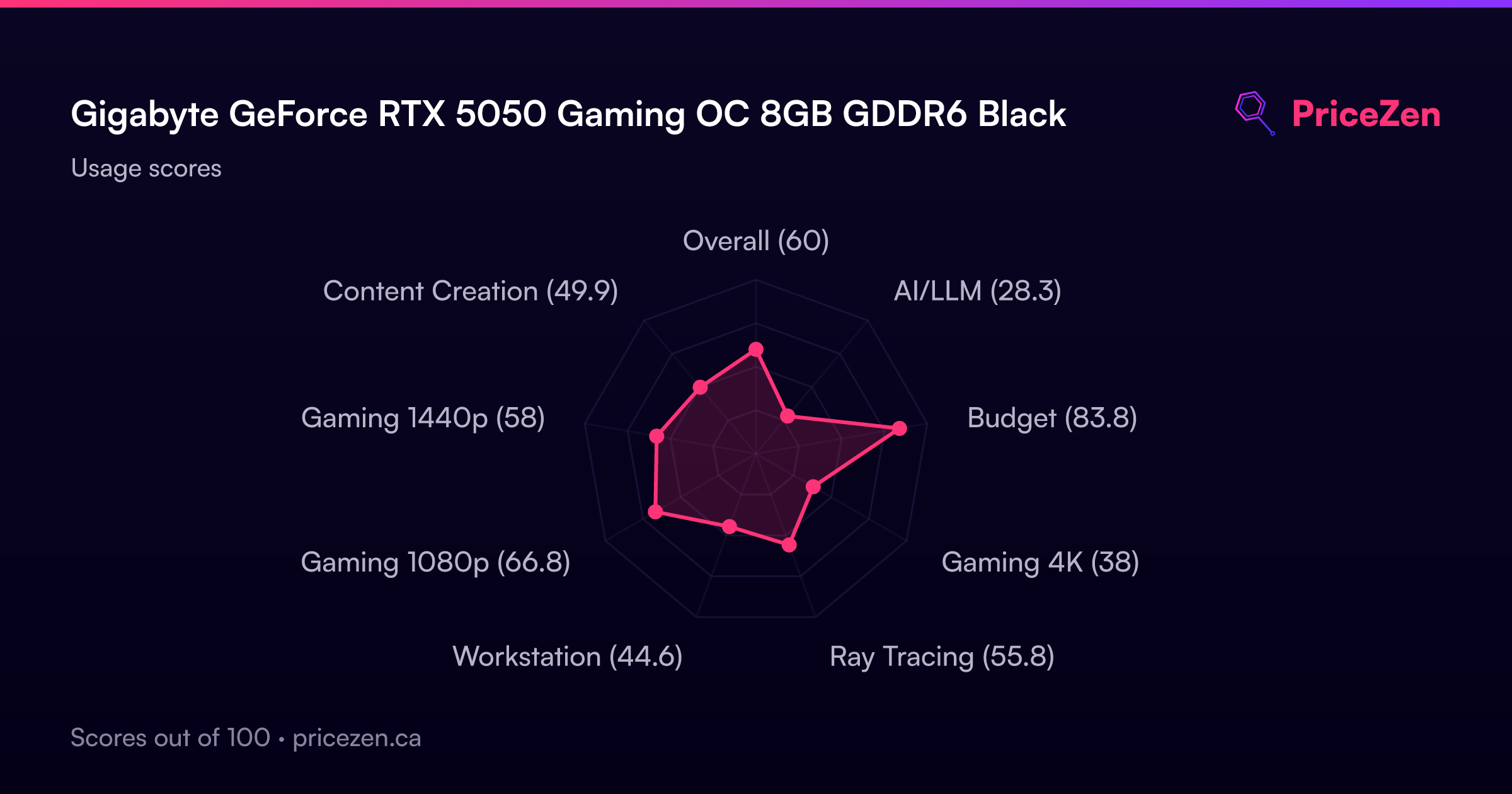
Usage Scores
- Overall60
- AI/LLM28.3
- Budget83.8
- Gaming 4K38
- Ray Tracing55.8
- Workstation44.6
- Gaming 1080p66.8
- Gaming 1440p58
- Content Creation49.9