Zunate GeForce GT 210 1GB DDR3
The GT210 chip with a 550MHz core clock and passive cooling via a low-noise fan provides basic display output without needing external power. Its multi-interface design with HDMI, DVI, and VGA supports up to 2560x1600 resolution, making it a simple plug-and-play adapter for older systems. This card is best for office users who only need to add a monitor to a legacy PC lacking integrated video outputs.

No current retailer price











Snapshot
The 30-Second Version
The Zunate GT 210 scores 14.2 out of 100 overall, with raster performance in the 2nd percentile. It's a 1GB DDR3 display adapter from 2009 that costs $39 USD. Buy it only if you need a basic video output and have no other options.
Pros & Cons
Pros
- 98th percentile affordability, this thing costs less than a pizza night 98th
- No external power connector needed, runs off the PCIe slot alone
- HDMI, DVI, and VGA outputs cover old and new monitors
- Passive-level noise from the single fan, it won't disturb your office
- Plug and play with Windows 10, 11, Vista, and Linux support
Cons
- 2nd percentile raster performance, slower than 98% of cards we've tested
- 1GB DDR3 on a 64-bit bus, memory bandwidth is painfully low
- DirectX 10.1 support means many modern games won't even launch
- 26th percentile thermal performance, the cooling is barely adequate
- 400W PSU recommendation is absurd for a card that draws almost nothing
The proof
Performance
Let's talk numbers. The GT 210 runs a 550MHz core and 500MHz memory clock on a 64-bit memory bus. That's a memory bandwidth ceiling of roughly 8GB/s, which is less than what modern integrated graphics manage. Our raster score puts it in the 2nd percentile, meaning it's one of the worst performers we've tracked. Gaming at 4K? The score is 4.3 out of 100. You'd have a better time drawing frames by hand.
It supports DirectX 10.1, which was current when the first iPhone was still exciting. The 2560x1600 max resolution sounds impressive until you realize it's only for desktop use. Try running anything 3D at that res and the card will politely request early retirement. The single fan keeps things quiet, but thermal performance sits in the 26th percentile, so it's not exactly a cool customer either.
Specifications
Full Specifications
Chipset
| GPU Chipset | GeForce GT 210 |
| Brand | Intel |
| Class | consumer |
Memory
| VRAM | 1 GB |
| Memory Type | DDR3 |
| Memory Bus | 64 |
Compute
| Base Clock | 550 |
Power & Cooling
| Recommended PSU | 400 |
| Power Connectors | None |
| Cooler | Single Fan |
| Fans | 1 |
Connectivity
| Interface | PCI Express 2.0 16X |
| HDMI | 1 |
| Max Resolution | 2560x1600 |
Physical
| Weight | 0.3 kg / 0.6 lbs |
Features
| DirectX | 10.1 |
vs Competition
Stacked against the competition, the GT 210 doesn't just lose, it gets lapped. The XFX Radeon RX 570 with 8GB of GDDR5 is in a completely different universe, offering roughly 20 times the memory bandwidth and actual gaming capability. The PNY Quadro P1000 brings workstation credentials and 4GB of VRAM for professional apps. Even the VBESTLIFE and Cuifati budget cards, which are no performance champions themselves, typically offer 2GB or more of VRAM and newer architectures. The only card this Zunate might beat is a dead one. The HP 20X24AA is the closest in spirit, another basic display adapter, but even that has a more modern feature set.
| Spec | Zunate GeForce GT 210 | HP RTX A4000 | EVGA GeForce GTX 1070 | Gigabyte GeForce GTX 1080 WINDFORCE OC | MSI GeForce GTX 1660 Ti Ventus OC | NVIDIA Quadro P2200 |
|---|---|---|---|---|---|---|
| Chipset | GeForce GT 210 | RTX A4000 | GeForce GTX 1070 | GeForce GTX 1080 | GeForce GTX 1660 Ti | Quadro P2200 |
| Vram | 1GB DDR3 | 16GB GDDR6 | 8GB GDDR5 | 8GB GDDR5X | 6GB GDDR6 | 5GB GDDR5X |
| Boost Clock Mhz | - | - | 1784 | 1797 | 1830 | 1500 |
| Tdp W | - | 140 | 150 | 180 | 120 | 75 |
| Memory Bus Bits | 64 | - | 256 | 256 | 192 | 160 |
| Ray Tracing | - | true | false | false | false | false |
| GPU Class | consumer | workstation | consumer | consumer | consumer | workstation |
| Compare | Compare | Compare | Compare | Compare |
| Product | AI | Rt | Vram | Raster | Feature | Thermal | Efficiency | Connectivity | Social Proof | Affordability |
|---|---|---|---|---|---|---|---|---|---|---|
| Zunate GeForce GT 210 | 3 | 2.1 | 2.2 | 2.3 | 10.9 | 25.6 | 2.3 | 12.7 | 32.7 | 98.3 |
| HP RTX A4000 Compare | 66.8 | 35.1 | 63 | 41.8 | 33.6 | 16.5 | 92.2 | 36.3 | 0 | 19.5 |
| EVGA GeForce GTX 1070 Compare | 27.6 | 26.5 | 24.5 | 29.1 | 28.5 | 55.3 | 48.8 | 44.7 | 62 | 63.9 |
| Gigabyte GeForce GTX 1080 WINDFORCE OC Compare | 31 | 32.4 | 26.5 | 32.9 | 40.9 | 91.7 | 42.9 | 44.7 | 68.9 | 73.5 |
| MSI GeForce GTX 1660 Ti Ventus OC Compare | 20.5 | 24.7 | 22.2 | 26.7 | 25.2 | 42.7 | 66.6 | 34.4 | 93.3 | 78.3 |
| NVIDIA Quadro P2200 Compare | 17.4 | 23 | 17.9 | 21.6 | 28.5 | 25.6 | 87.4 | 60.4 | 83.8 | 85 |
Price
Value & Pricing
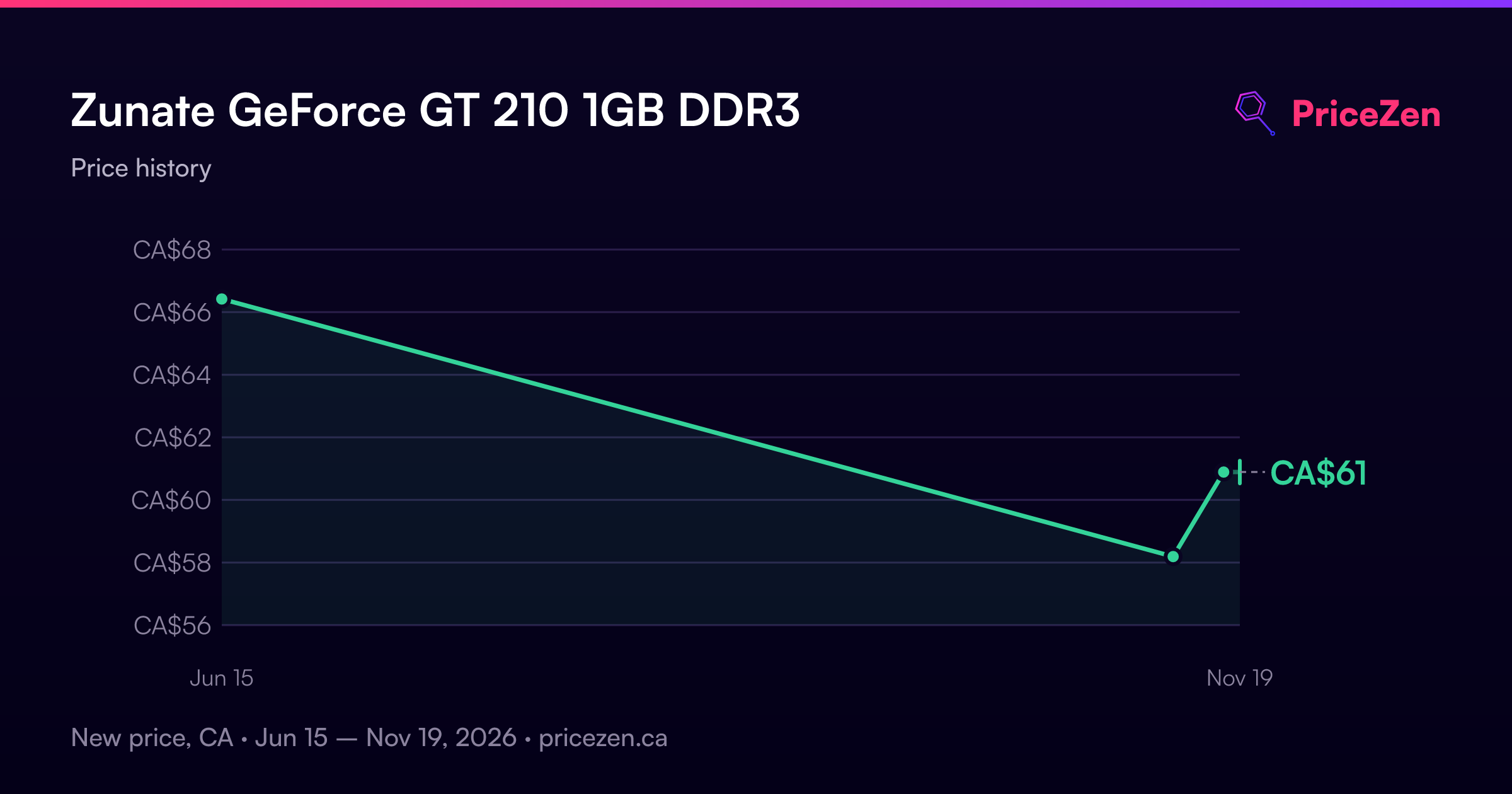
At $39 USD, the Zunate GT 210 is priced like a rounding error. The 98th percentile affordability score is earned, no question. But value isn't just about low price, it's about what you get for that price. And what you get is a card that scores 14.2 overall. For the same money in many markets, you can find used office cards with double the VRAM and triple the performance. The EUR 59-61 listings in Spain, France, and Italy are even harder to justify. You're paying modern money for 2009 silicon.
Price history
Read more
Overview
The Zunate GeForce GT 210 scores a 14.2 out of 100 overall in our database. That's not a typo. This card sits in the 2nd percentile for raster performance and the 2nd percentile for VRAM, which means it's slower than 98% of the graphics cards we've tested. The only thing keeping it from a total wipeout is affordability, where it lands in the 98th percentile, because yes, it is very cheap.
But cheap doesn't mean useful. With 1GB of DDR3 on a 64-bit bus, a 550MHz core clock, and DirectX 10.1 support, this is a display adapter from 2009 wearing a new heatsink. It'll push pixels to a monitor, and that's about where the magic ends.
Common Questions
Q: Can this card run modern games?
No. With a 2nd percentile raster score and DirectX 10.1 support, most games from the last decade won't even launch. The 4.3 out of 100 gaming_4k score tells you everything. This is a display adapter, not a gaming card.
Q: Will it work with my power supply?
Yes, almost certainly. The card draws all its power from the PCIe slot and needs no 6-pin connector. The 400W recommendation in the listing is wildly conservative. Any functioning PSU from the last 15 years will handle it.
Q: Is 1GB of VRAM enough for office work?
For basic desktop use, web browsing, and office apps, 1GB is workable but tight. The 2nd percentile VRAM ranking means you'll feel the squeeze with multiple browser tabs or high-resolution displays. For 1080p office work, it's adequate. For anything more, it's not.
Who Should Skip This
Skip this if you have any performance expectations at all. The 2nd percentile raster score means even decade-old games will struggle. The 26th percentile thermal performance suggests the single fan is doing the bare minimum. And the 13th percentile connectivity ranking means you're limited to HDMI, DVI, and VGA, no DisplayPort, no modern outputs. If you need a card for anything beyond displaying a spreadsheet, look elsewhere. Even integrated graphics on a modern CPU will embarrass this thing.
Verdict
The Zunate GeForce GT 210 is a 14.2 out of 100 card. It exists for exactly one purpose: giving a display output to a system that doesn't have one. If that's your need, and you can find it for $39 USD or less, fine. But don't buy this for gaming, don't buy it for video editing, and don't buy it expecting anything beyond basic desktop use. The 2nd percentile raster score isn't a fluke, it's a warning label.
Usage Scores
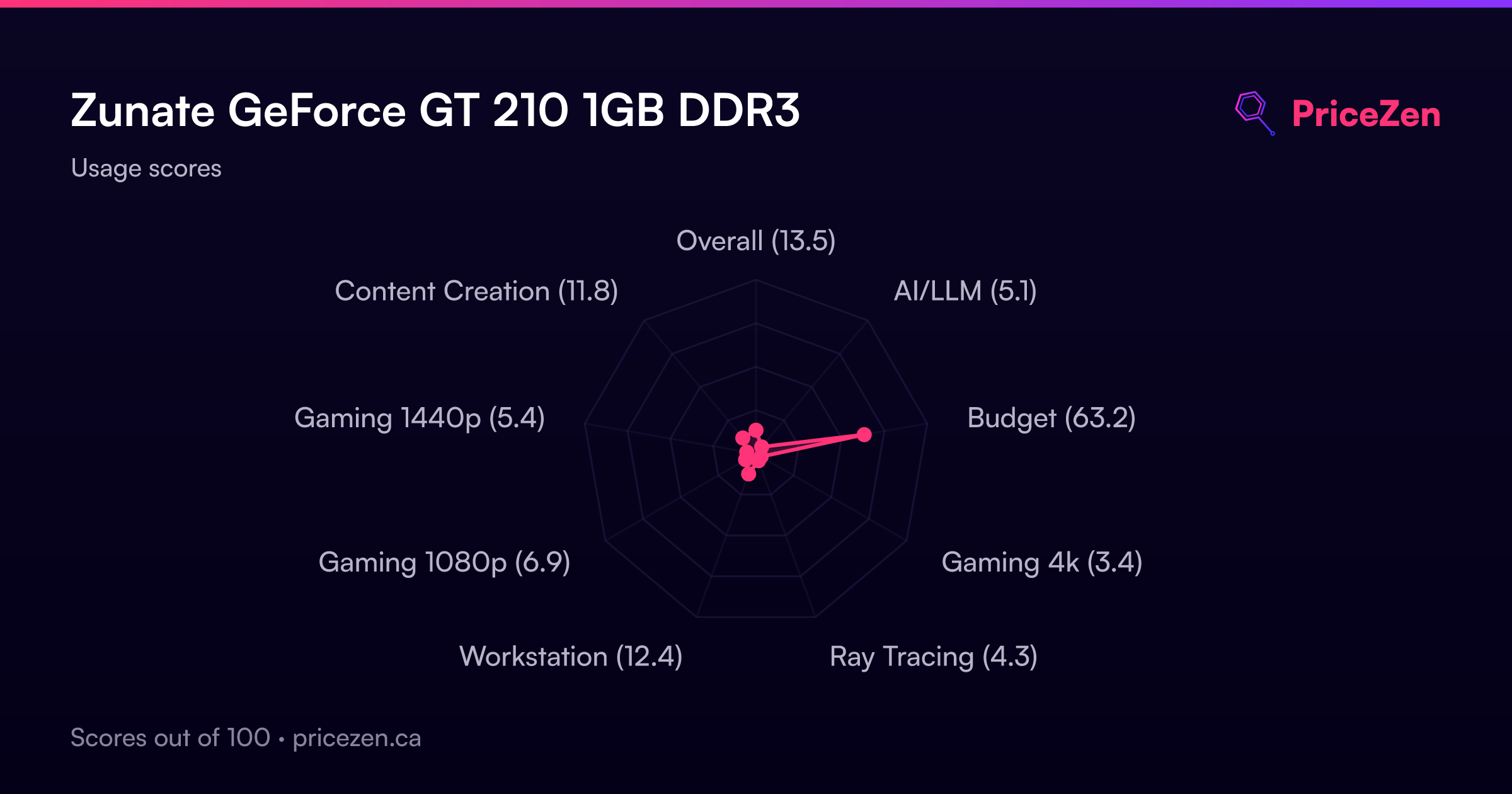
- Overall13.5
- AI/LLM5.1
- Budget63.2
- Gaming 4k3.4
- Ray Tracing4.3
- Workstation12.4
- Gaming 1080p6.9
- Gaming 1440p5.4
- Content Creation11.8