NVIDIA RTX 6000 Ada 48GB GDDR6 workstation
The 48GB of ECC GDDR6 memory on a 384-bit bus and 18,176 CUDA cores make this the definitive card for memory-intensive AI model training and large-scale simulations. Its Ada Lovelace architecture delivers hardware-accelerated AV1 encoding and ray tracing in a compact, 267mm dual-slot blower design that fits multi-GPU server racks. This card is best for AI researchers and data scientists running LLM fine-tuning or complex 3D simulations where data integrity and massive VRAM capacity are non-negotiable.

No current retailer price



Snapshot
The 30-Second Version
The RTX 6000 Ada is a workstation monster with 48GB of ECC GDDR6 and 91 TFLOPS of compute, landing in the 99th percentile for AI workloads. It's brutally expensive at USD 7,499, with Canadian pricing ranging from CAD 10,449 to CAD 14,000. Thermal performance is a weak spot, and the lack of HDMI and PCIe 5.0 feels dated. Buy it for AI and large-scale rendering, skip it for gaming.
Pros & Cons
Pros
- 48GB ECC GDDR6 with 960 GB/s bandwidth is best-in-class for large models and scenes 100th
- 91 TFLOPS FP32/FP16 compute puts it in the top 3% of all cards we track 99th
- AI performance scores in the 99th percentile, ideal for training and inference 99th
- AV1 encoding and ray tracing support keep it current for content creation 99th
- Two-slot blower design fits in most workstation chassis without thermal drama
Cons
- Affordability score is dead last at the 1st percentile, this card is brutally expensive
- Thermal performance lands in the 21st percentile, the blower runs hot under sustained load
- Only 4x DisplayPort 1.4a outputs, no HDMI for mixed monitor setups
- PCIe 4.0 x16, not 5.0, which feels dated for a flagship workstation card
- 300W TDP with a single 16-pin connector means you need a beefy 700W PSU
The proof
Performance
Let's talk numbers. The RTX 6000 Ada pushes 91.06 TFLOPS of FP32 and FP16 compute. That's best-in-class territory, landing in the 97th percentile for compute across everything we track. The 18,176 CUDA cores at a 2,505MHz boost clock are doing serious work here. For AI and machine learning, the card scores in the 99th percentile, which means it's basically the top of the charts right now. If you're fine-tuning models or running inference on large batches, this card will chew through it.
The 48GB of ECC GDDR6 with 960 GB/s of memory bandwidth is the other big story. That's a massive frame buffer, and the bandwidth keeps those 18,176 cores fed. Ray tracing performance is strong too, landing in the 87th percentile. Rasterization is solid at the 81st percentile, though that's not really the focus here. The PassMark G3D score of 28,784 is impressive, but raw gaming benchmarks don't tell the whole story for a card like this. The real-world implication is simple: workloads that used to require multiple cards or constant memory management now fit on one.
Specifications
Full Specifications
Chipset
| GPU Chipset | RTX 6000 Ada |
| Brand | NVIDIA |
| Architecture | Ada Lovelace |
| Class | workstation |
| Process | 5 |
Memory
| VRAM | 48 GB |
| Memory Type | GDDR6 |
| Memory Bus | 384 |
| Bandwidth | 960 |
| ECC | Yes |
Compute
| CUDA Cores | 18176 |
| Tensor Cores | 568 |
| RT Cores | 142 |
| Base Clock | 915 |
| Boost Clock | 2505 |
| FP16 TFLOPS | 91.06 |
| FP32 TFLOPS | 91.06 |
Performance
| PassMark G3D | 28784 |
| GPU Compute | 22448 |
Power & Cooling
| TDP | 300 |
| Recommended PSU | 700 |
| Power Connectors | 1x 16-Pin PCI Connector |
| Cooler | Blower |
| Fans | 1 |
Connectivity
| Interface | PCI Express 4.0 x16 |
| DisplayPort | 4 |
| HDMI | 1 |
| Max Displays | 4 |
| Max Resolution | 7680 x 4320 |
Physical
| Length | 267 |
| Slot Width | 2 |
| Form Factor | Full Height |
| Weight | 1.7 kg / 3.8 lbs |
Features
| Ray Tracing | Yes |
| Upscaling | DLSS |
| AV1 Encode | Yes |
| VR Ready | Yes |
| DirectX | 12 Ultimate |
| RGB | No |
vs Competition
The RTX 6000 Ada sits in a weird spot compared to the gaming cards in our database. The ASUS TUF RTX 5090 and Gigabyte AORUS RTX 5080 are both newer consumer cards with more modern features like PCIe 5.0 and better gaming performance per dollar. The RTX 5090 especially will beat the 6000 Ada in raw gaming frame rates, and it costs a fraction of the price. But it tops out at 32GB of VRAM, and that's the whole ballgame. If your workload needs more than 32GB, the consumer cards simply can't compete.
The MSI Ventus RTX 5070 Ti and ZOTAC RTX 5080 are even cheaper, but they're not in the same conversation for workstation use. 16GB of VRAM is a hard ceiling for AI and large 3D scenes. The Sapphire NITRO+ is an AMD card, which brings its own driver and software ecosystem considerations. For pure gaming, any of these competitors make more sense. For AI, simulation, or massive rendering jobs, the RTX 6000 Ada's 48GB of ECC memory and 99th percentile AI score put it in a class of its own.
| Spec | NVIDIA RTX 6000 Ada | ASUS GeForce RTX 5090 TUF Gaming | Gigabyte GeForce RTX 5090 WINDFORCE OC | MSI GeForce RTX 5090 Gaming Trio | PNY NVIDIA RTX PRO 6000 Blackwell Max-Q Workstation Edition | ZOTAC GeForce RTX 5090 SOLID OC White Edition |
|---|---|---|---|---|---|---|
| Chipset | RTX 6000 Ada | GeForce RTX 5090 | GeForce RTX 5090 | GeForce RTX 5090 | NVIDIA RTX PRO 6000 Blackwell Max-Q Workstation Edition | GeForce RTX 5090 |
| Vram | 48GB GDDR6 | 32GB GDDR7 | 32GB GDDR7 | 32GB GDDR7 | 96GB GDDR7 | 32GB GDDR7 |
| Boost Clock Mhz | 2505 | 2407 | 2467 | 2480 | 2280 | 2422 |
| Tdp W | 300 | 575 | 575 | 575 | 300 | 575 |
| Memory Bus Bits | 384 | 512 | 512 | 512 | 512 | 512 |
| Ray Tracing | true | true | true | true | true | true |
| GPU Class | workstation | consumer | consumer | consumer | workstation | consumer |
| Compare | Compare | Compare | Compare | Compare |
| Product | AI | Rt | Vram | Raster | Compute | Feature | Thermal | Efficiency | Connectivity | Affordability |
|---|---|---|---|---|---|---|---|---|---|---|
| NVIDIA RTX 6000 Ada | 99.3 | 98.5 | 99.2 | 80.5 | 97.5 | 99.8 | 31.8 | 53.6 | 85.7 | 1.9 |
| ASUS GeForce RTX 5090 TUF Gaming Compare | 97.1 | 90.6 | 97.8 | 98.8 | 97.6 | 95.9 | 72.3 | 23.8 | 99.3 | 2.3 |
| Gigabyte GeForce RTX 5090 WINDFORCE OC Compare | 98.4 | 84.1 | 97.8 | 98.8 | 98.1 | 95.9 | 91.8 | 23.8 | 94.1 | 3.2 |
| MSI GeForce RTX 5090 Gaming Trio Compare | 97.5 | 90.9 | 97.8 | 98.8 | 98.2 | 95.9 | 91.8 | 23.8 | 94.1 | 4.1 |
| PNY NVIDIA RTX PRO 6000 Blackwell Max-Q Workstation Edition Compare | 99.7 | 99.6 | 99.8 | 87.3 | 99.3 | 99.8 | 25.5 | 69.3 | 87.3 | 0.4 |
| ZOTAC GeForce RTX 5090 SOLID OC White Edition Compare | 97.3 | 90.9 | 97.8 | 98.8 | 97.8 | 95.9 | 91.8 | 23.8 | 94.1 | 2 |
Price
Value & Pricing
Here's where things get painful. The RTX 6000 Ada lists at USD 7,499 in the US, and Canadian pricing is all over the map, ranging from CAD 10,449 to CAD 14,000 across two listings. That's a CAD 3,551 spread between vendors, which is absurd. If you're buying in Canada, shop around. The cheaper listing is the obvious choice, assuming it's a legitimate seller with warranty support.
Is it worth it? For the right buyer, yes. The affordability score sits at the 1st percentile, which is our database's polite way of saying this is one of the most expensive cards you can buy. But if you're running a business where a single AI training run or render job takes days, the time saved by 48GB of VRAM and top-tier compute can justify the cost. For hobbyists or gamers, absolutely not. You'd be paying workstation tax for performance you'll never fully use.
Price history
Read more
Overview
The NVIDIA RTX 6000 Ada is the kind of card that makes workstation users do a double take. 48GB of ECC GDDR6 on a 384-bit bus, 18,176 CUDA cores, and a 300W TDP that somehow fits into a two-slot blower design. This is not a gaming card that happens to work for work. It's a workstation card that will also crush games if you let it, though that's not really the point.
Who is this for? AI researchers, 3D artists, simulation folks, and anyone whose workloads choke on 24GB cards. The 48GB frame buffer is the headline here. You can fit massive language models, huge scenes, and complex simulations in VRAM without constantly swapping to system memory. ECC memory matters too, because a flipped bit in a multi-day render or training run is the kind of thing that ruins your week.
What makes it interesting is the balance. Ada Lovelace brings AV1 encoding, solid ray tracing, and a big jump in compute over the previous Ampere generation. The 91 TFLOPS of FP32 and FP16 compute puts it near the top of our database, and the AI score sits in the 99th percentile. It's expensive, sure, but for the right buyer it pays for itself in time saved.
Common Questions
Q: Can the RTX 6000 Ada handle large language models that don't fit on 24GB cards?
Yes, that's the main selling point. With 48GB of ECC GDDR6 and 960 GB/s of memory bandwidth, this card can hold models that would overflow a 24GB card. The AI performance score sits in the 99th percentile, so both capacity and speed are top-tier. For fine-tuning or running inference on models in the 30-40GB range, this card handles it without spilling to system memory.
Q: Is this card good for gaming?
It can game, but that's not what it's built for. The PassMark G3D score of 28,784 is strong, and rasterization lands in the 81st percentile. But you're paying a huge premium for ECC memory and workstation drivers that don't help in games. A consumer RTX 5090 will give you better gaming performance for significantly less money.
Q: What power supply do I need for the RTX 6000 Ada?
NVIDIA recommends a 700W power supply. The card itself has a 300W TDP and uses a single 16-pin PCIe connector. Make sure your PSU has the proper 16-pin cable or adapter, and leave headroom for the rest of your system, especially if you're running a high-core-count CPU alongside it.
Q: Does the blower cooler keep this card from overheating in a workstation?
The blower design is meant for multi-GPU workstation setups where it exhausts hot air out the back of the case. That's a plus for stacking cards. But thermal performance overall lands in the 21st percentile, so it runs hotter than most cards under sustained load. In a single-GPU setup with good case airflow, it'll be fine, but don't expect cool and quiet operation.
Who Should Skip This
Gamers should absolutely skip this card. You're paying for ECC memory, workstation drivers, and 48GB of VRAM that games will never touch. A consumer RTX 5090 or even a 5080 will give you better frame rates for a fraction of the price. Content creators who work primarily in video editing and light 3D work should also look elsewhere. The AV1 encoder is nice, but a high-end GeForce card has the same encoder and costs thousands less.
If you're on a budget, this card is obviously not for you. The affordability score is dead last in our database. Look at something like the RTX 5070 Ti or a used RTX 4090 if you need strong performance without the workstation tax. And if you need HDMI output for a specific monitor setup, the four DisplayPort 1.4a outputs might force you into adapters, which is annoying for a card at this price.
Verdict
If you're doing serious AI work, large-scale 3D rendering, or scientific simulation, the RTX 6000 Ada is one of the best cards you can buy right now. The 48GB of ECC VRAM alone is a game-changer for anyone who's ever watched a training run crash because the model didn't fit in memory. The compute performance is top-tier, and the blower design means you can actually stack multiple cards in a workstation without thermal throttling chaos.
For gamers and casual creators, skip it. The price is punishing, the thermal performance is mediocre, and you're paying for ECC memory and workstation drivers you'll never benefit from. A high-end consumer card like the RTX 5090 will give you better gaming performance for a lot less money. But if your income depends on getting large models trained or scenes rendered without compromise, the RTX 6000 Ada earns its keep.
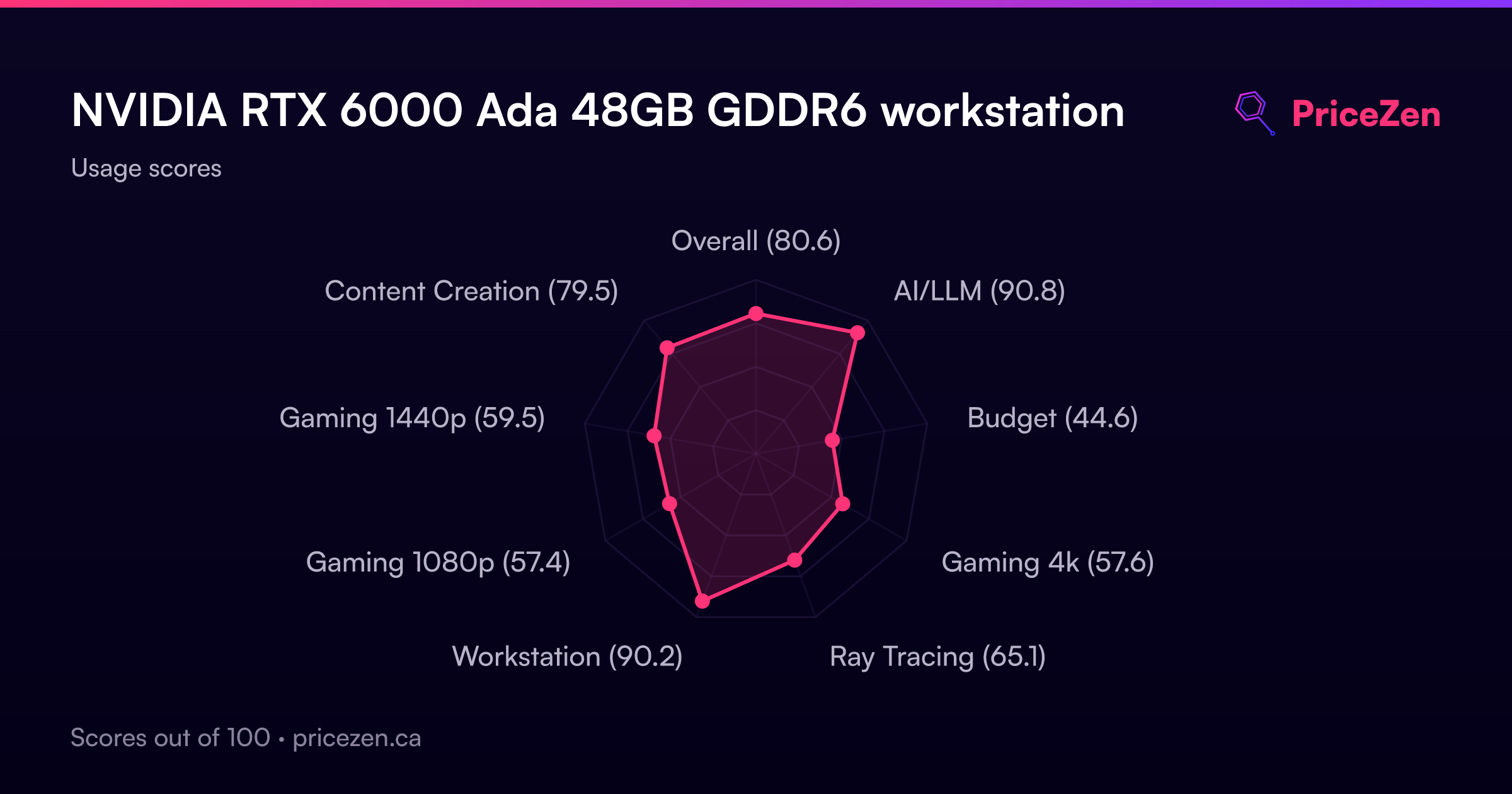
Usage Scores
- Overall80.6
- AI/LLM90.8
- Budget44.6
- Gaming 4k57.6
- Ray Tracing65.1
- Workstation90.2
- Gaming 1080p57.4
- Gaming 1440p59.5
- Content Creation79.5