Gigabyte Radeon RX 9070 Gaming 16GB GDDR6 Black

Excellent 4K performance, cool under load verified Nov 29
82/100 overall score 4.5 average from 247 owner ratings
- GPU
- Radeon RX 9070
- VRAM
- 16GB GDDR6
- Boost clock
- 2520 MHz
- TDP
- 220 W
- Memory bus
- 256 bit
- Ray tracing
- Yes
- Class
- consumer
Compare prices at 4 stores
Cheapest first. New, refurbished and bundled offers are kept apart, so you compare like with like.
| Store | Sold by | Colour and condition | Price | vs lowest | Last checked | Link |
|---|---|---|---|---|---|---|
| New4 offersSingle unit | ||||||
| Not checked in the last 7 days, so these prices may have changed | ||||||
| Newegg | Newegg | Not listed | Price not confirmed | Not known | Go to store | |
| Out of stock when last checked | ||||||
| Canada Computers | Canada Computers | Not listed | No price | Out of stock | Not known | Go to store |
| B&H Photo | B&H Photo | Not listed | No price | Out of stock | Not known | Go to store |
| Amazon | Not known | Not listed | No price | Out of stock | 6 days ago | Go to store |
 Source: PriceZen, checked Nov 23, 2026
A price counts as current when we checked it in the last 7 days. “Marketplace seller” means a third-party seller on that store, not the store itself.




Snapshot
The 30-Second Version
The Gigabyte Radeon RX 9070 Gaming is a 16GB RDNA 4 graphics card that delivers strong 4K gaming, class-leading cooling and excellent owner satisfaction at 4.5/5. Ray tracing is only average and pricing swings from USD 605 to USD 972, so buy it at the low end and it's a superb value.
Pros & Cons
Pros
- 16GB GDDR6 with 645 GB/s bandwidth, plenty for 4K textures 96th
- Cooling ranks among the best we track; owners report sub-75C even overclocked 92nd
- Strong value score (86.2) and very happy owners (4.5/5 across 474 reviews) 82nd
- Good overclocking and undervolting headroom according to buyers 81st
- Modern I/O: PCIe 5.0 x16, dual DP 2.1a and dual HDMI 2.1b
Cons
- Ray tracing performance is only about average for the class
- AI/LLM work is its weakest area in our scoring
- Some owners report noticeable fan noise under load
- 288mm long and 2.5 slots wide, so check your case clearance
- Price spread is wild, and the cheapest listings aren't always in stock
What owners think
The Word on the Street
- Owners repeatedly praise the jump in 4K performance, especially those escaping 8GB cards, and many say it matches or beats their old Nvidia setup.
- Buyers consistently highlight how cool the card runs and how well it responds to undervolting and overclocking, with reports of staying under 75 degrees at full load.
- A recurring complaint is fan noise under load and Gigabyte's quirky software, though several owners say the noise fades after a break-in period.
How owner sentiment changed over time
ExclusiveBased on when customers actually wrote their reviews - so you can see whether early praise held up.
10 written reviews, Mar 2025 – May 2026: 10 happy
Across all 247 store ratings: 4.5★. Most owners rate without writing a review. The chart counts the 10 written reviews.
- Apr – Jun 20253 of 3 happy
Buyers in Q2 2025 praised the card's performance, build quality, and drivers, with one noting it rivals the 5070 Ti after undervolting.
- Performance matches or exceeds Nvidia 5070 Ti with undervolt.
- Aorus model praised for best aesthetics among partner cards.
- Solid drivers, especially after recent Nvidia update.
- High build quality and strong recommendation from owners.
- Jan – Mar 20256 of 6 happy
Buyers praise the card's performance, value, and overclocking capability, with minor software quirks and a noise issue noted.
- Excellent performance and value, especially at MSRP, with significant upgrade from previous GPUs.
- Great overclocking potential with low temperatures and high boost clocks.
- Software can be quirky but manageable after familiarization.
- One report of fan noise requiring break-in or vertical mount.
Each dot is one written review, in the month it was written. Happy = 4-5★, mixed = 3★, unhappy = 1-2★. Period summaries are in English.
The proof
Performance
The external PassMark G3D benchmark score is 25398, which puts raw raster throughput in solid middle-of-the-pack territory for current desktop GPUs, not chart-topping. Compute is stronger: 36.13 FP32 TFLOPS and 72.25 FP16 TFLOPS land well above average, and the AI ranking is strong too, though our model still flags AI/LLM work as this card's weakest area at 66.3. Ray tracing scores about average, so heavy RT titles are where you'll feel the ceiling first. For plain rasterized gaming at 1080p and 4K, owners consistently describe it as fast, and several say an undervolt or mild overclock unlocks noticeably more headroom without cooking the card.
Thermals are the standout. Cooling ranks among the best on the market, helped by that triple-fan setup, composite copper heat pipes and a large copper plate. One owner reports staying under 75 degrees while overclocked at full utilization. Efficiency is strong as well for a 220W TDP card, although a few buyers still grumble about power draw compared to lower-wattage Nvidia options. Fan noise is the flip side: some owners say it can get loud under load, and a couple report it settling down after a break-in period.
Specifications
Full Specifications
Chipset
| GPU Chipset | Radeon RX 9070 |
| Brand | AMD |
| Architecture | RDNA 4 |
| Class | consumer |
| Process | 4 |
Memory
| VRAM | 16 GB |
| Memory Type | GDDR6 |
| Memory Bus | 256 |
| Bandwidth | 644.6 |
Compute
| Stream Processors | 3584 |
| Tensor Cores | 112 |
| RT Cores | 56 |
| Base Clock | 2070 |
| Boost Clock | 2520 |
| FP16 TFLOPS | 72.25 |
| FP32 TFLOPS | 36.13 |
Performance
| PassMark G3D | 25398 |
| GPU Compute | 14794 |
Power & Cooling
| TDP | 220 |
| Recommended PSU | 750 |
| Power Connectors | 2 x 8-Pin |
| Cooler | Triple Fan |
| Fans | 3 |
Connectivity
| Interface | PCI Express 5.0 x16 |
| DisplayPort | 2 |
| HDMI | 2 |
| Max Displays | 4 |
| Max Resolution | 7680 x 4320 |
Physical
| Length | 288 |
| Slot Width | 2.5 |
| Form Factor | Full Height |
Features
| Ray Tracing | Yes |
| VR Ready | Yes |
| DirectX | 12 |
| RGB | Yes |
vs Competition
Against the MSI GeForce RTX 5070 Ti Ventus 3X OC and the PNY GeForce RTX 5070 Ti OC, the argument here is memory and price. This card brings 16GB of GDDR6 and a 256-bit bus, and several owners who switched from Nvidia say they're getting comparable frame rates with better driver behavior lately. Where the 5070 Ti options pull ahead is ray tracing, since RT is only about average on this card in our rankings. If you play RT-heavy titles at high settings, cross-shop those two seriously.
The ASUS GeForce RTX 5080 PRIME EVO OC and ZOTAC GeForce RTX 5080 APOCALYPSE are a tier up in ambition, and this card's mid-pack raster ranking means it isn't chasing them. Buy those if you want the fastest thing you can get and budget isn't the constraint. The Sapphire Radeon RX 7900 XTX NITRO+ is the interesting in-family fight: if you find it near the same money, compare carefully, but the RX 9070's newer RDNA 4 design, strong efficiency ranking and best-in-class owner sentiment make it the easier recommendation for most people.
| Spec | Gigabyte Radeon RX 9070 Gaming | ASUS GeForce RTX 5080 PRIME EVO OC | MSI GeForce RTX 5070 Ti Ventus 3X OC | ZOTAC GeForce RTX 5080 APOCALYPSE | PNY GeForce RTX 5080 ARGB OC | Sapphire Radeon RX 7900 XTX NITRO+ |
|---|---|---|---|---|---|---|
| Chipset | Radeon RX 9070 | GeForce RTX 5080 | GeForce RTX 5070 Ti | GeForce RTX 5080 | GeForce RTX 5080 | Radeon RX 7900 XTX |
| Vram | 16GB GDDR6 | 16GB GDDR7 | 16GB GDDR7 | 16GB GDDR7 | 16GB GDDR7 | 24GB GDDR6 |
| Boost Clock Mhz | 2520 | 2685 | 2482 | 2730 | 2620 | 2680 |
| Tdp W | 220 | 360 | 300 | 360 | 360 | 339 |
| Memory Bus Bits | 256 | 256 | 256 | 256 | 256 | 384 |
| Ray Tracing | Yes | Yes | Yes | Yes | Yes | Yes |
| GPU Class | consumer | consumer | consumer | consumer | consumer | consumer |
| Compare | Compare | Compare | Compare | Compare |
| Product | AI | Rt | Vram | Raster | Compute | Feature | User Sentiment | Efficiency | Connectivity | Social Proof | Affordability |
|---|---|---|---|---|---|---|---|---|---|---|---|
| Gigabyte Radeon RX 9070 Gaming | 81.5 | 63.8 | 75.1 | 67.4 | 77.4 | 51.9 | 96 | 80.6 | 76 | 75.1 | 47.1 |
| ASUS GeForce RTX 5080 PRIME EVO OC Compare | 85.5 | 97.7 | 89.1 | 94.5 | 93.3 | 88.4 | 71.1 | 56.6 | 94.2 | 93.7 | 19.4 |
| MSI GeForce RTX 5070 Ti Ventus 3X OC Compare | 78.9 | 92.4 | 85.9 | 88.9 | 87.8 | 95.7 | 85 | 71.6 | 94.2 | 84.1 | 21.2 |
| ZOTAC GeForce RTX 5080 APOCALYPSE Compare | 85.5 | 97.7 | 89.1 | 94.5 | 93.3 | 95.7 | 99.5 | 56.6 | 94.2 | 98.8 | 23.7 |
| PNY GeForce RTX 5080 ARGB OC Compare | 85.5 | 97.7 | 89.1 | 94.5 | 93.3 | 95.7 | 71.1 | 56.6 | 94.2 | 75.1 | 16.1 |
| Sapphire Radeon RX 7900 XTX NITRO+ Compare | 95.3 | 96.4 | 92 | 83.4 | 95.6 | 95.7 | 85 | 51.3 | 98.8 | 69.5 | 13.6 |
Price
Value & Pricing
This is where the card makes its case. Our budget score of 86.2 is one of its strongest numbers, and affordability sits around the middle of the pack rather than at the top, mostly because pricing is messy right now. In the US we track a USD 367 spread across listings, from USD 605 to USD 972, and the only in-stock single-unit listing we currently see is Newegg at USD 972, which is the expensive end of that range. In Canada the spread is CAD 131, from CAD 799 to CAD 930. We watch these prices over time, partly through our community browser extension, and the advice is simple: at the low end this is a great buy, at USD 972 you should cross-shop the RTX 5070 Ti cards before pulling the trigger.
Price history
Read more
Overview
The Gigabyte Radeon RX 9070 Gaming (GV-R9070GAMING-16GD) is a desktop graphics card built on AMD's RDNA 4 architecture, and it sits in the upper-mid price bracket: listings we track run from USD 605 to USD 972 in the US, and CAD 799 to CAD 930 in Canada. You get 16GB of GDDR6 on a 256-bit bus pushing 645 GB/s, 3584 stream processors, 56 ray tracing cores and a boost clock up to 2520 MHz. That's a lot of card for the money, and our scoring model agrees: it lands at 81.2 overall with an 86.2 for budget value.
So is the RX 9070 good for gaming? Yes, and comfortably so. Owners upgrading from older 8GB cards report that 4K stops being a slideshow once VRAM stops being the bottleneck, which is exactly what 16GB buys you. The card is 288mm long and takes 2.5 slots, uses two 8-pin power connectors and wants a 750W PSU, so it's not a tiny thing, but it's not a monster either. Triple-fan WINDFORCE cooling, RGB lighting, two DisplayPort 2.1a and two HDMI 2.1b outputs round it out.
We collect specs, prices and owner reviews from multiple stores with our own automated system and rank every card against the rest of its category. Nobody pays us to like anything. And on this one, owners are unusually happy: sentiment sits in the 96th percentile of everything we track, with a 4.5/5 average across 474 reviews.
Common Questions
Q: Is the Gigabyte RX 9070 Gaming good for 4K gaming?
Yes. The 16GB of GDDR6 and 645 GB/s of bandwidth give it plenty of room for 4K textures, and owners upgrading from 8GB cards report big frame rate gains at that resolution.
Q: What power supply do I need for the RX 9070 Gaming?
Gigabyte recommends a 750W PSU, and the card draws up to 220W through two 8-pin connectors, so no adapter cables are needed.
Q: Will the RX 9070 Gaming fit in my case and motherboard?
It's 288mm long and 2.5 slots thick, so measure your case first. It uses a PCI Express 5.0 x16 interface and works fine in older PCIe 4.0 and 3.0 slots too.
Q: How does the RX 9070 compare to the RTX 5070 Ti?
Owners who've used both report similar gaming performance, and this card's 16GB of VRAM and strong value score make it competitive. The RTX 5070 Ti is the safer pick if ray tracing matters most to you, since RT is only about average here.
Who Should Skip This
Skip this card if ray tracing is your main event, since its RT ranking is only middling and the MSI GeForce RTX 5070 Ti Ventus 3X OC or PNY GeForce RTX 5070 Ti OC are better fits there. It's also not the pick for local AI or LLM tinkering, which is its weakest scored area. Small-form-factor builders should look elsewhere too: 288mm and 2.5 slots won't squeeze into a compact case. And if you want maximum raster horsepower regardless of cost, the ASUS GeForce RTX 5080 PRIME EVO OC is the card to chase instead.
Verdict
Should you buy the Gigabyte RX 9070 Gaming? If you're gaming at 1440p or 4K, coming off an 8GB card, and you can find it near the bottom of that USD 605 to USD 972 range, yes. It's fast, it runs cool, owners love it, and 16GB of VRAM means you won't be shopping again in two years because textures outgrew your card.
At USD 972 it's a harder sell, and heavy ray tracing fans or anyone doing local LLM work should look elsewhere. But as a straightforward gaming GPU with excellent owner feedback and real overclocking headroom, this is one of the easier recommendations in our rankings right now.
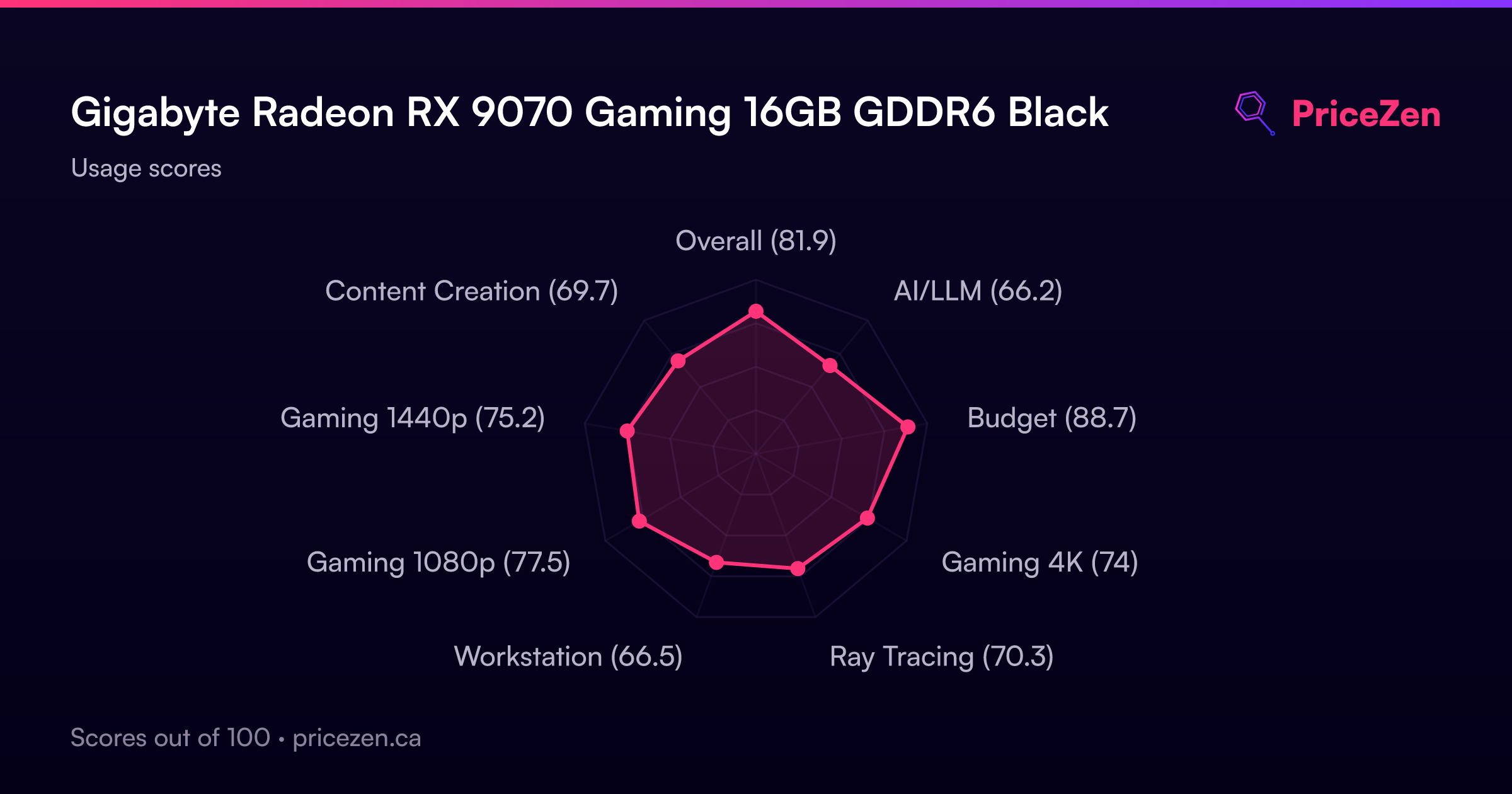
Usage Scores
- Overall81.9
- AI/LLM66.2
- Budget88.7
- Gaming 4K74
- Ray Tracing70.3
- Workstation66.5
- Gaming 1080p77.5
- Gaming 1440p75.2
- Content Creation69.7