MSI GeForce RTX 3070 Ventus LHR 2X OC 8GB GDDR6 Black

Ray tracing on tap, VR ready verified Nov 29
60/100 overall score 4.6 average from 573 owner ratings
- GPU
- GeForce RTX 3070
- VRAM
- 8GB GDDR6
- Boost clock
- 1755 MHz
- TDP
- 220 W
- Memory bus
- 256 bit
- Ray tracing
- Yes
- Class
- consumer
Compare prices at 2 stores
Cheapest first. New, refurbished and bundled offers are kept apart, so you compare like with like.
| Store | Sold by | Colour and condition | Price | vs lowest | Last checked | Link |
|---|---|---|---|---|---|---|
| New2 offersSingle unit | ||||||
| Not checked in the last 7 days, so these prices may have changed | ||||||
| Amazon | Marketplace seller | Not listed | CA$1,090.00 | Nov 20 | Go to store | |
| Newegg | Marketplace seller | Not listed | CA$1,107.99 | Nov 3 | Go to store | |
| Refurbished and renewed2 offersNot new: condition and warranty vary by seller | ||||||
| Not checked in the last 7 days, so these prices may have changed | ||||||
| Newegg | Marketplace seller | Refurbished | CA$990.00 | Nov 21 | Go to store | |
| Out of stock when last checked | ||||||
| Newegg | Newegg | Refurbished | No price | Out of stock | 6 days ago | Go to store |
 Source: PriceZen, checked Nov 23, 2026
A price counts as current when we checked it in the last 7 days. “Marketplace seller” means a third-party seller on that store, not the store itself.
Price history
Checked that dayNot checked that day, still on offer
Source: PriceZen, checked Nov 21, 2026











Snapshot
The 30-Second Version
A compact, well-liked RTX 3070 that scores 84.7/100 for budget value. The 8GB VRAM and warm dual-fan cooler are the trade-offs. Worth buying at the lower end of its price range for 1080p gaming.
Pros & Cons
Pros
- Compact 232mm length fits tight builds without sag complaints from owners. 84th
- Strong budget score of 84.7 makes it one of the better value picks we track. 68th
- DLSS and ray tracing support keep it relevant for modern games. 66th
- 4.6/5 from 573 owners is genuinely strong social proof.
Cons
- 8GB VRAM falls behind most current cards and limits future headroom.
- Dual-fan cooler runs hot unless you tweak the fan curve yourself.
- AI and LLM performance is a weak spot at 29.5/100.
- CAD pricing swings wildly from CAD 464 to CAD 1,108 across listings.
What owners think
The Word on the Street
- Multiple owners praise the compact size and say it fits smaller cases where longer cards simply won't go.
- Several buyers highlight strong value for the price, especially after waiting out inflated GPU pricing.
- A common theme is that temperatures hit the mid-80s under load unless you manually adjust the fan curve in software like MSI Afterburner.
How owner sentiment changed over time
ExclusiveBased on when customers actually wrote their reviews - so you can see whether early praise held up.
21 written reviews, Nov 2020 – May 2026: 20 happy, 1 without stars
Across all 573 store ratings: 4.6★. Most owners rate without writing a review. The chart counts the 21 written reviews.
Each dot is one written review, in the month it was written. Happy = 4-5★, mixed = 3★, unhappy = 1-2★.
The proof
Performance
The PassMark G3D benchmark score of 22099 puts raster performance right around the middle of the pack, which is fine for 1080p and decent at 1440p with DLSS helping out. Ray tracing sits above average thanks to those 40 RT cores, and the 15.97 TFLOPS of FP32 compute is respectable. But here's the catch: 8GB of VRAM ranks below most cards we track, and that ceiling shows up in newer titles with heavy textures. The dual-fan cooler keeps things compact, but owners report temps climbing to 85C without a custom fan curve. At 220W TDP with a 650W PSU recommendation and two 8-pin connectors, power demands are reasonable. Efficiency lands slightly above average in our rankings.
Specifications
Full Specifications
Chipset
| GPU Chipset | GeForce RTX 3070 |
| Brand | NVIDIA |
| Architecture | Ampere |
| Class | consumer |
| Process | 8 |
Memory
| VRAM | 8 GB |
| Memory Type | GDDR6 |
| Memory Bus | 256 |
| Bandwidth | 448 |
Compute
| CUDA Cores | 5888 |
| Tensor Cores | 160 |
| RT Cores | 40 |
| Base Clock | 1755 |
| Boost Clock | 1755 |
| FP16 TFLOPS | 15.97 |
| FP32 TFLOPS | 15.97 |
Performance
| PassMark G3D | 22099 |
| GPU Compute | 11026 |
Power & Cooling
| TDP | 220 |
| Recommended PSU | 650 |
| Power Connectors | 2 x 8-Pin |
| Cooler | Dual Fan |
| Fans | 2 |
Connectivity
| Interface | PCI Express 4.0 |
| DisplayPort | 3 |
| HDMI | 1 |
| Max Displays | 4 |
| Max Resolution | 7680 x 4320 |
Physical
| Length | 232 |
| Slot Width | 2.9 |
| Form Factor | Full Height |
| Weight | 1.3 kg / 2.8 lbs |
Features
| Ray Tracing | Yes |
| Upscaling | DLSS |
| AV1 Encode | No |
| VR Ready | Yes |
| DirectX | 12 Ultimate |
| RGB | No |
vs Competition
Against the current field, this card is showing its age but still has a niche. The Gigabyte RTX 5070 Ti Eagle Ice and ASUS RTX 5080 PRIME EVO OC are newer-generation cards that'll outrun it in raw performance, and the Sapphire RX 7900 XTX NITRO+ brings more VRAM to the table. The ZOTAC RTX 5080 APOCALYPSE and PNY RTX 5080 ARGB OC also sit higher in our overall rankings. But none of that matters if your budget tops out around USD 538. This MSI wins on price and compact size where those heavier hitters can't compete. Cross-shop the 5070 Ti if you can stretch your budget; stick with this if you can't.
| Spec | MSI GeForce RTX 3070 Ventus LHR 2X OC | Gigabyte GeForce RTX 5070 Ti Eagle Ice | ASUS GeForce RTX 5080 PRIME EVO OC | ZOTAC GeForce RTX 5080 APOCALYPSE | PNY GeForce RTX 5080 ARGB OC | Sapphire Radeon RX 7900 XTX NITRO+ |
|---|---|---|---|---|---|---|
| Chipset | GeForce RTX 3070 | GeForce RTX 5070 Ti | GeForce RTX 5080 | GeForce RTX 5080 | GeForce RTX 5080 | Radeon RX 7900 XTX |
| Vram | 8GB GDDR6 | 16GB GDDR7 | 16GB GDDR7 | 16GB GDDR7 | 16GB GDDR7 | 24GB GDDR6 |
| Boost Clock Mhz | 1755 | 2542 | 2685 | 2730 | 2620 | 2680 |
| Tdp W | 220 | 300 | 360 | 360 | 360 | 339 |
| Memory Bus Bits | 256 | 256 | 256 | 256 | 256 | 384 |
| Ray Tracing | Yes | Yes | Yes | Yes | Yes | Yes |
| GPU Class | consumer | consumer | consumer | consumer | consumer | consumer |
| Compare | Compare | Compare | Compare | Compare |
| Product | AI | Rt | Vram | Raster | Compute | Feature | Thermal | Efficiency | Connectivity | Social Proof | Affordability |
|---|---|---|---|---|---|---|---|---|---|---|---|
| MSI GeForce RTX 3070 Ventus LHR 2X OC | 36 | 67.9 | 37.4 | 55.2 | 44 | 65.6 | 54.2 | 61 | 54.6 | 84.1 | 58.3 |
| Gigabyte GeForce RTX 5070 Ti Eagle Ice Compare | 78.9 | 88.6 | 85.9 | 88.9 | 87.8 | 95.7 | 91.8 | 71.6 | 94.2 | 93.7 | 23 |
| ASUS GeForce RTX 5080 PRIME EVO OC Compare | 85.5 | 97.7 | 89.1 | 94.5 | 93.3 | 88.4 | 91.8 | 56.6 | 94.2 | 93.7 | 19.4 |
| ZOTAC GeForce RTX 5080 APOCALYPSE Compare | 85.5 | 97.7 | 89.1 | 94.5 | 93.3 | 95.7 | 91.8 | 56.6 | 94.2 | 98.8 | 23.7 |
| PNY GeForce RTX 5080 ARGB OC Compare | 85.5 | 97.7 | 89.1 | 94.5 | 93.3 | 95.7 | 91.8 | 56.6 | 94.2 | 75.1 | 16.1 |
| Sapphire Radeon RX 7900 XTX NITRO+ Compare | 95.3 | 96.4 | 92 | 83.4 | 95.6 | 95.7 | 91.8 | 51.3 | 98.8 | 69.5 | 13.6 |
Price
Value & Pricing
At USD 538, this card earns its budget badge. Our affordability ranking puts it slightly above average, and the budget score of 84.7 backs that up. Canadian buyers need to shop carefully though, because we've tracked prices ranging from CAD 464 to CAD 1,108 across four listings. That's a CAD 644 spread for the same card, so don't just click the first result. In Japan it sits at JPY 90,730. If you land it near the low end of any of those ranges, it's a smart buy for 1080p and casual 1440p gaming.
Read more
Overview
The MSI RTX 3070 Ventus 2X 8G OC LHR is a compact Ampere card that still pulls its weight for gaming. You get 5888 CUDA cores, 8GB of GDDR6 on a 256-bit bus, and a 1755MHz boost clock in a 232mm package. That's short enough to fit most cases without drama.
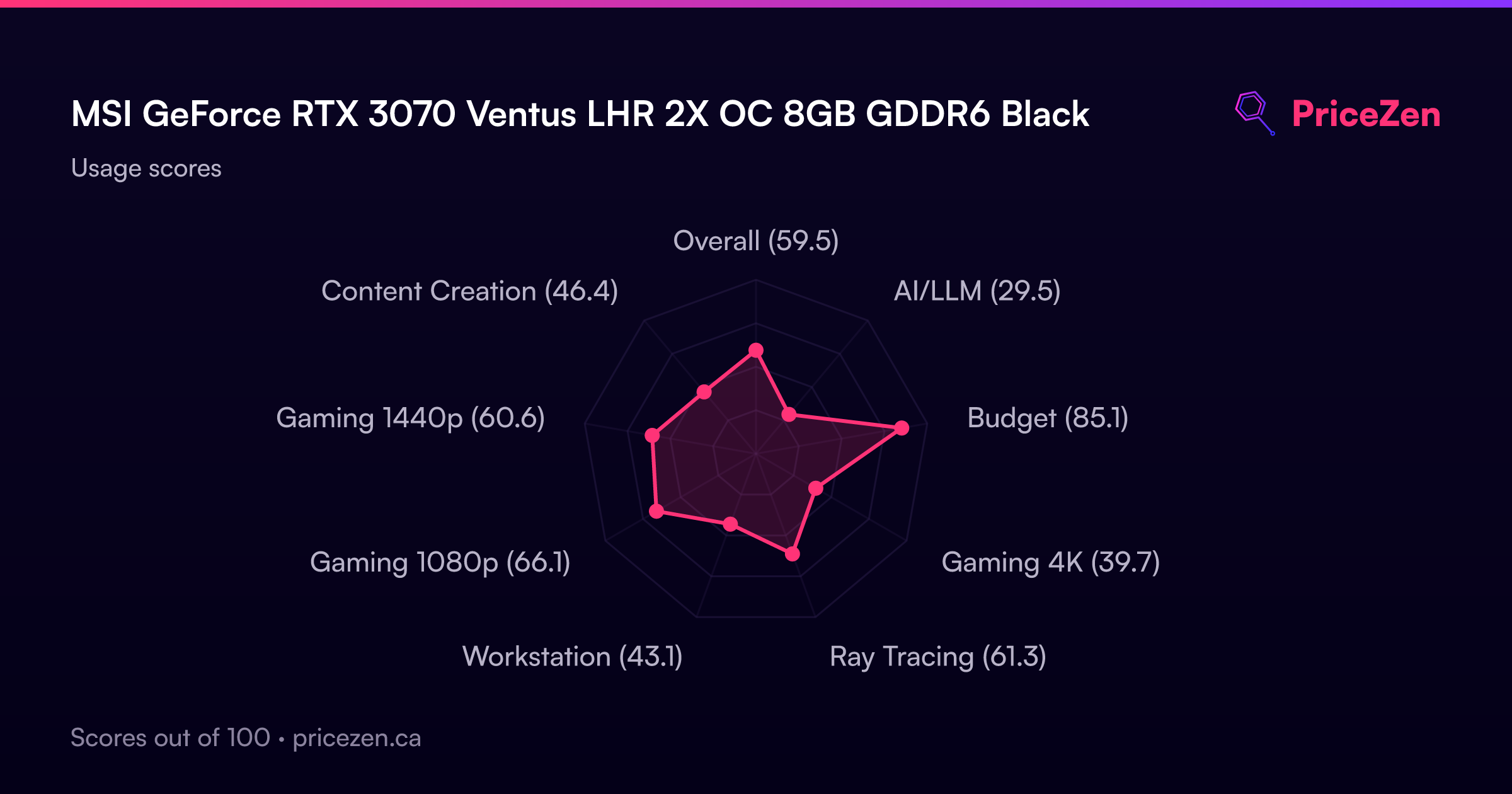
Our scoring model likes it best as a budget pick (84.7/100), with solid marks for 1080p gaming (66.2) and ray tracing (61.2). The weak spot is AI workloads at 29.5/100, which tracks with the 8GB VRAM sitting in the bottom half of the pack. Owners seem happy though: 4.6/5 across 573 reviews.
Common Questions
Q: Will 8GB of VRAM be enough for new games?
For 1080p, yes, most titles run fine. At 1440p with maxed textures, some newer games will push past 8GB, and our VRAM ranking puts this card below most of the current field.
Q: Does the dual-fan cooler keep it quiet and cool?
Owners report temps reaching 85C at stock fan settings, so plan to use MSI Afterburner to set a more aggressive curve. The trade-off for that 232mm compact size is less cooling headroom.
Q: What power supply do I need?
MSI recommends a 650W PSU, and the card draws 220W through two 8-pin connectors. Most mid-range builds from the last few years should handle it without an upgrade.
Who Should Skip This
If you're doing AI or LLM work locally, look elsewhere because the 29.5/100 AI score and 8GB VRAM will bottleneck you fast. Same story if you want to game at 4K or crank every texture slider to ultra in the latest releases. And if you refuse to touch fan curve software, the stock thermal behavior will annoy you.
Verdict
Buy this if you're building or upgrading a compact 1080p gaming rig on a real budget. It's got the ports (3x DP 1.4a, HDMI 2.1), the features (DLSS, ray tracing, VR ready), and the owner satisfaction to back it up. Just go in knowing the 8GB VRAM is a ticking clock for demanding new titles, and plan to set a custom fan curve on day one.
Usage Scores
- Overall59.5
- AI/LLM29.5
- Budget85.1
- Gaming 4K39.7
- Ray Tracing61.3
- Workstation43.1
- Gaming 1080p66.1
- Gaming 1440p60.6
- Content Creation46.4