Gigabyte GeForce RTX 4060 AERO 8GB GDDR6

RGB lighting to match your build verified Nov 29
47/100 overall score
- GPU
- GeForce RTX 4060
- VRAM
- 8GB GDDR6
- Boost clock
- 2460 MHz
- TDP
- 115 W
- Memory bus
- 128 bit
- Ray tracing
- Yes
- Class
- consumer
Compare prices at 1 store
Cheapest first. New, refurbished and bundled offers are kept apart, so you compare like with like.
| Store | Sold by | Colour and condition | Price | vs lowest | Last checked | Link |
|---|---|---|---|---|---|---|
| New1 offerSingle unit | ||||||
| Not checked in the last 7 days, so these prices may have changed | ||||||
| Newegg | Marketplace seller | Not listed | CA$1,099.99 | Nov 9 | Go to store | |
 Source: PriceZen, checked Nov 9, 2026
A price counts as current when we checked it in the last 7 days. “Marketplace seller” means a third-party seller on that store, not the store itself.
Snapshot
The 30-Second Version
The RTX 4060 AERO is a compact, extremely efficient 1080p card, with a 115W TDP and triple-fan cooling that put it near the top of our efficiency rankings. The trade-off is 8GB on a 128-bit bus and a 1440p score of 49.2/100, so it's a 1080p card and nothing more. We track it at CAD 1,100 at Newegg, with only one listing in our Canadian data. Buy it for a small, quiet 1080p build, ideally on a discount, and skip it for 1440p or AI work.
Pros & Cons
Pros
- Efficiency in the 98th percentile, 115W TDP with a 450W PSU recommendation 98th
- Triple WINDFORCE fans on a low-power chip give above-average thermal headroom 72nd
- Two HDMI plus two DisplayPort, more HDMI than most cards offer
- 281mm long and two slots thick, easy to fit in smaller cases
- DLSS 3 with frame generation, plus dual BIOS and a metal backplate
Cons
- 8GB on a 128-bit bus sits in the lower third of our VRAM ranking
- AI score of 23.9/100, the weakest area by a wide margin
- 1440p gaming score of 49.2/100 means compromises at that resolution
- Ray tracing performance falls behind the middle of the pack
- CAD 1,100 with only one store listing, so no price competition to shop
The proof
Performance
The PassMark G3D benchmark score of 19495 puts this card in the middle of the road for raw raster throughput, and our own scores agree: 57.8/100 for 1080p gaming and 49.2/100 for 1440p. Read that as a card that's happy at 1080p with sensible settings, and one you'll be compromising with at 1440p. Ray tracing sits below the midpoint of our rankings, so the 3rd-gen RT cores are there but they aren't a reason to buy this over something bigger. DLSS 3 with frame generation is the real lever here, and it's the feature that lets a card in this class punch above its native numbers in supported titles. Outside those titles, you're back to what 15.11 TFLOPS and 272 GB/s can actually do.
The other half of the story is memory and thermals. 8GB on a 128-bit bus lands in the lower third of our VRAM ranking, and that's the spec most likely to bite you first: texture-heavy games at high settings, 1440p, and anything resembling a large language model all want more than 8GB. Our AI score of 23.9/100 is the weakest thing about this card, full stop. On the flip side, 115W with a triple-fan cooler gives it a thermal ranking that's above average and an efficiency ranking near the very top of our data. A 450W PSU recommendation and a single 8-pin connector mean this drops into almost any existing build without a power supply upgrade, which is a real, practical win.
Specifications
Full Specifications
Chipset
| GPU Chipset | GeForce RTX 4060 |
| Brand | NVIDIA |
| Architecture | Ada Lovelace |
| Class | consumer |
| Process | 5 |
Memory
| VRAM | 8 GB |
| Memory Type | GDDR6 |
| Memory Bus | 128 |
| Bandwidth | 272 |
Compute
| CUDA Cores | 3072 |
| Tensor Cores | 4 |
| RT Cores | 3 |
| Base Clock | 1830 |
| Boost Clock | 2460 |
| FP16 TFLOPS | 15.11 |
| FP32 TFLOPS | 15.11 |
Performance
| PassMark G3D | 19495 |
| GPU Compute | 9163 |
Power & Cooling
| TDP | 115 |
| Recommended PSU | 450 |
| Power Connectors | 8-Pin |
| Cooler | Triple Fan |
| Fans | 3 |
Connectivity
| Interface | PCI Express 4.0 x8 |
| DisplayPort | 2 |
| HDMI | 2 |
| Max Displays | 4 |
| Max Resolution | 7680 x 4320 |
Physical
| Length | 281 |
| Slot Width | 2 |
| Form Factor | ATX |
Features
| Ray Tracing | Yes |
| Upscaling | DLSS 3 |
| DirectX | 12 |
| RGB | Yes |
vs Competition
The competitor set in our data is brutal for this card. The ASUS GeForce RTX 5080 PRIME EVO OC, ZOTAC GeForce RTX 5080 APOCALYPSE and PNY GeForce RTX 5080 ARGB OC all sit a tier or two above where this card's raster and ray tracing rankings land, and the MSI GeForce RTX 5070 Ti Ventus 3X OC is the one we'd tell most 1440p gamers to cross-shop first. Against any of them, the AERO gives ground on raw throughput, on ray tracing, and especially on memory: 8GB in the lower third of our VRAM ranking is not a spec that ages gracefully. The Sapphire Radeon RX 7900 XTX NITRO+ is the other name worth putting on your shortlist if you're shopping for outright performance rather than a compact, low-draw card.
Where the Gigabyte wins is everything those bigger cards can't claim. A 115W TDP, a 450W PSU recommendation, one 8-pin connector, 281mm of length and two slots of thickness make this the card you pick when the case, the power supply or the electricity meter is the constraint. Its efficiency ranking is near the top of our entire dataset, and that's not a consolation prize, it's a genuine design advantage. So the split is clean: if you're building around a big performance target, look at the 5070 Ti or 5080 options and the 7900 XTX. If you're building around a small case and a modest PSU at 1080p, this is the one that fits without drama.
| Spec | Gigabyte GeForce RTX 4060 AERO | ASUS GeForce RTX 5080 PRIME EVO OC | MSI GeForce RTX 5070 Ti Ventus 3X OC | ZOTAC GeForce RTX 5080 APOCALYPSE | PNY GeForce RTX 5080 ARGB OC | Sapphire Radeon RX 7900 XTX NITRO+ |
|---|---|---|---|---|---|---|
| Chipset | GeForce RTX 4060 | GeForce RTX 5080 | GeForce RTX 5070 Ti | GeForce RTX 5080 | GeForce RTX 5080 | Radeon RX 7900 XTX |
| Vram | 8GB GDDR6 | 16GB GDDR7 | 16GB GDDR7 | 16GB GDDR7 | 16GB GDDR7 | 24GB GDDR6 |
| Boost Clock Mhz | 2460 | 2685 | 2482 | 2730 | 2620 | 2680 |
| Tdp W | 115 | 360 | 300 | 360 | 360 | 339 |
| Memory Bus Bits | 128 | 256 | 256 | 256 | 256 | 384 |
| Ray Tracing | Yes | Yes | Yes | Yes | Yes | Yes |
| GPU Class | consumer | consumer | consumer | consumer | consumer | consumer |
| Compare | Compare | Compare | Compare | Compare |
| Product | AI | Rt | Vram | Raster | Compute | Feature | Thermal | Efficiency | Connectivity | Affordability |
|---|---|---|---|---|---|---|---|---|---|---|
| Gigabyte GeForce RTX 4060 AERO | 27.6 | 38.5 | 31.2 | 42.1 | 36.7 | 59.6 | 71.8 | 97.6 | 38.9 | 54.8 |
| ASUS GeForce RTX 5080 PRIME EVO OC Compare | 85.5 | 97.7 | 89.1 | 94.5 | 93.3 | 88.4 | 91.8 | 56.6 | 94.2 | 19.3 |
| MSI GeForce RTX 5070 Ti Ventus 3X OC Compare | 78.9 | 92.4 | 85.9 | 88.9 | 87.8 | 95.7 | 91.8 | 71.6 | 94.2 | 21.1 |
| ZOTAC GeForce RTX 5080 APOCALYPSE Compare | 85.5 | 97.7 | 89.1 | 94.5 | 93.3 | 95.7 | 91.8 | 56.6 | 94.2 | 23.6 |
| PNY GeForce RTX 5080 ARGB OC Compare | 85.5 | 97.7 | 89.1 | 94.5 | 93.3 | 95.7 | 91.8 | 56.6 | 94.2 | 16.1 |
| Sapphire Radeon RX 7900 XTX NITRO+ Compare | 95.3 | 96.4 | 92 | 83.4 | 95.6 | 95.7 | 91.8 | 51.3 | 98.8 | 13.6 |
Price
Value & Pricing
At CAD 1,100 from Newegg, this is a card you buy for its efficiency and its size, not for frames per dollar. Our budget score of 73.6/100 is respectable, but the affordability percentile is only around the midpoint of our data, which tells you the price is fair rather than exciting. The 1080p score of 57.8/100 is the honest measure of what you're paying for, and if your goal is maximum frame rate per dollar, that combination should give you pause.
We only have one Canadian listing in our system right now, so there's no cross-store spread to play and no cheaper retailer to point you toward. That matters: with a single seller, you don't get the usual pressure that drags a price down over time. Our advice is to watch it rather than rush. If it dips meaningfully below CAD 1,100, the efficiency and compact cooling start to look like a genuinely good deal for a small-form-factor 1080p build. At full ask, it's a niche pick.
We started tracking prices for this product on Nov 9, 2026. The chart appears once we have more data.
Read more
Overview
The Gigabyte GeForce RTX 4060 AERO is the white-and-silver take on NVIDIA's entry-level Ada Lovelace card, and it's aimed squarely at people building a tidy 1080p machine rather than chasing frame rate records. Under the shroud you get 3072 CUDA cores boosting to 2460MHz, 8GB of GDDR6 on a 128-bit bus pushing 272 GB/s, and a 15.11 TFLOPS FP32 figure. That's a modest card by current standards, and our scoring model treats it that way: solid for budget builds, middle of the pack for 1080p gaming, and clearly out of its depth once you start asking about local AI work.
What makes it interesting isn't the silicon, it's the packaging. Three WINDFORCE fans on a 115W TDP chip is a lot of cooler for very little heat, plus you get RGB Fusion, dual BIOS and a metal backplate on a 281mm, two-slot card. The output layout is unusual too: two DisplayPort and two HDMI, which is handy if your setup leans on HDMI displays or a TV. And the efficiency story is genuinely excellent, sitting in the 98th percentile against everything else in our GPU data. If your case is small, your PSU is modest, or your power bill matters, that number counts for more than a benchmark chart.
The catch is price. We track this card at CAD 1,100 at Newegg, and that's the only listing in our Canadian data right now. Our affordability ranking lands at about average, and the budget score of 73.6/100 is doing a lot of heavy lifting relative to how the card actually performs. So this is a review about a very efficient, very well-cooled 1080p card that needs to be bought at the right price to make sense.
Common Questions
Q: Is 8GB of VRAM enough, or will I regret it?
For 1080p with sensible settings, 8GB is workable, and that's exactly where this card's gaming score of 57.8/100 sits. But 8GB on a 128-bit bus lands in the lower third of our VRAM ranking, and at 1440p or with maxed-out textures you'll be turning things down. If you plan to keep this card for years and move up a resolution, more memory should be your first priority.
Q: Will it fit my case and power supply?
Almost certainly. It's 281mm long, two slots thick, and draws 115W with a single 8-pin connector, with a 450W PSU recommendation. That's about as friendly as a modern GPU gets for older prebuilts and small cases, and the triple-fan cooler contributes to an above-average thermal ranking in our data.
Q: Can I use it for running local AI models?
We'd say no. Our AI score for this card is 23.9/100, its weakest result by far, and the AI percentile sits well down our rankings. The 8GB buffer and 272 GB/s of bandwidth are the limiting factors, and 15.11 TFLOPS of FP16 compute won't rescue you. If local models are the goal, shop for memory capacity first.
Q: Does DLSS 3 make it viable at 1440p?
It helps in supported games, and frame generation is the single biggest lever this card has. But our 1440p score of 49.2/100 reflects native capability, and ray tracing sits below the midpoint of our rankings too. Treat DLSS 3 as a bonus at 1080p rather than a fix for a resolution this card wasn't built for.
Who Should Skip This
Skip this if you're gaming at 1440p or planning to. A 49.2/100 score at that resolution and 8GB of VRAM in the lower third of our rankings mean you'll be dialing settings back constantly, and the MSI GeForce RTX 5070 Ti Ventus 3X OC is the first name we'd put on your list instead. Same story if ray tracing is your thing, since this card's RT ranking falls behind the middle of the pack.
Also skip it if you want to run local AI models. The 23.9/100 AI score is the clearest signal in the whole dataset, and no amount of driver updates changes 8GB on a 128-bit bus. Look at the ASUS GeForce RTX 5080 PRIME EVO OC, ZOTAC GeForce RTX 5080 APOCALYPSE, PNY GeForce RTX 5080 ARGB OC or Sapphire Radeon RX 7900 XTX NITRO+ if raw capability is what you're after. And if you just want the most frames per dollar at any size or wattage, this card's efficiency advantage isn't the thing you're paying for.
Verdict
For a 1080p gamer with a compact case, an older or modest power supply, and a taste for white builds, this is an easy card to live with. The triple-fan cooler on a 115W chip means it should stay quiet and cool, the two HDMI outputs are unusually flexible, and DLSS 3 gives you a real escape hatch in demanding titles. Our 1080p score of 57.8/100 says it's competent rather than thrilling, and that's fine if your monitor is 1080p and your expectations are calibrated.
For anyone targeting 1440p, heavy ray tracing, or local AI, we'd steer you elsewhere. The 49.2/100 at 1440p and 23.9/100 for AI aren't gaps you can tweak away, and 8GB of VRAM is the wall you'll hit. At CAD 1,100 with a single retailer in our data, we'd also wait for a better price before pulling the trigger. Good card, specific job, needs the right price.
Usage Scores
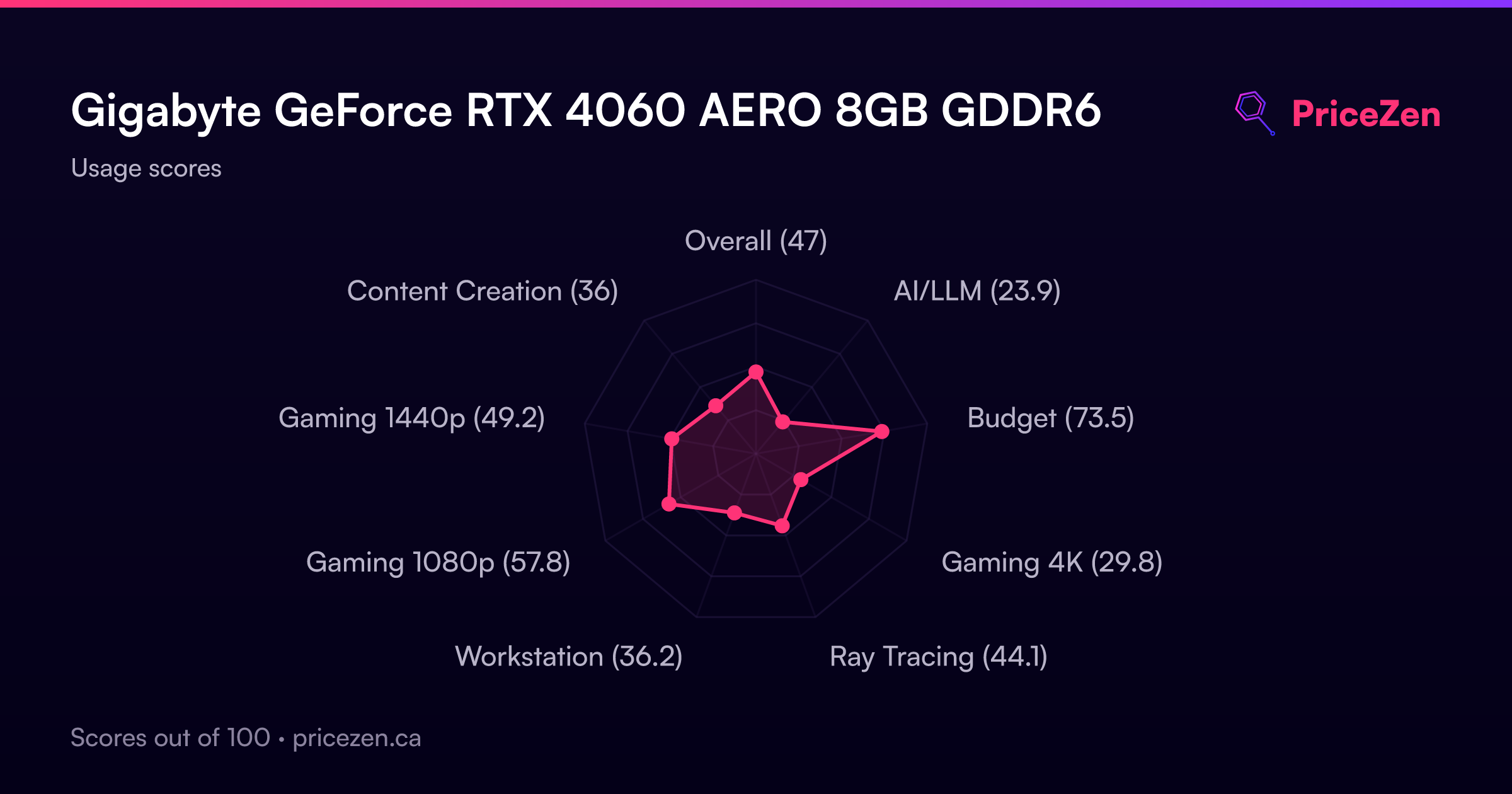
- Overall47
- AI/LLM23.9
- Budget73.5
- Gaming 4K29.8
- Ray Tracing44.1
- Workstation36.2
- Gaming 1080p57.8
- Gaming 1440p49.2
- Content Creation36