STORMCRAFT PHANTOM PH980XDCC-580N1 2026, Ryzen 7 9800X3D, 32GB, 2TB SSD, RTX 5080
The Ryzen 7 9800X3D processor with its 3D V-Cache and RTX 5080 16GB graphics deliver top-tier frame rates for high-refresh 4K gaming, cooled by a 360mm AIO liquid cooler. The 2TB Gen 4.0 NVMe SSD ensures near-instant load times, all housed in a premium case with a seamless tempered glass display. This system is best for competitive gamers and streamers who need maximum CPU and GPU performance without building their own rig.

No current retailer price
Snapshot
The 30-Second Version
The PHANTOM pairs a Ryzen 7 9800X3D with an RTX 5080 that ranks near the top, plus 32GB DDR5-6000 and a 2TB Gen 4 SSD, for $2,800 at Newegg. Owners love the gaming performance and out-of-box setup, rating it 4.3/5. But reliability ranks near the bottom and port selection even lower, so the parts are excellent while the trust signals aren't. Great pick for confident gamers, risky if you want a safe, boring purchase.
Pros & Cons
Pros
- RTX 5080 with 16GB VRAM ranks near the top of the category 97th
- Ryzen 7 9800X3D boosts to 5.2GHz and is a standout for high-refresh gaming 90th
- 32GB DDR5 at 6000MHz and a 2TB Gen 4 NVMe SSD both rank among the best configs we track 87th
- 360mm AIO plus seven ARGB fans, with owners reporting solid thermals 81st
- Arrives game-ready with Windows 11 Home, and buyers praise the out-of-box setup
Cons
- Reliability ranking sits near the bottom, a genuine weak spot
- Port selection ranks near the bottom, one of the worst in the category
- Eight CPU cores cap workstation value at 68.6/100
- Only one store carries it at $2,800, so there's no price competition to shop
- No independent benchmark data for this exact build, and one owner reported severe underperformance
What owners think
The Word on the Street
How owner sentiment changed over time
ExclusiveBased on when customers actually wrote their reviews - so you can see whether early praise held up.
6 written reviews, May 2026: 5 happy, 1 unhappy
Each dot is one written review, in the month it was written. Happy = 4-5★, mixed = 3★, unhappy = 1-2★.
The proof
Performance
The GPU is the headline. In our rankings the RTX 5080 config sits near the top of the charts among gaming desktops we track, and the 16GB of VRAM gives you room for heavy texture packs and 4K targets rather than bumping into memory limits. The 9800X3D lands well above average, and its 3D cache design is the reason owners keep talking about smooth frame pacing at 1440p high settings. Worth being clear about the trade-off: eight cores is plenty for games and light streaming, but it's why the workstation score drops to 68.6. Core-heavy rendering and encoding jobs will lean on the GPU instead of the CPU, and that's a real ceiling if you bill by the render.
Memory and storage back it up nicely. 32GB of DDR5 at 6000MHz ranks among the better configs on the market, and the 2TB Gen 4 NVMe drive sits near the top, so load times and library space aren't going to be your bottleneck any time soon. Cooling is handled by a 360mm AIO plus seven ARGB fans, and owners who asked about thermals and noise got pointed straight at that setup. Here's the honest caveat: there's no independent benchmark data attached to this specific build, so we're working from component-level scores and owner reports, not measured results. And one buyer posted a scathing 1-star review claiming extreme underperformance versus a lower-tier rig they'd used. One report isn't a trend, but with a reliability ranking that low, it's not something we'd wave away either.
Specifications
Full Specifications
Processor
| CPU | AMD RYZEN 7 9800X3D |
| Cores | 8 |
| Frequency | 4.7 GHz |
| L3 Cache | 96 MB |
Graphics
| GPU | NVIDIA GeForce RTX 5080 |
| Type | Discrete |
| VRAM | 16 GB |
| VRAM Type | GDDR7 |
Memory & Storage
| RAM | 32 GB |
| RAM Generation | DDR5 |
| Storage | 2 TB |
| Storage Type | NVMe SSD |
Build
| Form Factor | desktop |
| PSU | 850 |
System
| OS | Windows 11 Home |
vs Competition
Against the HP OMEN GT16-0364, ASUS ROG GM700 and Lenovo Legion Tower 5a Gen 10, the PHANTOM's argument is its parts sheet: a near-top GPU, an above-average gaming CPU, and top-tier RAM and storage. Those are the names to cross-shop if you want big-brand support behind similar money, because our reliability ranking for this STORMCRAFT sits near the bottom while port selection is even lower. If you plug in a lot of peripherals, capture gear, external drives and a wired headset all at once, that port score should worry you more than any frame rate difference.
The Dell Desktop ECT1250 is the odd one out here, and if your workload leans productivity rather than games, the PHANTOM's 68.6 workstation score suggests you'd be paying for graphics muscle you won't use. And the Apple Mac Studio M5 Max is a completely different philosophy: this STORMCRAFT is a Windows 11 gaming tower with a discrete RTX 5080 and user-visible RGB fans, so if you're buying for games and VR, the comparison barely starts. Where the PHANTOM gives ground is everything around the silicon: connectivity, service history and the confidence that comes with a household-name badge.
| Spec | STORMCRAFT PHANTOM PH980XDCC-580N1 | Apple Mac Studio M5 Max | Lenovo T Series Towers Legion Tower 5a Gen 10 | Dell Desktop ECT1250 | HP OMEN GT16-0364 | ASUS ROG GM700 |
|---|---|---|---|---|---|---|
| CPU | AMD RYZEN 7 9800X3D | Apple M5 Max | AMD Ryzen 7 7800X3D | Intel Core Ultra 7 265 | AMD Ryzen 7 8700F | AMD Ryzen 7 9800X3D |
| RAM (GB) | 32 | 36 | 32 | 32 | 32 | 32 |
| Storage (GB) | 2048 | 1024 | 4096 | 2048 | 1024 | 2048 |
| GPU | NVIDIA GeForce RTX 5080 | Apple (32-Core) | NVIDIA GeForce RTX 5070 Ti | Intel UHD Graphics | NVIDIA GeForce RTX 5070 | NVIDIA GeForce RTX 5070 Ti |
| Form Factor | desktop | mini | mid-tower | sff | mid-tower | mid-tower |
| Psu W | 850 | 480 | 850 | 180 | 850 | 850 |
| OS | Windows 11 Home | macOS | Windows 11 Home | Windows 11 Home | Windows 11 Home | Windows 11 Home |
| Compare | Compare | Compare | Compare | Compare |
| Product | CPU | GPU | RAM | Ports | Storage | User Sentiment | Reliability |
|---|---|---|---|---|---|---|---|
| STORMCRAFT PHANTOM PH980XDCC-580N1 | 80.5 | 97.4 | 87 | 5.3 | 90 | 75.9 | 11.6 |
| Apple Mac Studio M5 Max Compare | 95.7 | 85.1 | 92.4 | 88.9 | 68.8 | 95 | 99.3 |
| Lenovo T Series Towers Legion Tower 5a Gen 10 Compare | 73.4 | 94.6 | 77.9 | 88.3 | 98.1 | 95 | 70 |
| Dell Desktop ECT1250 Compare | 88.2 | 60.2 | 81.6 | 74.5 | 82.7 | 98.5 | 70 |
| HP OMEN GT16-0364 Compare | 69.5 | 90.8 | 87 | 97.9 | 53.4 | 98.5 | 70 |
| ASUS ROG GM700 Compare | 80.5 | 94.6 | 81.6 | 96 | 90 | 98.5 | 37.3 |
Price
Value & Pricing
At $2,800 from Newegg, you're paying for a GPU that ranks near the top and a CPU built specifically for gaming, plus memory and storage that both land in the top tier of our rankings. On pure parts-per-dollar, that's a defensible ask, and several owners say exactly that, calling out the component mix as strong for the money. One long-time system builder even praised the assembly quality and the QA checklist that shipped with the machine, which is the sort of detail boutique builders live or die on.
The catch is that we only have one listing in our price tracker, so there's no cross-store spread to hunt for a deal and no discount history to lean on. You're taking the sticker as-is. For a brand without a long track record, we'd want either a price edge or a stronger reliability signal to feel great about it, and right now the reliability ranking is the thing holding this back from being an easy recommendation.
Read more
Overview
STORMCRAFT isn't a name you see on every shelf, and that's kind of the point. The PHANTOM PH980XDCC-580N1 is a boutique-style gaming tower built around two parts that do most of the heavy lifting in modern games: AMD's Ryzen 7 9800X3D (8 cores, 4.7GHz base, up to 5.2GHz boost) and an RTX 5080 with 16GB of VRAM. Around that you get 32GB of DDR5 at 6000MHz, a 2TB Gen 4 NVMe SSD, a B850 board, a 360mm AIO, seven ARGB fans and an 850W 80+ Gold power supply, all wrapped in a tempered glass case with Windows 11 Home already installed. It's $2,800 at Newegg, which is the only listing we're tracking right now.
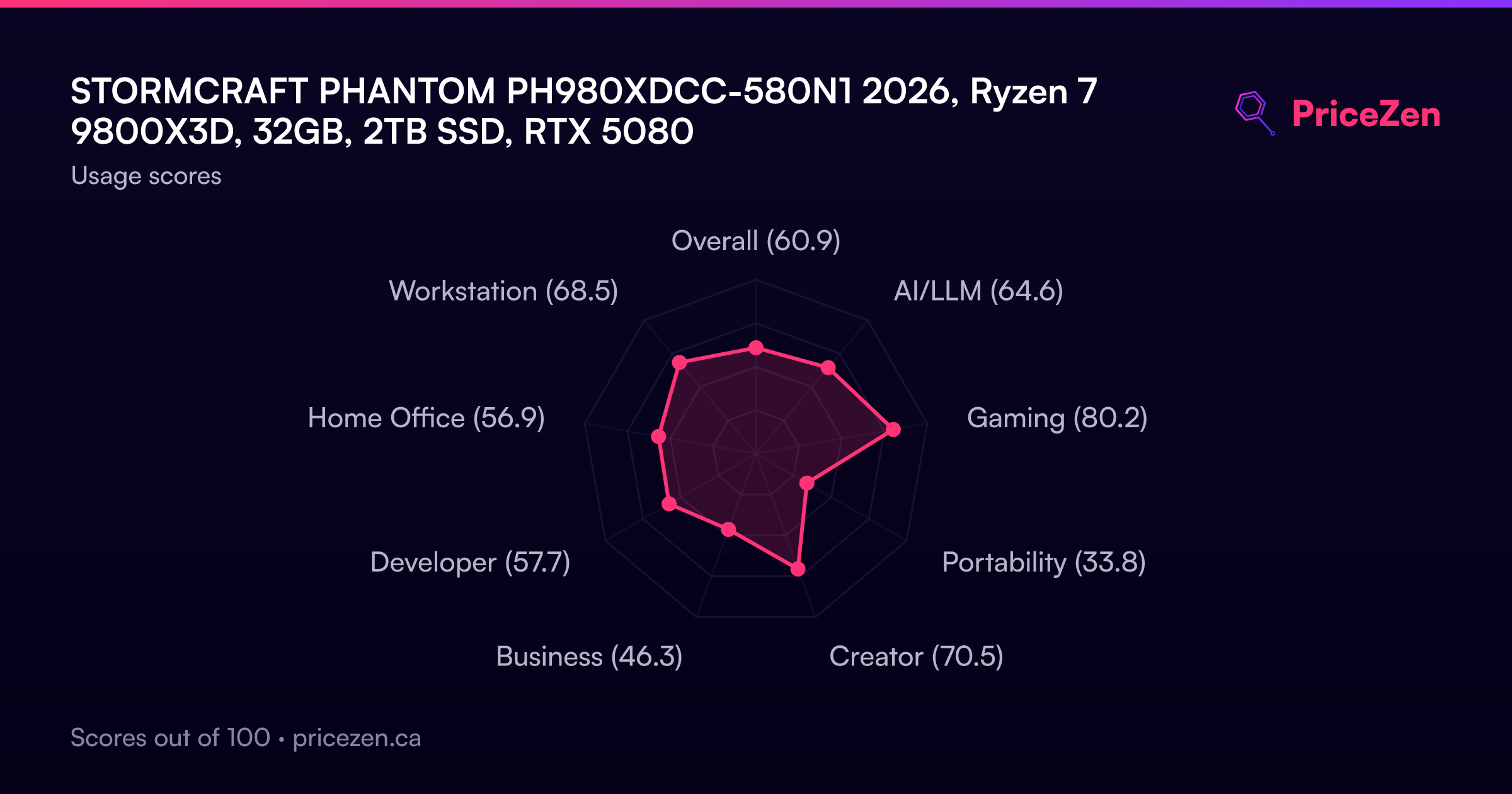
This is aimed squarely at someone who wants high-refresh 1440p or serious 4K gaming without picking parts themselves. Our scoring model puts it at 80.2/100 for gaming, 70.5 for creator work and 68.6 for workstation duty. That spread tells you exactly what it is: a gaming machine first, a competent side-hustle editor second. If your day job is compiling huge codebases or running simulations, the shape of this build isn't optimized for you.
What makes it interesting is the gap between how good the parts list looks and how thin the trust signals are. Owners rate it 4.3/5 across 24 reviews, and our distilled sentiment score sits at 85/100, though that's medium confidence off just 10 pieces of evidence. Meanwhile our reliability ranking has it near the bottom, and port selection lands even lower, which is one of the worst we've seen in this category. Great hardware, real questions about the boring stuff. That tension is the whole story here.
Common Questions
Q: Can it actually handle 1440p high refresh and 4K gaming?
That's exactly what it's built for. The RTX 5080 with 16GB of VRAM ranks near the top in our GPU standings, and the 9800X3D's 3D cache is a known quantity for high frame rates. Owners specifically report good results at 1440p on high settings, and our gaming score of 80.2/100 backs that up.
Q: Will it stay cool and quiet under load?
On paper it's well equipped: a 360mm AIO liquid cooler, seven ARGB fans and an 850W 80+ Gold PSU give it plenty of thermal and power headroom. Owners who asked about thermals were pointed to that setup and haven't raised widespread complaints. We don't have measured noise or temperature figures for this build, so treat that as promising rather than proven.
Q: Is 32GB of RAM and 2TB of storage enough, and can I add more later?
For gaming, comfortably. The 32GB DDR5-6000 kit ranks among the better configs and the 2TB Gen 4 NVMe drive near the top, so both are among the better configs in this category. It's on a B850 board, but owners have flagged that upgrade documentation is thin, so plan on checking clearance and slot availability yourself.
Q: Is it good for video editing and creative work?
It's capable rather than specialized. Our creator score is 70.5/100 and workstation is 68.6, which reflects an eight-core CPU that's tuned for games rather than heavy multithreaded rendering. The GPU and fast SSD help a lot in Premiere-style workflows, but if rendering is your paycheck, a higher-core-count machine is the smarter spend.
Who Should Skip This
Skip this if you need a machine you can forget about. Our reliability ranking puts it near the bottom, and when a boutique build with limited review volume also has a buyer reporting severe underperformance, that's a risk profile you should only accept knowingly. Same goes for anyone with a desk full of peripherals: the port selection ranks near the bottom, which is close to dead last in this category. Look at the HP OMEN GT16-0364, ASUS ROG GM700 or Lenovo Legion Tower 5a Gen 10 if support and connectivity matter more to you than squeezing out the last few frames.
Also skip it if your work is CPU-bound. Eight cores is a gaming choice, and the 68.6 workstation score reflects that. Heavy 3D rendering, big compiles and simulation work want more threads, and the Dell Desktop ECT1250 is worth a look for productivity-first buying. And if you're deep in Adobe workflows and want hard numbers before spending $2,800, the unanswered Premiere comparisons in the Q&A mean you'd be guessing. That's not a great place to be with this much money on the table.
Verdict
If you're a gamer chasing high-refresh 1440p or comfortable 4K, and you want to unbox, plug in and play, this thing makes a strong case. The 80.2 gaming score, the near-top-ranked GPU and consistent owner praise for out-of-box readiness all line up. VR buyers are covered too, with multiple owners confirming it's ready to go. Just go in knowing you're betting on a smaller builder, and check every port you need before you commit.
For creators it's a maybe. The 70.5 creator score means it'll handle editing and streaming fine, but the eight-core CPU and unanswered questions about Premiere performance versus rival machines mean we can't call it a purpose-built content box. For workstation buyers, skip it. And for anyone who's been burned by prebuilt QC before, that low reliability ranking plus the lone underperformance review is enough reason to look at the big-brand alternatives instead. Good hardware, cautious buy.
Usage Scores
- Overall60.9
- AI/LLM64.6
- Gaming80.2
- Portability33.8
- Creator70.5
- Business46.4
- Developer57.7
- Home Office56.9
- Workstation68.5