HP EliteDesk 8 G1i 2024, Core Ultra 9 285T, 32GB, 512GB SSD, Black
The Intel Core Ultra 9 285T 24-core CPU with built-in AI acceleration and 32GB of 5600MHz DDR5 memory powers multitasking in a 1.35kg chassis with Wi‑Fi 7. Dual empty M.2 PCIe 4.0 slots allow easy storage expansion, while Thunderbolt 4, HDMI 2.1, and quad USB‑A ports provide broad peripheral compatibility. This vPro‑ready mini PC suits developers and IT administrators handling code compiles, virtual machines, and office productivity in space‑constrained environments.

No current retailer price


Snapshot
The 30-Second Version
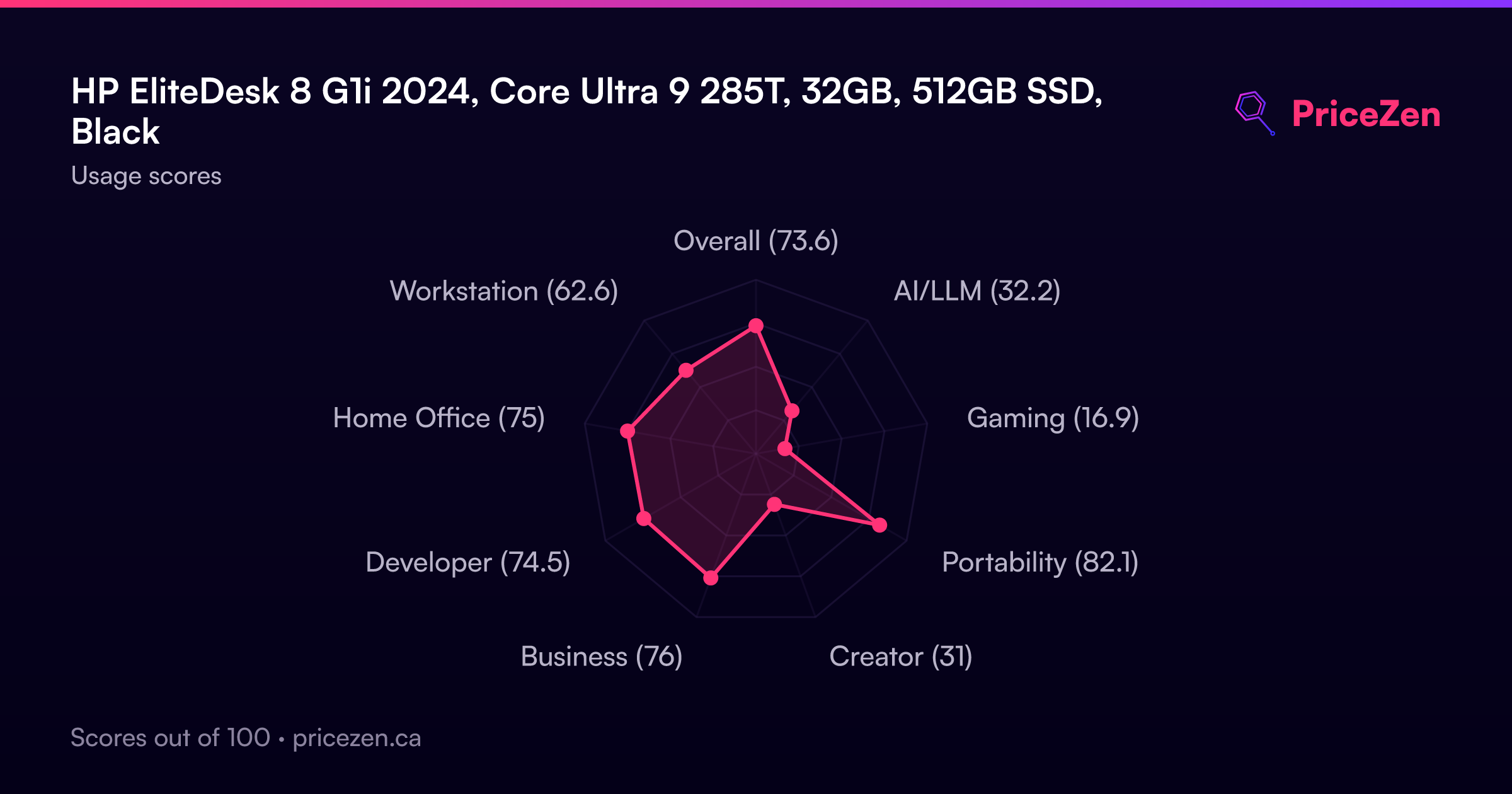
The EliteDesk 8 G1i crams a 24-core Core Ultra 9 285T and 32GB of 5600 MHz DDR5 into a 90W mini PC with vPro and Wi-Fi 7, and our model rates it 82.1/100 for compact setups. Integrated graphics mean a 16.9/100 gaming score, so this is a work machine, full stop. Prices swing from USD 2,160 at Newegg to USD 2,841 at Best Buy, which is a USD 690 difference for identical hardware. Buy it at the low end for heavy Windows workloads, skip it entirely if you game.
Pros & Cons
Pros
- 24-core Core Ultra 9 285T ranks well above average for CPU performance in this category 82nd
- 32GB of 5600 MHz DDR5 sits at the 82nd percentile, plenty for VMs and heavy multitasking 79th
- Two empty M.2 2280 PCIe 4.0 x4 slots make storage expansion straightforward 77th
- Thunderbolt 4, USB-C 3.2 Gen 2x2, HDMI 2.1, DisplayPort, Wi-Fi 7 and Bluetooth 5.4 in one mini chassis 70th
- vPro plus Windows 11 Pro and a 90W PSU: managed, low-draw business deployment
Cons
- Gaming score of 16.9/100, integrated Intel Graphics only
- 512GB SSD ranks around average (41st percentile) at this price
- USD 690 spread between Newegg at USD 2,160 and Best Buy at USD 2,841
- 1.4GHz base clock reflects the 90W power envelope, not a high-clock speed demon
- Only gigabit Ethernet despite Wi-Fi 7 on board
The proof
Performance
The Core Ultra 9 285T lands in the 79th percentile in our CPU rankings, so well above average for this category without being the fastest thing you can buy. Twenty-four cores is a lot of parallel muscle for compiling code, running several virtual machines, chewing through spreadsheets or juggling a browser with far too many tabs. The 1.4GHz base clock is the trade-off baked into that 90W power budget: this chip is built to spread work across many cores efficiently rather than sprint on a single thread. For heavily threaded workloads it's a strong showing. For tasks that lean on one fast core, you're paying Ultra 9 money for a chip tuned toward efficiency.
Memory is the other high point. 32GB of DDR5 at 5600 MHz sits at the 82nd percentile, comfortably above the middle of the pack, and that's the spec that keeps a heavy multitasking session from swapping to disk. Storage is where the config stumbles: 512GB ranks at the 41st percentile, basically average, and on a machine at this price it feels stingy. The two free PCIe 4.0 x4 M.2 slots fix that cheaply if you're willing to open the case. Graphics rank at the 60th percentile, fine for driving displays and hardware video decode, nowhere near discrete GPU territory. Port selection scores 77, reliability 70, both solid rather than spectacular.
Specifications
Full Specifications
Processor
| CPU | Intel Core Ultra 9 285T |
| Cores | 24 |
| Frequency | 1.4 GHz |
| L3 Cache | 36 MB |
Graphics
| GPU | Intel Graphics |
| Type | Integrated |
Memory & Storage
| RAM | 32 GB |
| RAM Generation | DDR5 |
| Storage | 512 GB |
| Storage Type | NVMe SSD |
Build
| Form Factor | mini |
| PSU | 90 |
| Weight | 2.7 kg / 6.0 lbs |
Connectivity
| USB-C Ports | 2 |
| USB Ports | 4 |
| Thunderbolt | Thunderbolt 4 |
| HDMI | 1x HDMI 2.1 |
| DisplayPort | 2x DisplayPort 2.1 |
| Wi-Fi | Wi-Fi 7 |
| Bluetooth | Bluetooth 5.4 |
| Ethernet | Gigabit Ethernet |
System
| OS | Windows 11 Pro |
vs Competition
The competitor set here is a strange mix, which itself says something about what this product is. The Apple Mac Studio M5 Max is the obvious cross-shop for anyone whose work is creative and whose software runs happily on macOS. If that's you, weigh the platform question first, because the EliteDesk's pitch is Windows 11 Pro, vPro management and a 24-core x86 chip in a 90W envelope. If your workflow lives in Windows-only enterprise tooling, the Mac isn't really a substitute no matter how good it is.
Then there's the tower crowd: the Lenovo T Series Towers Legion Tower 5a Gen 10, ASUS ROG GM700 and MSI Aegis ZS2 A9NVP-1407US. Those are full-size machines, and the reason to look at them instead is graphics. Our gaming score for the HP is 16.9/100 and its GPU ranks at only the 60th percentile, so if games or GPU-accelerated rendering are on your list, a tower is the honest answer and no amount of CPU cores fixes that. The Dell Desktop ECT1250 is the closest philosophical rival, another business-first desktop, and there the HP argues its case with the 82.1/100 compact score, the 82nd-percentile memory config and those two spare PCIe 4.0 M.2 slots. Pick the HP when desk space and manageability matter more than raw graphics.
| Spec | HP EliteDesk 8 G1i | Apple Mac Studio M5 Max | Lenovo T Series Towers Legion Tower 5a Gen 10 | Dell Desktop ECT1250 | ASUS ROG GM700 | MSI Aegis ZS2 A9NVP-1407US |
|---|---|---|---|---|---|---|
| CPU | Intel Core Ultra 9 285T | Apple M5 Max | AMD Ryzen 7 7800X3D | Intel Core Ultra 7 265 | AMD Ryzen 7 9800X3D | AMD Ryzen 9 9900X |
| RAM (GB) | 32 | 36 | 32 | 32 | 32 | 32 |
| Storage (GB) | 512 | 1024 | 4096 | 2048 | 2048 | 2048 |
| GPU | Intel Graphics | Apple (32-Core) | NVIDIA GeForce RTX 5070 Ti | Intel UHD Graphics | NVIDIA GeForce RTX 5070 Ti | NVIDIA GeForce RTX 5070 |
| Form Factor | mini | mini | mid-tower | sff | mid-tower | mid-tower |
| Psu W | 90 | 480 | 850 | 180 | 850 | 750 |
| OS | Windows 11 Pro | macOS | Windows 11 Home | Windows 11 Home | Windows 11 Home | Windows 11 Home |
| Compare | Compare | Compare | Compare | Compare |
| Product | CPU | GPU | RAM | Ports | Storage | Reliability |
|---|---|---|---|---|---|---|
| HP EliteDesk 8 G1i | 79.2 | 60.3 | 81.6 | 76.5 | 40.7 | 70 |
| Apple Mac Studio M5 Max Compare | 95.7 | 85.2 | 92.4 | 89 | 68.8 | 99.3 |
| Lenovo T Series Towers Legion Tower 5a Gen 10 Compare | 73.4 | 94.7 | 77.9 | 88.3 | 98.1 | 70 |
| Dell Desktop ECT1250 Compare | 88.2 | 60.3 | 81.6 | 74.5 | 82.7 | 70 |
| ASUS ROG GM700 Compare | 80.5 | 94.7 | 81.6 | 96 | 90 | 37.2 |
| MSI Aegis ZS2 A9NVP-1407US Compare | 92.4 | 90.8 | 87.1 | 90.4 | 82.7 | 37.2 |
Price
Value & Pricing
Here's where you need to pay attention, because the pricing on this thing is wild. We track listings across stores and the USD range runs from USD 2,160 to USD 2,850, a USD 690 gap for the same configuration. Newegg is cheapest right now at USD 2,160, Amazon sits at USD 2,762 and Best Buy is at USD 2,841. Buying from the wrong store costs you roughly a third of a decent monitor for zero extra hardware. In Canada there's a single listing at CAD 3,719.
At USD 2,160 the argument holds together: you're getting a top-tier core count, above-average memory, enterprise management features and a port list that shames most mini PCs, in a box that sips from a 90W supply. At USD 2,841 it's a harder sell, mainly because the 512GB drive is merely average for the class and you'll likely want to fill one of those empty M.2 slots on day one. Budget for that. Our advice is simple: check the price before you check anything else, because the value verdict on this machine flips depending on which cart you're using.
Price history
Read more
Overview
The HP EliteDesk 8 G1i is a mini PC that shows up with a spec sheet usually reserved for much bigger boxes. A 24-core Intel Core Ultra 9 285T, 32GB of DDR5 running at 5600 MHz, vPro manageability and Windows 11 Pro, all wrapped in a chassis that runs off a 90W power supply. That last number is the interesting one. This isn't a shrunken gaming tower, it's a low-power business machine with a genuinely serious CPU bolted into it.
Our scoring model puts it at 82.1/100 for compact setups, 76/100 for business use and 75/100 for home office work. That trio tells you exactly who this is aimed at: someone who wants a lot of compute on a desk that has no room for a tower, or an IT department rolling out machines that need remote management and proper security tooling. The included wired keyboard and mouse mean it's a working desktop the moment you plug in a monitor.
What makes it worth a closer look is the combination of connectivity and expandability in something this small. Thunderbolt 4, USB-C 3.2 Gen 2x2, four USB-A ports, HDMI 2.1, DisplayPort, gigabit Ethernet, Wi-Fi 7 and Bluetooth 5.4. And under the hood there are two empty M.2 2280 PCIe 4.0 x4 slots sitting next to the installed drive, which is unusual generosity in a mini PC. The catch, and it's a big one, is graphics. Integrated Intel Graphics only, and our gaming score of 16.9/100 is about as blunt as numbers get.
Common Questions
Q: How much storage do you get, and can you add more?
It ships with a 512GB NVMe PCIe 4.0 x4 M.2 SSD, which ranks around the middle of the pack in our storage data. The good news is there are two empty M.2 2280 PCIe 4.0 x4 slots inside, so you can add fast drives without replacing the original one. For a machine at this price we'd plan on doing exactly that.
Q: Which processor is in it, and is it actually fast?
It's an Intel Core Ultra 9 285T with 24 cores and a 1.4GHz base clock, and it lands at the 79th percentile in our CPU rankings, well above average for this category. The core count is the headline: it's built for parallel work like compiling, virtual machines and heavy multitasking. The modest base clock is the trade-off for fitting into a 90W power budget.
Q: Can it handle games or GPU-heavy work?
Not really. It uses integrated Intel Graphics, which ranks at the 60th percentile, and our gaming score for this machine is 16.9/100. It'll drive multiple displays through HDMI 2.1, DisplayPort and Thunderbolt 4 just fine, but for gaming or GPU-accelerated rendering you want a tower with a discrete card.
Q: Why is the price so different between stores?
We track listings across retailers and the USD spread right now runs USD 2,160 to USD 2,850 for the same config, with Newegg cheapest at USD 2,160, Amazon at USD 2,762 and Best Buy at USD 2,841. There's no hardware difference to justify that gap. Check the current price before you commit, because it changes the value story completely.
Who Should Skip This
Gamers, obviously, but also anyone doing GPU-accelerated 3D rendering or video work that leans on CUDA-style acceleration. Integrated Intel Graphics and a 16.9/100 gaming score aren't a limitation you can tweak away. Look at the ASUS ROG GM700, MSI Aegis ZS2 A9NVP-1407US or Lenovo T Series Towers Legion Tower 5a Gen 10 instead, and accept that you're giving up the tiny footprint.
Also skip it if your daily computing is email, browsers and office apps. Twenty-four cores and 32GB of DDR5 are wasted there, and you'd be paying a premium for headroom you'll never touch while living with an average-sized 512GB drive. Creative users locked into macOS workflows should be looking at the Apple Mac Studio M5 Max rather than trying to make a vPro Windows box fit. And if you're buying at the USD 2,841 end of the range, wait or switch stores, because the same machine is USD 2,160 elsewhere.
Verdict
If you're building a compact workstation for development, virtualization, data work or a genuinely overloaded office workload, this is a strong buy at the Newegg price. The 24-core CPU and 32GB of fast DDR5 are the two specs that matter most for that kind of day, and both rank well above average in our data. Add vPro, Windows 11 Pro and a 90W draw and it's an easy machine for an IT team to standardize on. Our 76/100 business and 75/100 home office scores back that up.
If you're a general home user who mostly browses, streams and writes documents, you're overspending. Nothing in that workload needs 24 cores, and the 512GB drive is the part you'd actually notice. And if gaming is anywhere in the picture, stop here and go look at a tower instead. This is a specialist machine that happens to be small, not a do-everything box, and it's excellent precisely because it doesn't pretend otherwise.
Usage Scores
- Overall73.6
- AI/LLM32.3
- Gaming16.9
- Portability82.1
- Creator31
- Business76
- Developer74.5
- Home Office75
- Workstation62.6