Reatan X7 Mini, Ryzen 7 255, 48GB, 2TB SSD
The AMD Ryzen 7 255 with Radeon 780M graphics delivers smooth 1080p gaming and 8K video output, backed by 48GB DDR5 RAM and a 2TB NVMe SSD. Its OCuLink port allows external GPU expansion, and the dual-heatpipe cooling keeps it quiet under load. Best for home office users and developers who need a compact, upgradeable PC for multitasking and light gaming.

No current retailer price
Snapshot
The 30-Second Version
The Reatan X7 Mini is a memory-and-storage monster in a tiny box: 48GB of DDR5-5600 and a 2TB PCIe 4.0 SSD, both near the top of our category rankings, paired with an 8-core Ryzen 7 255. But the gaming score of 19.2/100 makes a mockery of the "Gaming PC" branding, and reliability ranks in the 12th percentile. At USD 1,300 on Amazon (CAD 1,812 in Canada), it's a strong pick for developers and heavy multitaskers who need the RAM, and a poor one for anyone chasing frame rates.
Pros & Cons
Pros
- 48GB of DDR5-5600, one of the best memory configs in the category 93rd
- 2TB PCIe 4.0 SSD included, top-tier storage for a mini 90th
- 8-core/16-thread Zen 4 chip with AVX-512 and 4.9GHz boost 79th
- OCuLink plus Thunderbolt and Wi-Fi 7 for future expansion
- RAM and storage both upgradeable via built-in slots
Cons
- Gaming score of 19.2/100 despite the gaming branding
- Reliability ranks in the 12th percentile, a real concern
- Port selection falls behind most rivals in our scoring
- Single 48GB stick means single-channel memory bandwidth
- OCuLink needs manual installation inside the case
The proof
Performance
Let's start with the chip. Eight cores and sixteen threads on Zen 4 with AVX-512 support and a 4.9GHz boost clock is a proper desktop-replacement workload processor, and our CPU ranking puts it above the middle of the pack rather than chart-topping. In practice that means compiles, transcodes, spreadsheet monsters and a dozen background services all coexisting without the machine turning into a slideshow. The Radeon 780M brings 12 compute units, 768 stream processors and a boost clock up to 2600MHz, plus hardware encode and decode for AV1, AVC and HEVC. That codec support is quietly useful: video playback and hardware-accelerated encoding barely touch the CPU. Graphics rank about average too, which is fine for an iGPU driving several displays.
And then there's the gaming score, which is the part you should read twice. At 19.2/100 it's a weak spot, well behind most of the category, and no amount of FSR marketing copy changes that. The 780M can run games, especially older or lighter ones with FSR enabled, but this is not a machine to buy for demanding new titles at high settings. The trade-off is baked into the design: an integrated GPU sharing power and cooling with the CPU inside a mini chassis will always give ground to a discrete card. There's also a subtler catch worth knowing about. All 48GB lives on one SO-DIMM, so you're running single-channel memory, and integrated graphics are exactly the workload that feels that pinch. Adding a second matched stick is the cheapest performance move available here. Cooling is handled by a dual-heatpipe setup, and the 2TB drive is a short 2230 form factor, so plan your upgrades around that.
Specifications
Full Specifications
Processor
| CPU | AMD Ryzen 7 255 |
| Cores | 8 |
| Frequency | 3.3 GHz |
| L3 Cache | 16 MB |
Graphics
| GPU | AMD Radeon 780M |
| Type | Integrated |
| VRAM Type | Shared |
Memory & Storage
| RAM | 48 GB |
| RAM Generation | DDR5 |
| Storage | 2 TB |
| Storage Type | NVMe SSD |
Build
| Form Factor | mini |
Connectivity
| USB-C Ports | 1 |
| Thunderbolt | USB 4.0 |
| Wi-Fi | Wi-Fi 7 |
| Bluetooth | Bluetooth 5.4 |
System
| OS | Windows 11 Pro |
vs Competition
The competitor set here is telling, because most of it isn't really competing on the same terms. The Apple Mac Studio M5 Max is the obvious cross-shop if your work is creative and you're not tied to Windows, and the Lenovo Legion Tower 5a Gen 10, HP OMEN GT16-0364 and ASUS ROG GM700 are full towers aimed at people who want discrete graphics. Against any of those, the Reatan's argument is size and its 48GB/2TB combination, not raw horsepower. Its gaming score of 19.2/100 tells you exactly where it gives ground: if gaming is the point of the purchase, a tower with a real GPU is the correct category, and the X7 Mini shouldn't be on your shortlist at all.
The Dell Desktop ECT1250 is the closer philosophical match, a compact work-first machine, and that's the fight the Reatan can actually win. Its memory ranks near the top of the category and storage is also among the best, which is a hard combination to beat in a small chassis, and the OCuLink port gives it an escape hatch that most minis simply don't offer. Where it loses is breadth: ports land in the 25th percentile and reliability in the 12th, both well behind most of the field. So cross-shop the Dell if you want a boring, dependable desk machine, cross-shop the towers if you game, and pick the Reatan if you specifically need enormous RAM and storage in a box you can hide behind a monitor.
| Spec | Reatan X7 Mini | Apple Mac Studio M5 Max | Lenovo T Series Towers Legion Tower 5a Gen 10 | Dell Desktop ECT1250 | HP OMEN GT16-0364 | ASUS ROG GM700 |
|---|---|---|---|---|---|---|
| CPU | AMD Ryzen 7 255 | Apple M5 Max | AMD Ryzen 7 7800X3D | Intel Core Ultra 7 265 | AMD Ryzen 7 8700F | AMD Ryzen 7 9800X3D |
| RAM (GB) | 48 | 36 | 32 | 32 | 32 | 32 |
| Storage (GB) | 2048 | 1024 | 4096 | 2048 | 1024 | 2048 |
| GPU | AMD Radeon 780M | Apple (32-Core) | NVIDIA GeForce RTX 5070 Ti | Intel UHD Graphics | NVIDIA GeForce RTX 5070 | NVIDIA GeForce RTX 5070 Ti |
| Form Factor | mini | mini | mid-tower | sff | mid-tower | mid-tower |
| Psu W | - | 480 | 850 | 180 | 850 | 850 |
| OS | Windows 11 Pro | macOS | Windows 11 Home | Windows 11 Home | Windows 11 Home | Windows 11 Home |
| Compare | Compare | Compare | Compare | Compare |
| Product | CPU | GPU | RAM | Ports | Storage | Reliability | Social Proof |
|---|---|---|---|---|---|---|---|
| Reatan X7 Mini | 64.9 | 64.7 | 92.6 | 24.8 | 90 | 11.6 | 79.3 |
| Apple Mac Studio M5 Max Compare | 95.7 | 85 | 92.5 | 89.1 | 68.7 | 99.3 | 66.8 |
| Lenovo T Series Towers Legion Tower 5a Gen 10 Compare | 73.3 | 94.6 | 78 | 88.6 | 98.1 | 70.1 | 99.9 |
| Dell Desktop ECT1250 Compare | 88.1 | 60.2 | 81.6 | 75 | 82.6 | 70.1 | 98.2 |
| HP OMEN GT16-0364 Compare | 69.4 | 90.7 | 87.1 | 97.9 | 53.4 | 70.1 | 98.2 |
| ASUS ROG GM700 Compare | 80.4 | 94.6 | 81.6 | 96.1 | 90 | 37.5 | 99.2 |
Price
Value & Pricing
At USD 1,300 on Amazon (the only US listing we're tracking right now), you're paying for the memory and storage as much as the silicon. A 48GB DDR5 module and a 2TB PCIe 4.0 drive are not cheap parts, and both sit near the top of our category rankings, so a big chunk of that price is stuff you'd otherwise buy separately. Canadian buyers are looking at CAD 1,812 from a single listing, and those two amounts aren't directly comparable, so don't do mental exchange-rate math and declare one market a bargain. We track prices over time, partly through our community browser extension, and with one listing per region there isn't much cross-store competition to squeeze the price down.
The honest value question is whether you need 48GB. If you do, this is a lot of machine in a small box and the price makes sense. If your work fits comfortably in less memory, you're paying a premium for headroom you'll never touch, and the middling CPU and GPU rankings mean you're not getting standout compute for the money. And the reliability ranking in the 12th percentile is a genuine cost consideration, not just a footnote. Reatan backs it with a 30-day no-questions return policy, a 1-year warranty and 24/7 support, which helps, but a year of coverage on a machine you plan to run daily is thin.
Read more
Overview
The Reatan X7 Mini is a small box with an oddly lopsided spec sheet, and that's what makes it interesting. You get an AMD Ryzen 7 255 (Hawk Point, Zen 4, 8 cores and 16 threads, 3.4GHz base with boosts up to 4.9GHz), a Radeon 780M integrated GPU, a single Crucial 48GB DDR5-5600 stick and a 2TB PCIe 4.0 SSD, all running Windows 11 Pro. Our system pulls specs, prices and owner ratings from multiple stores and scores every mini against the rest of the category, and this one lands at 63.7/100 overall. That's respectable, but the shape of the score matters more than the number: memory sits near the top of the category and storage is also among the best, while gaming comes in at 19.2/100.
So who's it for? Our category scoring puts home office at 67.3/100 and developer workloads at 65.1/100, which lines up neatly with the hardware. Forty-eight gigabytes of RAM is a genuinely unusual amount for a mini PC, and most people buying one of these are running a browser with too many tabs, a couple of containers, an IDE and maybe a virtual machine on the side. The 2TB drive means you're not immediately shopping for storage. If your work is CPU-and-memory shaped rather than graphics shaped, this configuration is aimed squarely at you.
The other hook is expandability. There's an OCuLink port for an external GPU or fast external storage, though Reatan is upfront that you have to open the case and install it manually. Thunderbolt, USB-C, Wi-Fi 7 and multi-display output up to 8K round things out, and both RAM and storage are upgradeable through built-in slots. It's a mini that assumes you might want to tinker later, which we like. Just don't confuse "gaming" in the product title with what the benchmarks actually say.
Common Questions
Q: Can it actually play modern games?
Some, but manage your expectations. The Radeon 780M has 12 compute units and 768 stream processors boosting to 2600MHz, and with FSR enabled it handles lighter and older titles fine. Our gaming score for this machine is 19.2/100, which puts it well behind most of the category, so demanding new releases at high settings aren't realistic without adding an external GPU through the OCuLink port.
Q: Is 48GB on a single stick a problem?
It's a real trade-off. One 48GB DDR5-5600 SO-DIMM means single-channel operation, and integrated graphics like the 780M are especially sensitive to memory bandwidth. The capacity itself is excellent, ranking near the top of the category, and since memory is upgradeable via the built-in slots, adding a second matched stick is the most worthwhile upgrade you can make.
Q: How does the OCuLink port work?
OCuLink gives you a high-speed path to an external GPU or fast external storage, with better signal stability and throughput than conventional external interfaces. The catch is that Reatan says manual installation is required after opening the case, so this isn't plug-and-play. If you're not comfortable working inside a mini chassis, treat that port as a bonus rather than a reason to buy.
Q: Should I worry about long-term reliability?
It's the weakest signal in our data. Reliability ranks in the 12th percentile against similar products, and the 4.2/5 average across 62 reviews is solid rather than exceptional. Reatan offers a 30-day no-questions return and exchange policy plus a 1-year warranty with 24/7 support, so we'd stress the machine hard in that first month and keep independent backups of anything important.
Who Should Skip This
Gamers should skip this one entirely. A 19.2/100 gaming score is not a rounding error, and the Radeon 780M sharing a mini chassis with the CPU can't compete with a discrete card. If frame rates are the goal, look at the towers in this comparison set instead: the Lenovo Legion Tower 5a Gen 10, HP OMEN GT16-0364 or ASUS ROG GM700. You'll give up the small footprint, but you'll get a machine built for the job rather than one with "Gaming" printed on the listing.
Also skip it if you need a machine you can forget about. The reliability ranking in the 12th percentile and a 1-year warranty make this a poor fit for an unattended server, a small-business workstation with no spare, or anything where downtime costs you money. And if your daily work is light browsing, email and documents, 48GB and 2TB are expensive headroom you'll never use. A simpler compact desktop like the Dell Desktop ECT1250 will do that job for less fuss.
Verdict
For developers, home-office power users and anyone running VMs, containers or heavy multitasking, this is a sensible buy. Our scoring agrees: 67.3/100 for home office and 65.1/100 for developer use, backed by 48GB of DDR5 and 2TB of fast storage that most minis make you pay extra for. Add a second SO-DIMM to get dual-channel bandwidth and you've got a compact workstation that should stay comfortable for years. The 8K multi-display output and hardware AV1 decoding make it a decent media and multi-monitor hub too.
For gamers, we'd pass, and the 19.2/100 gaming score is the whole argument. The "Gaming PC" label on the listing is doing a lot of heavy lifting that the Radeon 780M can't back up outside of light titles and FSR-assisted settings. Owners have given it 4.2/5 across 62 reviews, which is decent but not glowing, and combined with the low reliability ranking we'd treat this as a buy-with-a-plan: use the 30-day return window aggressively, keep backups, and don't build anything mission-critical on it without a fallback.
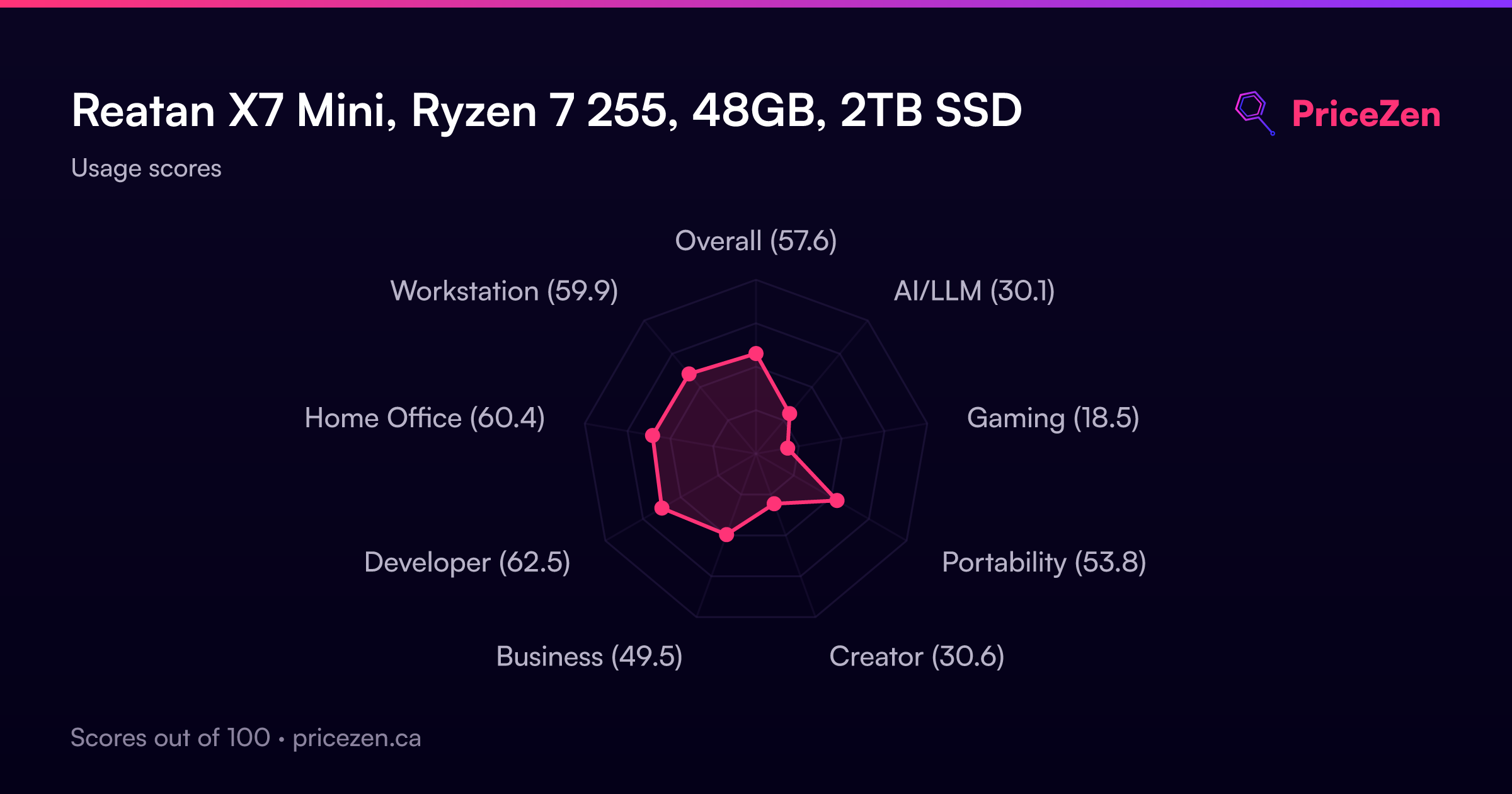
Usage Scores
- Overall58.2
- AI/LLM30.2
- Gaming18.7
- Portability53.8
- Creator30.7
- Business49.5
- Developer62.5
- Home Office60.4
- Workstation60.1