Z CAM E1CAM3C701 Black

Micro Four Thirds: small lenses, big choice verified Nov 28
16/100 overall score
- Type
- mirrorless
- Video
- 4K
- Weight
- 209 g
Compare prices at 1 store
Cheapest first. New, refurbished and bundled offers are kept apart, so you compare like with like.
| Store | Sold by | Colour and condition | Price | vs lowest | Last checked | Link |
|---|---|---|---|---|---|---|
| New1 offerSingle unit | ||||||
| Out of stock when last checked | ||||||
| Amazon | Not known | Not listed | No price | Out of stock | Oct 30 | Go to store |
 Source: PriceZen, checked Oct 30, 2026
A price counts as current when we checked it in the last 7 days. “Marketplace seller” means a third-party seller on that store, not the store itself.











Snapshot
The 30-Second Version
The Z CAM E1 is the world's smallest 4K interchangeable lens camera at 209g, but it ranks in the 5th percentile for build quality. The MCTF low-light tech is impressive, pushing ISO to 102,400 with usable results up to 6400. Unless you need a drone-mounted 4K camera with app control, there are far better options at this price point.
Pros & Cons
Pros
- World's smallest 4K interchangeable lens camera at just 209g
- Micro-four-thirds mount works with AF lenses from Olympus, Panasonic, Leica, and Sigma
- MCTF noise filtering pushes ISO to 102,400 with usable quality up to 6400
- Wi-Fi and Bluetooth app control for remote shooting and live streaming
- Drone-friendly design with remote configuration and content download
Cons
- Build quality ranks in the 5th percentile, one of the worst we've seen
- No in-body stabilization, ranking in the 34th percentile
- Autofocus performance sits at the 34th percentile
- Tiny 1.5-inch fixed display at the 28th percentile
- Video quality overall lands at just the 23rd percentile
The proof
Performance
The headline feature is 4K recording in a body that weighs less than most smartphones. You get cinema 4K at 24fps and UHD at 30fps with H.264 compression. That's respectable for a camera this size, though the 23rd percentile video ranking tells you the overall package doesn't keep up with modern mirrorless bodies. The micro-four-thirds mount is the real win here. It works with AF lenses from Olympus, Panasonic, Leica, and Sigma, plus a pile of manual focus glass.
Low-light is where the E1 gets interesting. The MCTF temporal noise filtering lets you push to 102,400 ISO, with usable quality up to 6400. That's a bold claim for a sensor ranked in the 28th percentile. The catch is everything else: burst shooting sits at the 32nd percentile, autofocus at the 34th, and there's no in-body stabilization. The 1.5-inch fixed display is a weak spot too, landing at the 28th percentile. This camera wants to be mounted on a drone or a rig, not held up to your face.
Specifications
Full Specifications
Sensor
| Size | micro-four-thirds |
Video
| Max Resolution | 4K |
Display & EVF
| Screen Size | 1.5" |
Build
| Weight | 0.2 kg / 0.5 lbs |
Connectivity
| Wi-Fi | Yes |
| Bluetooth | Yes |
vs Competition
Stacked against the Sony a6700, the E1 looks like a toy. The a6700 brings class-leading autofocus, in-body stabilization, and a build quality that won't crack if you look at it wrong. The Fujifilm X-S20 offers similar video chops with far better ergonomics and a proper articulating display. Even the Panasonic Lumix S5 IIX, despite being full-frame and heavier, delivers dramatically better image quality and stabilization. The E1's only real advantage is size and weight. At 209g, it's less than half the weight of most competitors. But you're giving up build quality, autofocus, stabilization, and a usable display to get there. The OM System OM-1 and Canon EOS R7 aren't even in the same conversation for video quality and reliability.
| Spec | Z CAM E1CAM3C701 | Sony Alpha a7R VI | Fujifilm X-H2 | Nikon Z8 | Panasonic Lumix G9 II | OM System OM-1 Mark II |
|---|---|---|---|---|---|---|
| Type | mirrorless | mirrorless | mirrorless | mirrorless | mirrorless | mirrorless |
| Sensor | - | 66.8MP full-frame | 40.2MP aps-c | 45.7MP full-frame | 25.2MP micro-four-thirds | 20.4MP micro-four-thirds |
| AF Points | - | 759 | 425 | 493 | 779 | 1053 |
| Burst FPS | - | 30 | 15 | 30 | 75 | 120 |
| Video | 4K | 8K @120fps | 8K @60fps | 8K @120fps | 4K @120fps | 4K @60fps |
| IBIS | No | Yes | Yes | Yes | Yes | Yes |
| Weather Sealed | No | Yes | Yes | Yes | Yes | Yes |
| Weight (g) | 209 | 622 | 579 | 820 | 575 | 511 |
| Compare | Compare | Compare | Compare | Compare |
| Product | AF | EVF | Build | Burst | Video | Sensor | Battery | Display | Connectivity | Affordability | Stabilization |
|---|---|---|---|---|---|---|---|---|---|---|---|
| Z CAM E1CAM3C701 | 37.1 | 37.4 | 5.7 | 32.1 | 22 | 32.4 | 45.9 | 27.5 | 54.4 | 20.2 | 33.1 |
| Sony Alpha a7R VI Compare | 96.6 | 98.9 | 94.3 | 87.7 | 98.9 | 81.2 | 96.4 | 97.3 | 95.6 | 12.9 | 99.6 |
| Fujifilm X-H2 Compare | 91.6 | 96.2 | 93.3 | 79 | 94.6 | 98.8 | 97.1 | 94.9 | 95.6 | 25.3 | 95.7 |
| Nikon Z8 Compare | 92.9 | 90.7 | 97.5 | 94.6 | 98.5 | 67.9 | 88.4 | 97.1 | 95.6 | 16.3 | 87.8 |
| Panasonic Lumix G9 II Compare | 97.7 | 90.4 | 93.2 | 95.8 | 97.3 | 59.9 | 89.8 | 96.4 | 95.6 | 38.3 | 87.8 |
| OM System OM-1 Mark II Compare | 98.6 | 99.8 | 92.7 | 99.3 | 83.7 | 47.3 | 95.1 | 94.9 | 95.6 | 26.1 | 99.6 |
Price
Value & Pricing
Pricing is all over the map. One listing in France shows it at 479 EUR, while a Japanese listing asks 737,617 JPY. That's a massive spread, and neither price feels like a bargain when you look at what modern mirrorless cameras deliver. The E1's value proposition hinges entirely on its size and remote control capabilities. If you need the smallest possible 4K camera for a drone or gimbal setup, the premium might make sense. For everyone else, the 5th percentile build quality and 23rd percentile video ranking make this a tough sell at any price.
Read more
Overview
The Z CAM E1 is a fascinating little oddball. It's the world's smallest 4K interchangeable lens camera at 209g, and it packs a micro-four-thirds sensor with an ISO range that stretches to 102,400. But the numbers tell a rough story: it lands in the 5th percentile for build quality and the 23rd for video in our database. This is a niche tool, not a daily driver.
What you're getting is a drone-friendly, app-controlled camera that can shoot 4096x2160 at 24fps or 3840x2160 at 30fps. The MCTF noise filtering is genuinely interesting for low-light work, keeping things usable up to 6400 ISO. But with no stabilization, a fixed 1.5-inch display, and autofocus that sits in the 34th percentile, you need to know exactly what you're signing up for.
Common Questions
Q: Can the Z CAM E1 shoot 4K video?
Yes. It records cinema 4K at 4096x2160 at 24fps and UHD at 3840x2160 at 30fps using H.264 compression. However, the video quality overall ranks in the 23rd percentile compared to other mirrorless cameras, so don't expect the same results as a Sony a6700 or Fujifilm X-S20.
Q: What lenses work with the Z CAM E1?
The E1 uses a micro-four-thirds mount, so it's compatible with autofocus lenses from Olympus, Panasonic Lumix, Leica, and Sigma. It also supports a wide range of manual focus lenses with adapters. The autofocus performance itself ranks in the 34th percentile, so AF lenses will work but won't be as snappy as on newer bodies.
Q: Is the Z CAM E1 good for vlogging?
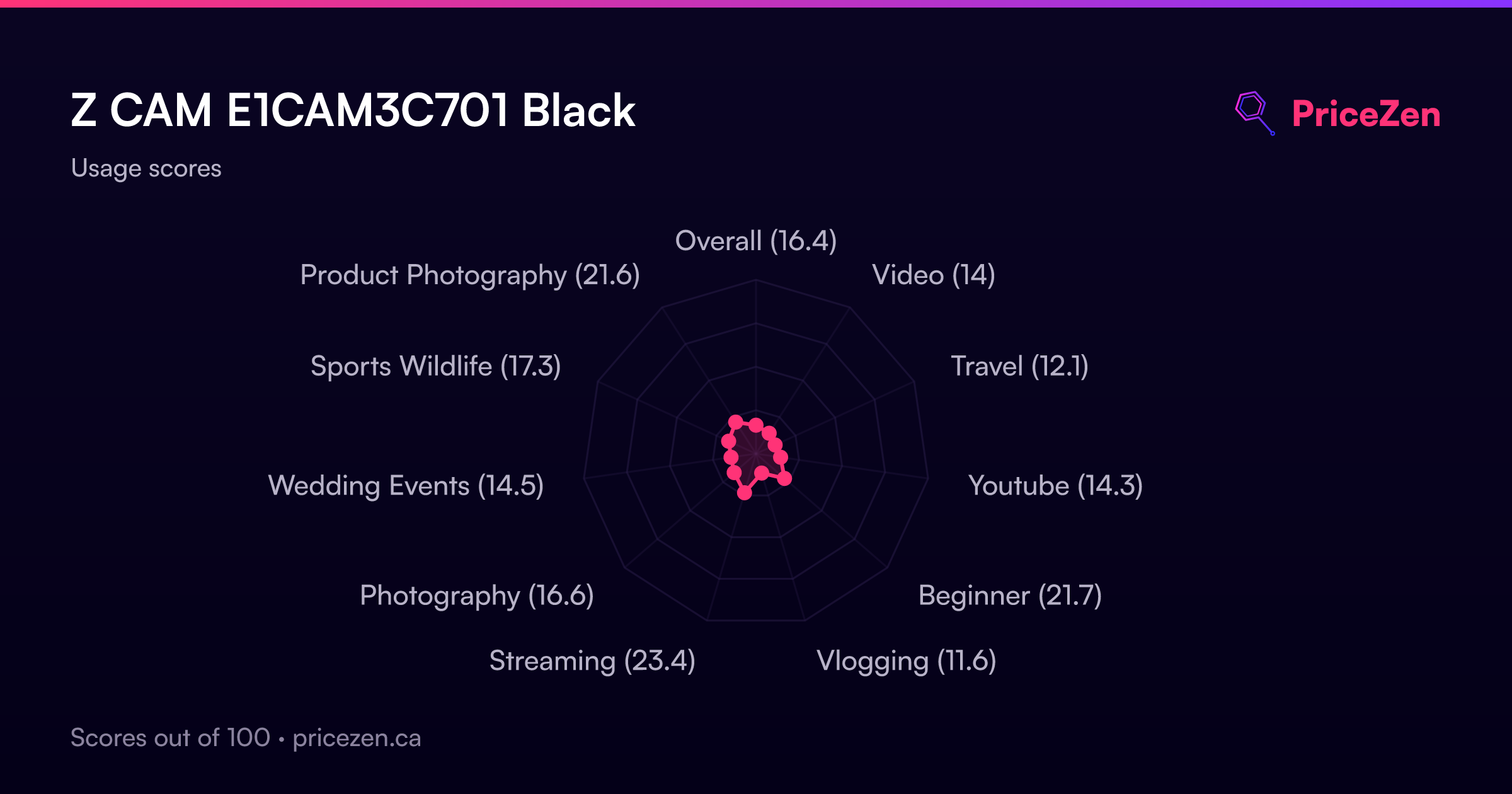
No. Vlogging is its weakest area, scoring just 12.2 out of 100. The 1.5-inch fixed display makes framing yourself nearly impossible, there's no in-body stabilization, and the autofocus is mediocre. You'd be much better off with something like a Fujifilm X-S20 for vlogging.
Who Should Skip This
Skip the E1 if you care about build quality, because the 5th percentile ranking means this thing feels fragile. Skip it if you want to vlog, since the 12.2 out of 100 vlogging score and fixed 1.5-inch display make self-shooting a nightmare. Skip it if you need reliable autofocus or stabilization, both of which sit in the 34th percentile. And skip it if you want a camera that holds its value, because the wildly inconsistent pricing between regions suggests a product that never found its footing.
Verdict
The Z CAM E1 is a specialist's tool with a very narrow use case. If you're building a lightweight drone rig or need a remotely controllable 4K camera that weighs next to nothing, it's worth a look. The MCTF low-light performance is genuinely impressive for the sensor size. But the 5th percentile build quality is a serious red flag, and the lack of stabilization combined with a 1.5-inch fixed display makes handheld shooting a chore. For most people, a used Sony a6700 or Fujifilm X-S20 will deliver far more capability for similar money.
Usage Scores
- Overall16.4
- Video14
- Travel12.1
- Youtube14.3
- Beginner21.7
- Vlogging11.6
- Streaming23.4
- Photography16.6
- Wedding Events14.5
- Sports Wildlife17.3
- Product Photography21.6