Panasonic LUMIX G DC-G9M2MK Black 2024
The 25.2MP sensor with phase detection autofocus—a first for Lumix Micro Four Thirds—delivers 75fps burst shooting and 8-stop IBIS for capturing fast action. Open gate 5.8K recording and 4K 120p video offer flexible framing for social content, while the included 12-60mm lens provides a versatile starting kit. This camera is best for hybrid shooters who need high-speed stills and detailed video in a 576g body without prioritizing weather sealing.

No current retailer price
Snapshot
The 30-Second Version
The G9II is the best Micro Four Thirds camera ever made, with autofocus that finally keeps up and stabilization that makes tripods feel optional. Buy it for wildlife and action, skip it if you shoot in the dark. Right now it's out of stock everywhere, so set an alert instead of hunting.
Pros & Cons
Pros
- Phase detection AF finally comes to MFT, and it's excellent 98th
- 75fps burst with a buffer that actually lasts 98th
- 8-stop IBIS is the best stabilization we've tested 96th
- 5.8K Open Gate and 4K 120fps video in a compact body 92nd
- Comfortable grip and intuitive controls for all-day shooting
Cons
- Kit lens is just okay, you'll want better glass
- Micro Four Thirds sensor struggles in low light
- Battery life is mediocre at best
- No weather sealing despite the rugged build
What owners think
The Word on the Street
How owner sentiment changed over time
ExclusiveBased on when customers actually wrote their reviews - so you can see whether early praise held up.
10 written reviews, May 2024 – Jul 2026: 9 happy, 1 mixed
Across all 18 store ratings: 4.7★. The chart counts the 10 written reviews.
Each dot is one written review, in the month it was written. Happy = 4-5★, mixed = 3★, unhappy = 1-2★.
The proof
Performance
The autofocus is the headline here, and it delivers. 779 phase detection points with subject detection for cars, motorcycles, and animal eyes means this thing locks on and stays locked. Burst shooting hits 75fps with the electronic shutter in AFS mode, and the buffer holds for over three seconds, which is genuinely useful for birds in flight or fast-moving subjects. The 8-stop IBIS is best-in-class, letting you handhold shots that would be blurry mush on most other bodies. Video is no slouch either, with 5.8K Open Gate recording and 4K at 120fps in 10-bit. The one thing that surprised us? How well the ergonomics hold up during long shoots. The grip is deep and comfortable, and the controls feel intuitive even if you're new to the system.
Specifications
Full Specifications
Sensor
| Type | CMOS |
| Size | micro-four-thirds |
| Megapixels | 25.21 MP |
| Processor | Venus Engine |
Autofocus
| AF Points | 779 |
| Eye AF | Yes |
| Animal AF | Yes |
| Subject Detection | Yes |
Shooting
| Burst (Mechanical) | 75 |
| Burst (Electronic) | 75 |
| Electronic Shutter | Yes |
Video
| Max Resolution | 6K |
| 4K FPS | 120 |
| 10-bit | Yes |
| Log Profile | Yes |
| Codec | H.265 |
Display & EVF
| Screen Size | 3" |
| Touchscreen | Yes |
| Articulating | Yes |
| EVF Resolution | 3.68 M dots |
Build
| Weather Sealed | No |
| Weight | 0.6 kg / 1.3 lbs |
Connectivity
| Wi-Fi | Yes |
| Bluetooth | Yes |
| USB | USB Type-C (superspeed USB 10Gbps (USB 3.2 Gen2)) |
| HDMI | HDMI Type A |
vs Competition
Our ranking puts the G9II up against the OM System OM-1 Mark II, the Fujifilm X-H2, the Sony FX30 and the Nikon Z8, and it holds its ground on the things MFT shooters care about. Against the OM-1 Mark II, the closest rival in mount and sensor size, the G9II's 779 phase detection points, 75fps electronic burst and 5.8K Open Gate recording are what tip it our way for hybrid work. The Fujifilm X-H2 is the pick if resolution matters more to you than raw speed, but nothing here matches the G9II's burst rate or its 8-stop stabilization. The Sony FX30 is a video-first body, and if you shoot almost nothing but motion, that's where we'd point you; for stills-led shooting with video alongside, the G9II is the better balance. The Nikon Z8 sits in a different weight and budget class entirely, and the whole reason to stay with the G9II is that you get this much speed without hauling bigger bodies and glass around. Already own MFT lenses? This is the obvious upgrade. Just find it in stock first.
| Spec | Panasonic LUMIX G DC-G9M2MK | Sony Alpha a7R VI | Fujifilm X-H2 | Nikon Z8 | OM System OM-1 Mark II | Canon EOS R6 Mark III |
|---|---|---|---|---|---|---|
| Type | mirrorless | mirrorless | mirrorless | mirrorless | mirrorless | mirrorless |
| Sensor | 25.2MP micro-four-thirds | 66.8MP full-frame | 40.2MP aps-c | 45.7MP full-frame | 20.4MP micro-four-thirds | 32.5MP full-frame |
| AF Points | 779 | 759 | 425 | 493 | 1053 | 1053 |
| Burst FPS | 75 | 30 | 15 | 30 | 120 | 40 |
| Video | 6K @120fps | 8K @120fps | 8K @60fps | 8K @120fps | 4K @60fps | 6K @120fps |
| IBIS | Yes | Yes | Yes | Yes | Yes | Yes |
| Weather Sealed | No | Yes | Yes | Yes | Yes | Yes |
| Weight (g) | 576 | 622 | 579 | 820 | 511 | 608 |
| Compare | Compare | Compare | Compare | Compare |
| Product | AF | EVF | Build | Burst | Video | Sensor | Battery | Display | User Sentiment | Connectivity | Social Proof | Affordability | Stabilization |
|---|---|---|---|---|---|---|---|---|---|---|---|---|---|
| Panasonic LUMIX G DC-G9M2MK | 97.6 | 91.9 | 50.5 | 95.9 | 92.4 | 58.8 | 46 | 82.1 | 85.4 | 73 | 44.3 | 0 | 98.4 |
| Sony Alpha a7R VI Compare | 96.5 | 98.9 | 94.3 | 88 | 98.9 | 80.5 | 96.4 | 97.3 | 95.4 | 95.3 | 97.4 | 13 | 99.6 |
| Fujifilm X-H2 Compare | 91.3 | 96.3 | 93.2 | 79 | 94.8 | 98.8 | 97.2 | 94.9 | 85.4 | 95.3 | 92.4 | 27.7 | 95.7 |
| Nikon Z8 Compare | 92.7 | 90.5 | 97.4 | 94.7 | 98.4 | 66.8 | 88.6 | 97.1 | 85.4 | 95.3 | 97.4 | 16.2 | 87.7 |
| OM System OM-1 Mark II Compare | 98.6 | 99.8 | 92.6 | 99.4 | 83.5 | 45.7 | 95.1 | 94.9 | 85.4 | 95.3 | 86.4 | 26.6 | 99.6 |
| Canon EOS R6 Mark III Compare | 98.6 | 89.8 | 93.8 | 90.8 | 89.4 | 61.3 | 96.7 | 94.9 | 70.2 | 95.3 | 92.4 | 22.4 | 99.6 |
Price
Value & Pricing
We track this price across stores, partly through our community browser extension, and right now there's nothing to buy: the G9II is out of stock at every vendor we follow. That takes the deal off the table for the moment. The spec sheet still justifies a serious look, with phase detection AF, 8-stop IBIS and 5.8K Open Gate video in one body, but you can't shop your way into it today. Our advice: set an alert and wait rather than chase down whatever listing pops up first. And when stock does land, budget for better glass than the kit lens if you want to get the most out of that sensor.
Read more
Overview
The Panasonic Lumix G9II is the best Micro Four Thirds camera you can buy right now, full stop. It's the first LUMIX MFT body with phase detection autofocus, and that one change transforms the whole shooting experience. If you've been holding out for a G9 successor that actually nails focus, this is it. The 25.2MP sensor, 75fps burst, and 8-stop IBIS put it in a class of its own for wildlife and action shooters who don't want to lug around full-frame glass.
Common Questions
Q: Is the G9II good for beginners?
Yes, actually. The controls are laid out intuitively and the autofocus does a lot of the heavy lifting. You won't outgrow it quickly either, so it's a solid first serious camera.
Q: Can I use my existing Micro Four Thirds lenses?
Absolutely. It works with the full range of MFT glass, which is one of the biggest reasons to buy this over a full-frame body. Your lens collection carries over.
Q: How does it handle video?
Really well. You get 5.8K Open Gate, 4K at 120fps, 10-bit color, and Log profiles. It's a legit hybrid camera, not a stills body with video bolted on.
Who Should Skip This
If you need a camera this week, skip it for now. It's out of stock at every store we track, and waiting on a restock is a bad plan if you have a shoot booked. If you shoot a lot in low light or need the absolute best image quality for large prints, this isn't your camera either, since the Micro Four Thirds sensor can't match a bigger one for high ISO performance. Look at the Nikon Z8 instead. Video-only shooters should go straight to the Sony FX30, and if you want resolution over burst speed, the Fujifilm X-H2 is the smarter buy.
Verdict
The Panasonic Lumix G9II is the camera MFT shooters have been waiting for. It fixes the autofocus gap that held the system back and adds genuinely useful video features without bloating the price. The low light limitations and mediocre kit lens are real, but they're trade-offs you accept for this level of speed and stabilization in a compact body. The catch right now is availability: it's out of stock everywhere we track, so this is a watch-list camera rather than a buy-today one. If you shoot wildlife, action, or hybrid content and want to stay with Micro Four Thirds, put an alert on it and grab one the moment stock returns.
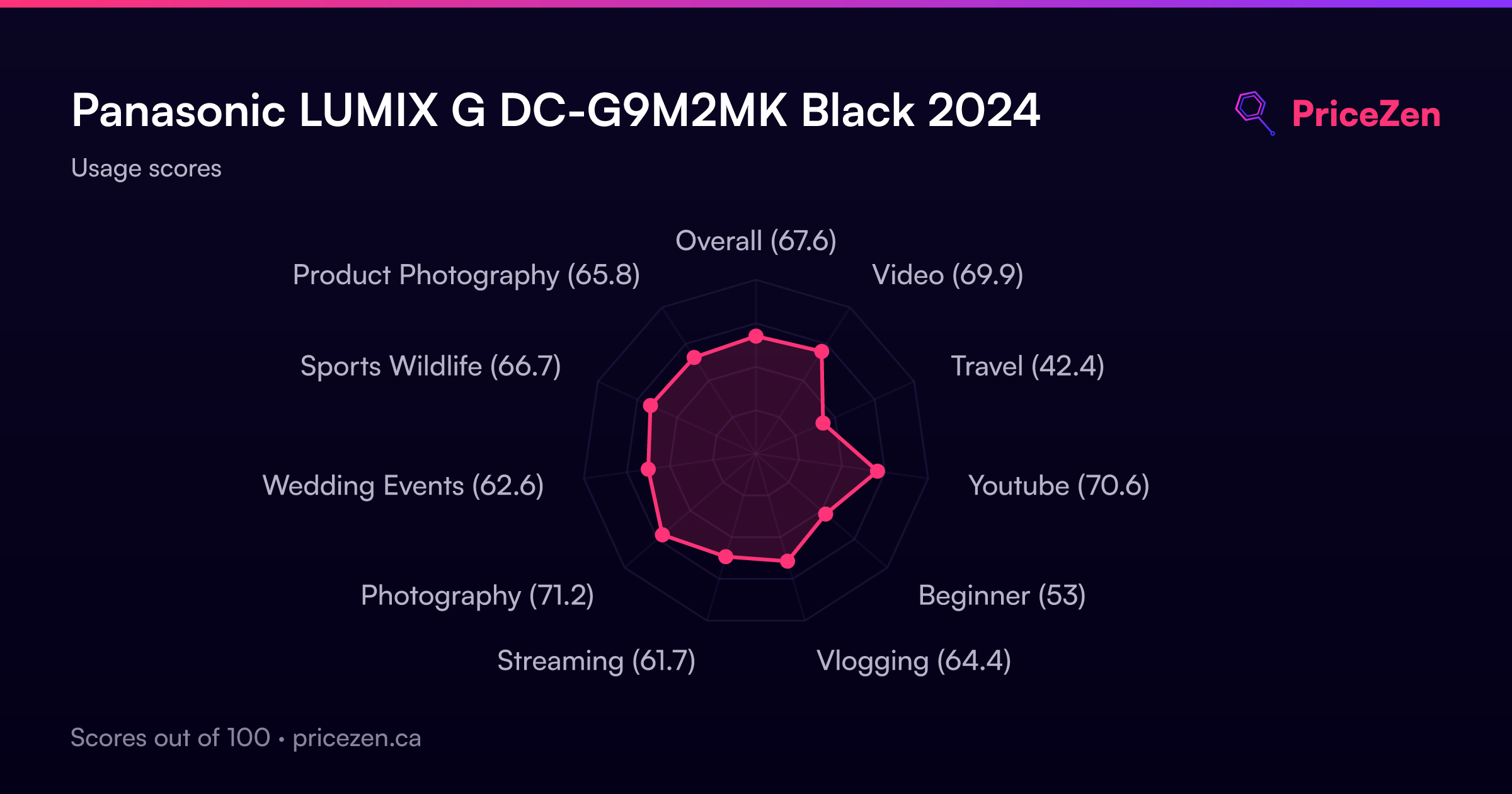
Usage Scores
- Overall67.7
- Video69.9
- Travel42.8
- Youtube70.6
- Beginner52.2
- Vlogging64.4
- Streaming61.3
- Photography70.8
- Wedding Events62.5
- Sports Wildlife66.6
- Product Photography65.4