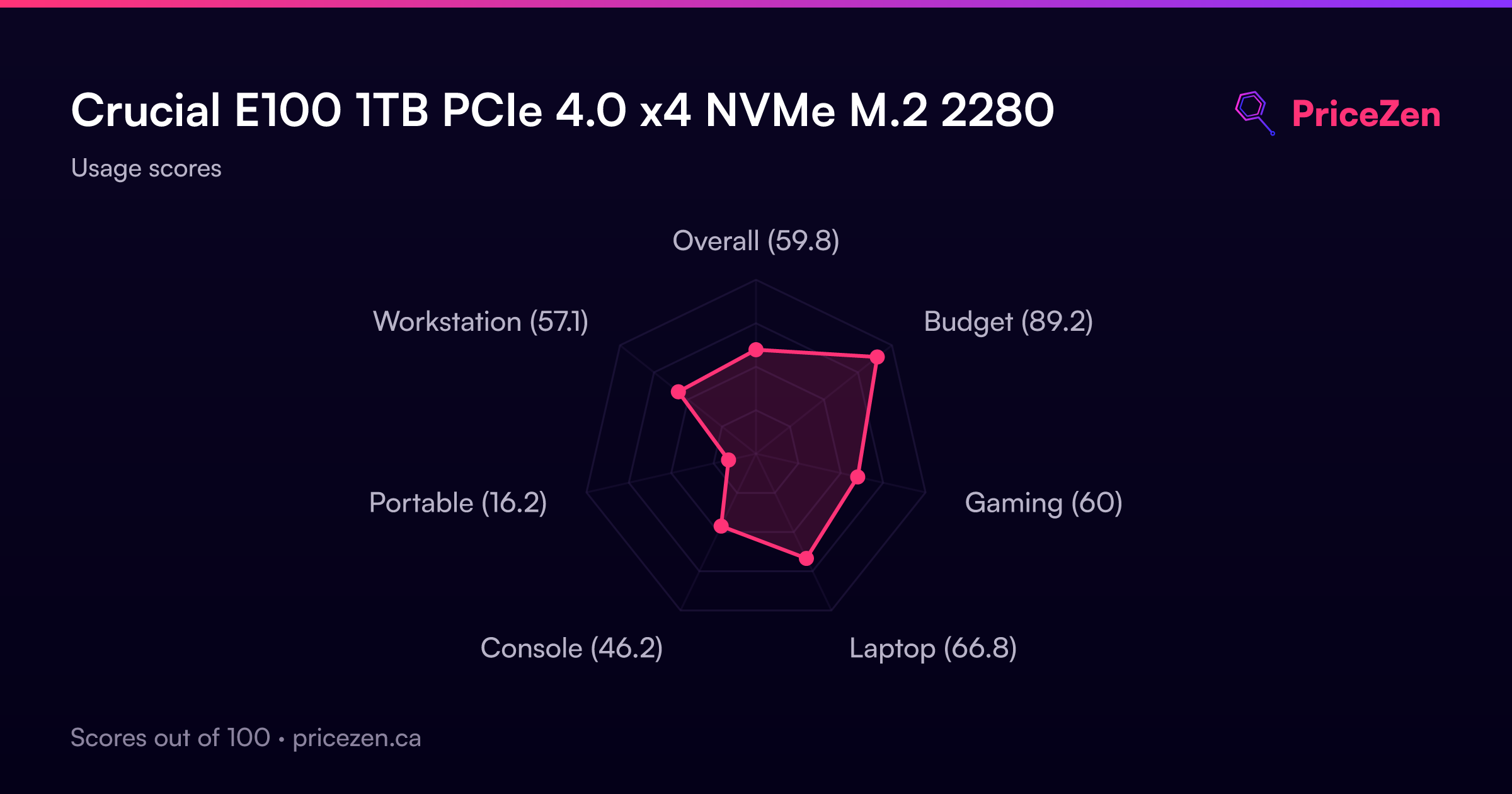
Crucial E100 1TB PCIe 4.0 x4 NVMe M.2 2280
The 1TB M.2 PCIe 4.0 NVMe drive hits 5000 MB/s reads and 4500 MB/s writes, making it 8 times faster than SATA SSDs and 33 times faster than HDDs. It offers up to 2TB capacity, a 3-year warranty, and 80 TBW endurance, with a 4.5/5 rating from 775 reviews. Best for budget builders upgrading from an HDD or SATA SSD who want Gen4 speed without the premium price.












Snapshot
The 30-Second Version
The Crucial E100 is a budget PCIe 4.0 SSD that hits 5000 MB/s reads and 4500 MB/s writes, which is plenty fast for gaming and everyday use. It's priced competitively, with Best Buy offering the best US deal at USD 158. Endurance is average at 80 TBW, and there's no DRAM cache, but for most people, this drive is an easy win. If you're upgrading from a hard drive or SATA SSD, you'll notice a massive difference.
Pros & Cons
Pros
- 5000 MB/s read speed at a budget price 74th
- Solid 4.5/5 customer rating from 775 reviews
- Easy installation with cloning instructions included
- Runs cooler and quieter than a hard drive
- 3-year warranty from a trusted brand
Cons
- No DRAM cache, relies on HMB
- 80 TBW endurance is just average
- Feature set is minimal, 15th percentile
- Write speeds dip under sustained load
- Not the best choice for heavy workstation use
What owners think
The Word on the Street
How owner sentiment changed over time
ExclusiveBased on when customers actually wrote their reviews - so you can see whether early praise held up.
11 written reviews, Jun 2025 – Apr 2026: 11 happy
Across all 771 store ratings: 4.5★. Most owners rate without writing a review. The chart counts the 11 written reviews.
Each dot is one written review, in the month it was written. Happy = 4-5★, mixed = 3★, unhappy = 1-2★.
The proof
Performance
Let's talk numbers. The E100 is rated for 5000 MB/s sequential reads and 4500 MB/s writes. That puts it at the 74th percentile for speed in our database, which is solidly above average. It's not going to win any benchmark races against the Samsung 980 PRO or WD Black SN850X, both of which push past 7000 MB/s, but here's the thing: for everyday tasks, game loading, and general productivity, you're not going to feel the difference. Windows boots in seconds, games load fast, and large file transfers are quick enough that you won't be staring at a progress bar.
The endurance rating is 80 TBW, which lands at the 51st percentile. That's about average for a budget drive, and it's fine for typical consumer use. If you're writing hundreds of gigabytes a day, you'll want something with more headroom, but for the average person, 80 TBW translates to years of normal use. The 3-year warranty is also pretty standard for this class. One thing to note: the E100 doesn't have a DRAM cache, which is typical for budget drives. It uses HMB (Host Memory Buffer) instead, which borrows a bit of your system RAM to keep things snappy. In practice, this works well for most workloads, though sustained heavy writes can dip a bit compared to DRAM-equipped drives.
Specifications
Full Specifications
Drive
| Capacity | 1000 |
| Form Factor | M.2 2280 |
| Interface | PCIe 4.0 x4 |
| Protocol | NVMe |
| PCIe Generation | 4 |
| External | No |
Performance
| Sequential Read (MB/s) | 5000 |
| Sequential Write (MB/s) | 4500 |
Reliability
| Endurance (TBW) | 80 |
| Warranty (years) | 3 |
Features
| Heatsink | No |
vs Competition
The Samsung 980 PRO is the obvious comparison, and it's a better drive on paper. Faster sequential speeds, higher endurance, and a proven track record. But it also costs more, sometimes significantly more. If you're doing heavy video editing or running workloads that hammer the drive constantly, the 980 PRO is worth the premium. For everyone else, the E100 gets you 90% of the way there for less money.
The WD Black SN850X is another step up, with speeds that embarrass the E100 on paper. But again, real-world differences are smaller than the spec sheet suggests. The Lexar NM1090 PRO and Corsair MP700 Elite are even faster, pushing into the 7000+ MB/s range, but they're aimed at enthusiasts who actually need that throughput. The MSI SPATIUM M480 PRO sits in a similar performance tier to the E100 but tends to cost a bit more. If you're just gaming and doing everyday tasks, the E100 is the sensible pick. If you're chasing benchmark scores or doing sustained professional work, look at the 980 PRO or SN850X.
| Spec | Crucial E100 | Samsung 9100 PRO | Kingston Fury Renegade | Western Digital WD_BLACK SN850P | Team Group MP44 | XPG GAMMIX S70 Blade |
|---|---|---|---|---|---|---|
| Capacity | 1TB | 2TB | 2TB | 4TB | 4TB | 2TB |
| Form Factor | M.2 2280 | M.2 2280 | M.2 2280 | M.2 2280 | M.2 2280 | M.2 2280 |
| Interface | PCIe 4.0 x4 | PCIe 5.0 x4 | PCIe 4.0 x4 | PCIe 4.0 x4 | PCIe 4.0 x4 | PCIe 4.0 x4 |
| Seq Read | 5,000 MB/s | 14,700 MB/s | 7,300 MB/s | 7,300 MB/s | 7,400 MB/s | 7,400 MB/s |
| Nand Type | - | TLC | TLC | - | TLC | TLC |
| Dram Cache | - | true | true | true | false | true |
| Endurance | 80 TBW | 1200 TBW | 2000 TBW | 2400 TBW | 2000 TBW | 1480 TBW |
| Compare | Compare | Compare | Compare | Compare |
| Product | Speed | Random | Feature | Capacity | Endurance | Social Proof | Affordability |
|---|---|---|---|---|---|---|---|
| Crucial E100 | 74.3 | 61.8 | 14.6 | 55.4 | 51.2 | 64.8 | 63.8 |
| Samsung 9100 PRO Compare | 98.9 | 99.8 | 99.7 | 78.6 | 85.6 | 94.9 | 21.4 |
| Kingston Fury Renegade Compare | 93.3 | 94.4 | 93.9 | 78.6 | 94 | 94.9 | 23.7 |
| Western Digital WD_BLACK SN850P Compare | 89 | 95.7 | 84.7 | 92.5 | 88.1 | 99.6 | 10.2 |
| Team Group MP44 Compare | 93.6 | 88.7 | 52.8 | 92.5 | 76.6 | 85.8 | 16.2 |
| XPG GAMMIX S70 Blade Compare | 92.9 | 90.5 | 93.9 | 78.6 | 77.2 | 75.1 | 31 |
Price
Value & Pricing
Here's where the E100 gets interesting. In the US, prices range from USD 158 to USD 190 across five listings, and Best Buy has the lowest price at USD 158. That's a meaningful spread, so it pays to shop around. In Europe, you're looking at EUR 158 to EUR 183, with the best deal also at the lower end. For a 1TB Gen4 drive with these speeds, that's genuinely good value. You're paying roughly the same as a high-end SATA SSD but getting four to five times the sequential performance.
Compared to the competition, the E100 undercuts the Samsung 980 PRO and WD Black SN850X by a decent margin, especially when those drives aren't on sale. The trade-off is that you're giving up top-tier performance and some endurance. But if you're building a budget system or just need a fast boot drive without breaking the bank, the E100 makes a strong case for itself. The affordability percentile sits at 64th, which means it's better than most drives in its class on price, and that's really the whole point of this product.
Amazon 1 offer From CA$220
Price history
Read more
Overview
The Crucial E100 is one of those drives that makes you do a double take. It's a PCIe 4.0 NVMe SSD with 5000 MB/s read speeds, and it's priced like a budget SATA drive from a few years ago. Crucial has been in the storage game forever, and they've built a reputation on reliable, no-nonsense drives that just work. The E100 slots in as their entry-level Gen4 option, and honestly, for most people, it's probably all the speed they'll ever need.
Who's this for? If you're building a budget gaming PC, upgrading an older laptop, or just want to breathe new life into a machine that's still chugging along on a hard drive or SATA SSD, this is squarely aimed at you. It's not trying to compete with the flagship drives that push 7000 MB/s. It's trying to give you 80% of that experience for a lot less money. And based on the numbers, it mostly succeeds.
The interesting thing here is the positioning. Crucial already has the P3 Plus as their mainstream Gen4 drive, and the T500 as their performance option. The E100 sits below both, but it's not a dramatic step down in real-world use. You get solid sequential speeds, decent endurance for the price, and that Crucial reliability baked in. It's the kind of drive you buy when you want to stop thinking about storage and just use your computer.
Common Questions
Q: Is this drive good for gaming?
Yes, absolutely. The 5000 MB/s read speed is well above what most games need, and you'll see fast load times across the board. While it's not as fast as flagship drives like the Samsung 980 PRO, the difference in game loading is typically a second or two at most. For the price, it's one of the best gaming SSD values out there.
Q: Does this drive have a DRAM cache?
No, the E100 doesn't have a DRAM cache. It uses HMB (Host Memory Buffer), which borrows a small amount of your system RAM to manage the drive's mapping tables. For most everyday tasks and gaming, this works perfectly fine. You might notice slightly lower sustained write speeds compared to DRAM-equipped drives, but for typical use, it's not a meaningful difference.
Q: How long will this drive last?
The E100 is rated for 80 TBW (terabytes written), which means you can write 80 terabytes of data before the drive's endurance rating is exhausted. For a typical user writing 20-30 GB per day, that works out to roughly 7-10 years of use. The 3-year warranty provides additional peace of mind, and Crucial's reputation for reliability is solid.
Q: Will this work in my laptop?
It depends on your laptop. The E100 is an M.2 2280 form factor drive with a PCIe 4.0 x4 interface. Most laptops from the last few years with an M.2 slot will support it, though older laptops with PCIe 3.0 slots will run it at reduced speeds (around 3500 MB/s). Check your laptop's specs to confirm it has an M.2 NVMe slot before buying.
Who Should Skip This
If you're a video editor, 3D artist, or anyone who regularly moves hundreds of gigabytes around, the E100's 80 TBW endurance and lack of DRAM cache will become limiting factors. Sustained write workloads will cause performance to dip, and you'll burn through the endurance rating faster than you'd like. For those use cases, look at the Samsung 980 PRO or WD Black SN850X, both of which offer higher endurance and more consistent performance under load.
You should also skip this if you're building a high-end system where storage is a bottleneck. If you've already spent big on a top-tier CPU and GPU, pairing them with a budget SSD doesn't make much sense. The Corsair MP700 Elite or Lexar NM1090 PRO would be better matches for a flagship build. And if you need more than 1TB of storage, you'll want to look at the 2TB version of this drive or consider a larger capacity option from another brand.
Verdict
For most people, the Crucial E100 is an easy recommendation. It's fast enough that you won't notice the difference between it and a flagship drive in daily use, and it's priced low enough that you can put the savings toward other components. Gamers on a budget, students, and anyone upgrading from a hard drive or SATA SSD will be thrilled with this thing. The 5000 MB/s read speed is genuinely fast, and the 4.5-star rating from 775 reviews suggests real buyers are happy with their purchase.
If you're a content creator who regularly moves large files around, or you're building a high-end workstation where every second counts, you should probably spend more and get something with higher endurance and a DRAM cache. The E100's 80 TBW rating and lack of DRAM mean it's not built for heavy sustained writes. But for the other 90% of users, this drive is a no-brainer at the right price. Just make sure you shop around, because that USD 32 price spread in the US means some retailers are charging more than they should.
Usage Scores
- Overall59.8
- Budget89.2
- Gaming60
- Laptop66.8
- Console46.2
- Portable16.2
- Workstation57.1