ASUS Radeon RX 6500 XT Dual 4GB GDDR6 Black
The RDNA 2 architecture and 2820 MHz boost clock provide efficient 1080p gaming, while the dual-fan Axial-tech design with 0dB technology keeps the 201mm card quiet under light loads. Its compact size and low 107W TDP make it a straightforward drop-in upgrade for older systems needing modern features like HDMI 2.1 and ray tracing support. This card is best for budget-conscious builders targeting esports titles at 1080p, not for AI workloads or high-fidelity AAA gaming.



Snapshot
The 30-Second Version
Cheap, tiny, and easy to power, but 4GB on a 64-bit bus holds it back hard. Affordability is the highlight, one of the best we've seen, while overall performance lands at 33.8/100. Worth it at USD 206 for a budget 1080p build, not for anything more ambitious.
Pros & Cons
Pros
- Affordability is a standout, one of the best in our data. 83rd
- At 201mm and two slots, it fits small cases without drama.
- 107W TDP and a single 6-pin connector keep the power side simple.
- HDMI 2.1 plus DisplayPort 1.4a covers modern displays.
Cons
- 4GB on a 64-bit bus is a real letdown for current games.
- Only two video outputs, so multi-monitor setups hit a wall fast.
- Ray tracing performance falls behind despite the 16 RT cores.
- AI and LLM work is basically off the table at 10.5/100.
The proof
Performance
The PassMark G3D benchmark score is 9626, and raster performance is in the bottom quarter of cards we track, so it lags behind most. Compute is similar at 5.76 FP32 TFLOPS, also in the bottom quarter. The real bottleneck is memory: 4GB across a 64-bit bus gives you 144 GB/s, and VRAM ranks in the bottom fifth. Modern games eat that alive. There are 16 RT cores on paper, but ray tracing scores are below average, so treat that checkbox as decoration. FSR helps stretch frames if you're willing to drop resolution. Thermals are about average with the dual-fan setup, efficiency is middling too, and AI work is the weak spot at 10.5/100. One more thing worth knowing: it's PCIe 4.0, so an older PCIe 3.0 board isn't the ideal home for it.
Specifications
Full Specifications
Chipset
| GPU Chipset | Radeon RX 6500 XT |
| Brand | AMD |
| Architecture | RDNA 2 |
| Class | consumer |
| Process | 6 |
Memory
| VRAM | 4 GB |
| Memory Type | GDDR6 |
| Memory Bus | 64 |
| Bandwidth | 143.9 |
Compute
| Stream Processors | 1024 |
| RT Cores | 16 |
| Base Clock | 2670 |
| Boost Clock | 2820 |
| FP16 TFLOPS | 11.53 |
| FP32 TFLOPS | 5.765 |
Performance
| PassMark G3D | 9626 |
| GPU Compute | 4356 |
Power & Cooling
| TDP | 107 |
| Recommended PSU | 500 |
| Power Connectors | 6-Pin |
| Cooler | Dual Fan |
| Fans | 2 |
Connectivity
| Interface | PCI Express 4.0 |
| DisplayPort | 1 |
| HDMI | 1 |
| Max Displays | 2 |
| Max Resolution | 7680 x 4320 |
Physical
| Length | 201 |
| Slot Width | 2 |
| Form Factor | Full Height |
Features
| Ray Tracing | Yes |
| Upscaling | FSR |
| AV1 Encode | No |
| DirectX | 12 Ultimate |
| RGB | No |
vs Competition
Against the cards it's usually cross-shopped with, this isn't a close fight on performance. The MSI GeForce RTX 5070 SHADOW and ZOTAC GeForce RTX 5070 Twin Edge OC are the ones to look at if you want headroom for newer titles, because 4GB and a bottom-quarter raster ranking will cap you long before your CPU does. Same story with the Gigabyte Radeon RX 7800 XT Gaming OC, XFX Radeon RX 7900 GRE Gaming and Sapphire Radeon RX 7900 GRE PULSE. Those are the cards to shortlist if you're gaming above 1080p or you care about ray tracing, where this one is below average. Where the ASUS wins is size and draw: 201mm, two slots, 107W, one 6-pin. If your case is tiny or your PSU is modest, that matters more than raw frames.
| Spec | ASUS Radeon RX 6500 XT Dual | MSI GeForce RTX 5070 Gaming Trio | Sapphire Radeon RX 9070 XT PULSE | XFX Radeon RX 9070 XT Mercury | PowerColor Radeon RX 9070 XT Hellhound OC | Gigabyte Radeon RX 9070 XT Gaming |
|---|---|---|---|---|---|---|
| Chipset | Radeon RX 6500 XT | GeForce RTX 5070 | Radeon RX 9070 XT | Radeon RX 9070 XT | Radeon RX 9070 XT | Radeon RX 9070 XT |
| Vram | 4GB GDDR6 | 12GB GDDR7 | 16GB GDDR6 | 16GB GDDR6 | 16GB GDDR6 | 16GB GDDR6 |
| Boost Clock Mhz | 2820 | 2610 | 2970 | 3100 | 3010 | 2970 |
| Tdp W | 107 | 250 | 304 | 304 | 304 | 304 |
| Memory Bus Bits | 64 | 192 | 256 | 256 | 256 | 256 |
| Ray Tracing | true | true | true | true | true | true |
| GPU Class | consumer | consumer | consumer | consumer | consumer | consumer |
| Compare | Compare | Compare | Compare | Compare |
| Product | AI | Rt | Vram | Raster | Compute | Feature | Thermal | Efficiency | Connectivity | Affordability |
|---|---|---|---|---|---|---|---|---|---|---|
| ASUS Radeon RX 6500 XT Dual | 16.5 | 29.4 | 17 | 22 | 21.5 | 52.4 | 54.8 | 47.6 | 29.8 | 83.2 |
| MSI GeForce RTX 5070 Gaming Trio Compare | 61.1 | 82.9 | 65.1 | 79 | 71 | 95.8 | 91.8 | 78.7 | 94.1 | 31.3 |
| Sapphire Radeon RX 9070 XT PULSE Compare | 89.3 | 84.8 | 73.5 | 74.9 | 90 | 95.8 | 72.1 | 44.9 | 88.9 | 43.7 |
| XFX Radeon RX 9070 XT Mercury Compare | 89.4 | 84.8 | 75.1 | 74.9 | 91 | 95.8 | 72.1 | 44.9 | 94.1 | 43.1 |
| PowerColor Radeon RX 9070 XT Hellhound OC Compare | 89.7 | 84.8 | 75.1 | 74.9 | 95.1 | 88.7 | 91.8 | 44.9 | 94.1 | 42 |
| Gigabyte Radeon RX 9070 XT Gaming Compare | 89.5 | 77.8 | 73.5 | 74.9 | 90 | 95.8 | 91.8 | 44.9 | 88.9 | 27.2 |
Price
Value & Pricing
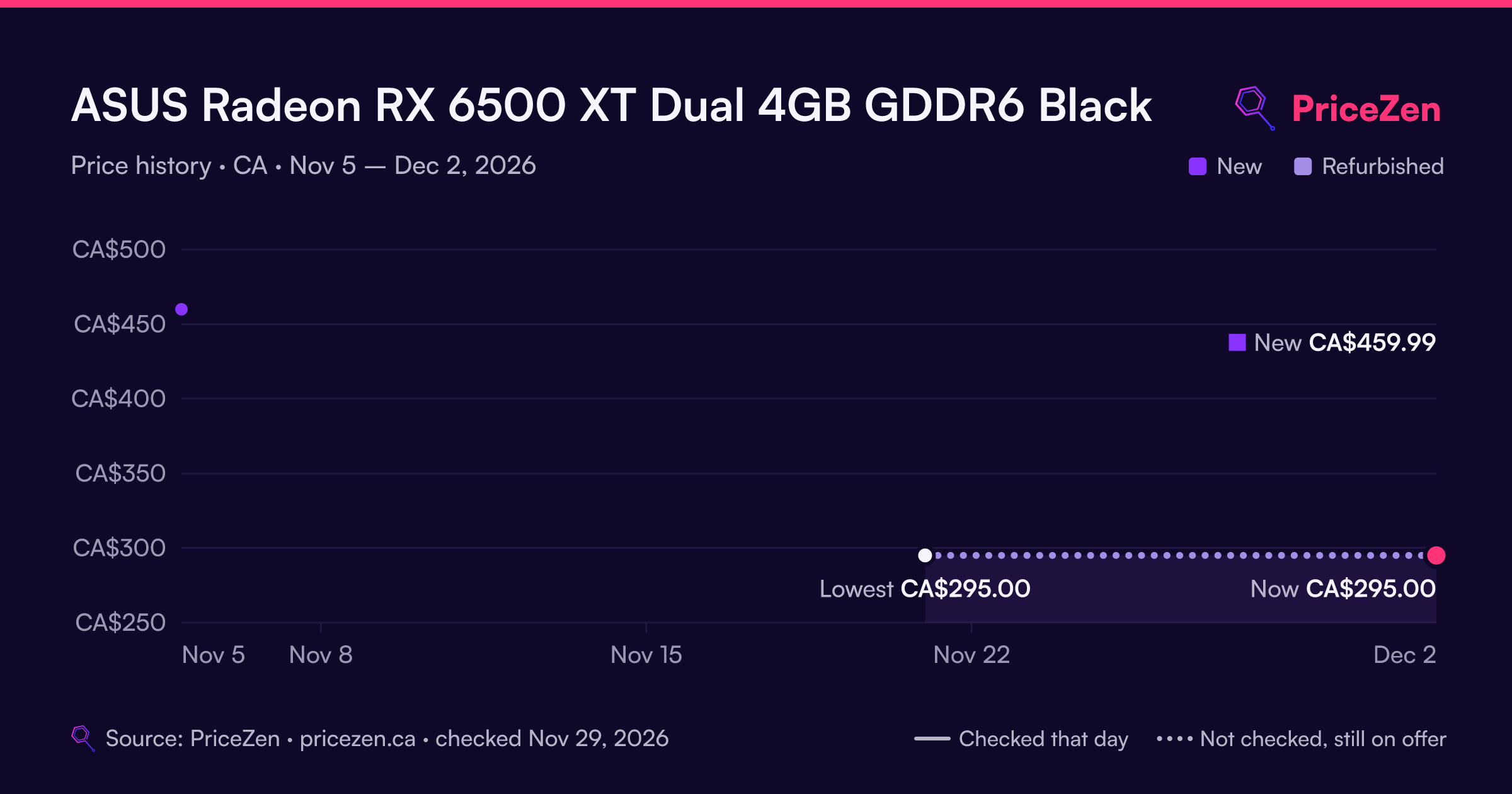
Newegg has it at USD 206, and that's the number that makes this card make any sense at all. Our budget score of 76.4 backs that up. In Canada the listings run from CAD 295 to CAD 460, a CAD 165 spread, which is a big gap for the same hardware. At the bottom of that range it's a reasonable cheap-build pick. At CAD 460 you're paying a lot for 4GB and a 64-bit bus, and we'd walk away. We track prices over time, partly through our community browser extension, so watch where it sits before you pull the trigger.
Newegg 1 offer From CA$295
Price history
Read more
Overview
This is ASUS's compact take on AMD's entry-level RDNA 2 card. 4GB of GDDR6 on a 64-bit bus, 1024 stream processors, a 2820MHz boost clock, and a 201mm dual-slot body that'll fit in cases where bigger cards won't. It pulls 107W and needs one 6-pin connector.
Our scoring model puts it at 33.8 overall, which tells you most of the story. But the budget score is 76.4 and affordability is one of the best we've seen. This thing isn't trying to win a spec fight. It's trying to get a cheap PC gaming at 1080p, and that's the only lane it belongs in.
Common Questions
Q: How many displays can I run off this card?
Two, since you get one HDMI 2.1 and one DisplayPort 1.4a. Connectivity is below average in our data, so plan around that limit.
Q: What power supply do I need?
A 500W unit is the recommendation, and the card draws 107W through a single 6-pin connector. No adapter gymnastics required.
Q: Will it handle ray tracing or local AI models?
Not really. There are 16 RT cores but ray tracing is below average, and AI scores just 10.5/100 with only 4GB of VRAM to work with.
Who Should Skip This
If you play current AAA releases, skip it. 4GB on a 64-bit bus with 144 GB/s means texture settings and stutter become your problem, not your preference. Same if you want three monitors, since there are only two outputs. And if you're buying for local AI or LLM tinkering, look elsewhere entirely, because 10.5/100 and 4GB of VRAM is a non-starter.
Verdict
Buy this if you're building or reviving a budget 1080p machine, you play lighter or older titles, and USD 206 is roughly your ceiling. It's also a sensible pick for a small-form-factor box where a longer card physically won't go. Anyone expecting to run current AAA games at high settings should keep shopping. Our gaming 1080p score of 33.5 is honest about what you're getting.
Usage Scores
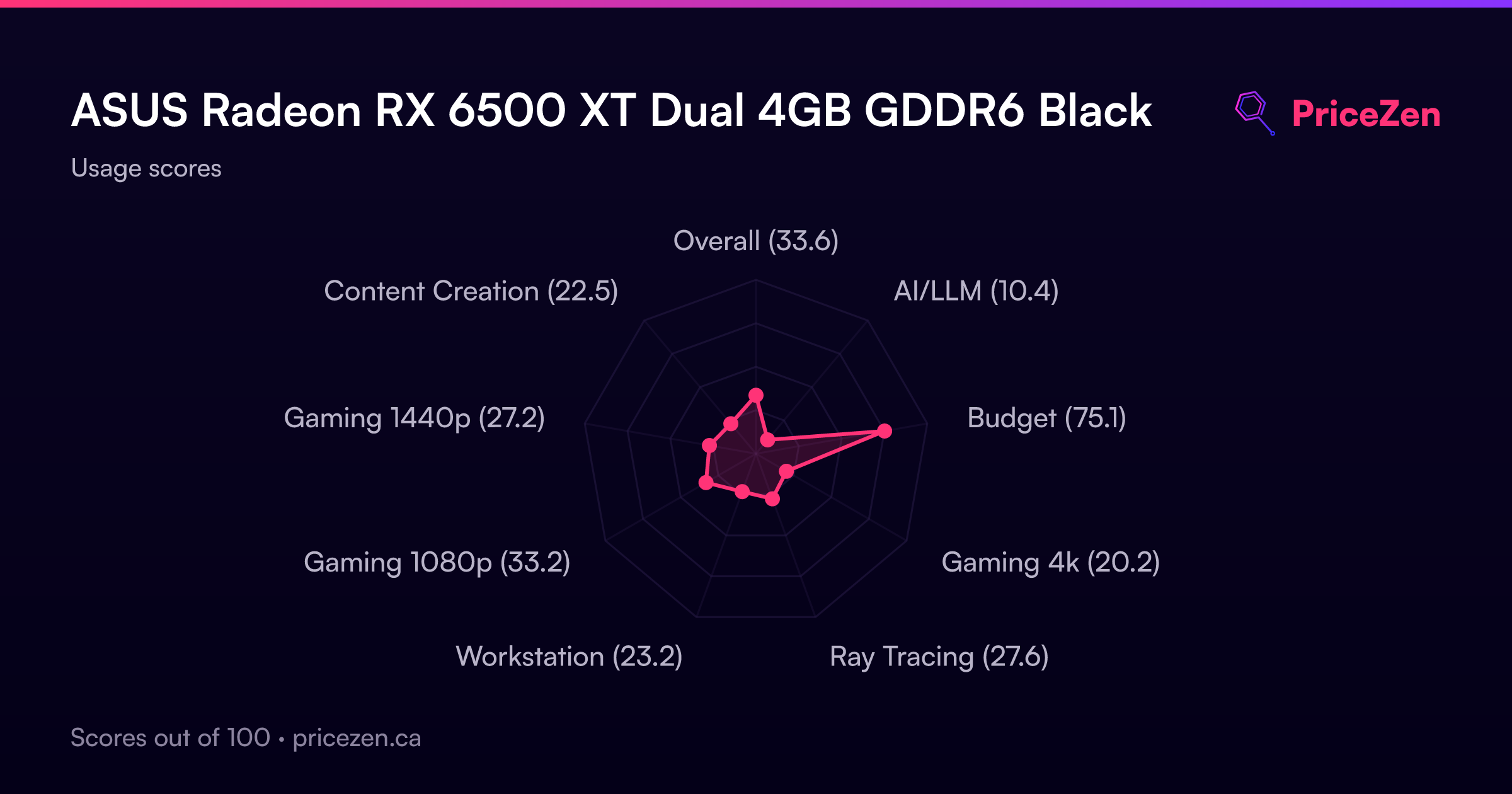
- Overall33.6
- AI/LLM10.4
- Budget75.1
- Gaming 4k20.2
- Ray Tracing27.6
- Workstation23.2
- Gaming 1080p33.2
- Gaming 1440p27.2
- Content Creation22.5