Samsung S85H Series QN77S85HAEXZC 77"
The 77-inch 4K OLED panel with Motion Xcelerator 120Hz and FreeSync Premium delivers smooth, tear-free gaming, while Auto HDR Remastering and 4K AI Upscaling Pro enhance lower-quality content. Wi-Fi 7 support and a 5-year Allstate protection bundle add practical value beyond the display. Best for smart home enthusiasts and gamers who want a large OLED with low input lag and future-proof connectivity.












Snapshot
The 30-Second Version
The Samsung S85H is a 77-inch OLED with a great panel and 120Hz gaming support, but its HDR brightness falls behind competitors. At $1,800, you're paying OLED prices without getting the full HDR experience. It's a solid pick for dark rooms and SDR content, but LG and Sony offer better picture quality for similar money.
Pros & Cons
Pros
- 77-inch OLED panel with top-tier display fundamentals 98th
- 120Hz refresh rate with FreeSync Premium for smooth gaming 98th
- Wi-Fi 7 support for future-proof connectivity 96th
- 4K AI Upscaling Pro makes older content look better 90th
- Strong smart home integration with Alexa, Google Assistant, and Bixby
Cons
- Picture quality and HDR scores land in the bottom half of the category
- 20W built-in audio is weak for a TV this size
- No price advantage over brighter OLED competitors at $1,800
- Only one customer review, so long-term reliability is unknown
- HDR brightness can't match LG or Sony OLED flagships
What owners think
How owner sentiment changed over time
ExclusiveBased on when customers actually wrote their reviews - so you can see whether early praise held up.
16 written reviews, Jun – Nov 2026: 15 happy, 1 mixed
Across all 239 store ratings: 4.8★. Most owners rate without writing a review. The chart counts the 16 written reviews.
- Oct – Dec 20269 of 10 happy
Buyers praised the OLED's sharp, bright picture and deep blacks, with several noting excellent contrast and color. A few reported screen distortion from side angles or remote issues, but overall satisfaction was high.
- Picture quality praised for sharpness, brightness, contrast, and color in multiple reviews.
- Screen distortion or ripples when viewed from an angle reported in two reviews.
- Remote control malfunction led to a return in one review.
- User interface and performance described as fast and snappy, like a phone.
- Jul – Sep 20265 of 5 happy
Buyers in this period praised the TV's picture quality, sound, and ease of setup, with several noting improvements over older models. All reviews were positive, highlighting intuitive controls and streaming app integration.
- Excellent picture quality, including vivid colors, true blacks, and good viewing angles, noted by multiple reviewers.
- Sound quality improved, with one reviewer noting their soundbar 'came alive' and another praising the TV's own sound.
- Easy setup and intuitive remote/navigation, with one reviewer saying no manual needed and another finding streaming services easy to configure.
- Upgrade from older TVs, with two reviewers replacing 7-12 year old models and noting significant improvements.
Each dot is one written review, in the month it was written. Happy = 4-5★, mixed = 3★, unhappy = 1-2★. Period summaries are in English.
The proof
Performance
The display itself is the star. At 77 inches with a 4K OLED panel, you're getting per-pixel lighting, which means true blacks and no blooming around bright objects. Our database puts the display quality in the 97th percentile for this category, so the panel fundamentals are excellent. The Motion Xcelerator 120Hz keeps fast action smooth, and combined with FreeSync Premium, gaming feels responsive without tearing.
But here's the thing. The picture quality score lands at the 36th percentile, and HDR sits at the 34th percentile. That's not a typo. The panel is great, but the brightness and HDR processing don't keep up with the best OLEDs out there. If you're in a bright room or you watch a lot of HDR content with bright highlights, you'll notice this thing doesn't punch as hard as an LG OLED evo or Sony BRAVIA 9. The Auto HDR Remastering helps with SDR content, but it can't add peak brightness the panel doesn't have.
Specifications
Full Specifications
Display
| Size | 77" |
| Resolution | 4K |
| Panel Type | OLED |
| Backlight | OLED |
| Aspect Ratio | 16:9 |
| Curved | No |
Picture Quality
| Contrast Ratio | Infinite Contrast |
| Motion Tech | Motion Xcelerator 120Hz |
| Processor | NQ4 AI Gen2 Processor |
HDR
| HDR Formats | HDR10+ Adaptive |
| HDR10+ | Yes |
Gaming
| Refresh Rate | 120 Hz |
| VRR | FreeSync Premium |
| ALLM | Yes |
| Game Mode | Yes |
Smart TV
| Platform | Tizen |
| Voice Assistant | Amazon Alexa, Google Assistant |
| Screen Mirroring | Apple AirPlay 2 |
| Works With | Apple AirPlay, Google Assistant, Alexa, Samsung SmartThings, Google Chromecast, Bixby |
Audio
| Speaker Config | 2 |
| Wattage | 20 |
| Dolby Atmos | Yes |
| Surround Sound | Dolby Atmos, OTS Lite, Q-Symphony, Adaptive Sound Pro |
| eARC | Yes |
Connectivity
| HDMI Ports | 4 |
| HDMI Version | 2.1 |
| USB Ports | 2 |
| Wi-Fi | Wi-Fi 6E |
| Bluetooth | 5.3 |
| Ethernet | Yes |
| Optical Audio | Yes |
| VESA Mount | 400x300 |
Power & Size
| Energy Star | Yes |
| Weight | 28.1 kg / 61.9 lbs |
vs Competition
The LG OLED evo C5 is the most direct competitor. LG's OLED panels have consistently led in brightness and HDR handling, and the C5 continues that. You'll get better HDR pop and a brighter overall image. The trade-off is LG's webOS versus Samsung's Tizen, which is more of a preference thing than a clear win either way.
The Sony BRAVIA 9 takes a different approach with a brighter panel and Sony's excellent processing. It costs more, but if you watch a lot of movies and care about accurate HDR, Sony's the benchmark. The TCL QM8K and Hisense U8 are the value plays. They're not OLED, but their mini-LED panels get much brighter, and they cost less. If you're in a bright room, those might actually look better than the S85H despite the OLED label.
| Spec | Samsung S85H Series QN77S85HAEXZC 77" | LG OLED evo OLED55C5PUA 55" | Sony A95L XR77A95L 77" | TCL QM8K Series 75QM8K 75" | Hisense U7 75U7SG 75" | Roku Pro Series 75R8C5 75" |
|---|---|---|---|---|---|---|
| Screen Size | 77 | 55 | 77 | 75 | 75 | 75 |
| Resolution | 3840x2160 | 3840x2160 | 3840x2160 | 3840x2160 | 3840x2160 | 3840x2160 |
| Panel Type | OLED | OLED | QD-OLED | Mini-LED | Mini-LED | QLED |
| Refresh Rate | 120 | 120 | 120 | 144 | 165 | 120 |
| Hdr | HDR10+ Adaptive | Dolby Vision, HDR10 | HDR10, HLG, Dolby Vision | Dolby Vision, HDR 10, HDR 10+, Hybrid Log-Gamma (HLG) | Dolby Vision, HDR 10+, HDR 10, Hybrid Log-Gamma (HLG) | Dolby Vision, HDR 10+, Hybrid Log-Gamma (HLG) |
| Smart Platform | Tizen | webOS | Google TV | Google TV | Google TV | Roku TV |
| Dolby Vision | - | Yes | Yes | Yes | Yes | Yes |
| Dolby Atmos | Yes | Yes | Yes | Yes | Yes | Yes |
| Hdmi Version | 2.1 | 2.1 | 2.1 | 2.1 | 2.1 | 2.1 |
| Compare | Compare | Compare | Compare | Compare |
| Product | HDR | Audio | Smart | Gaming | Display | User Sentiment | Connectivity | Social Proof | Affordability | Picture Quality |
|---|---|---|---|---|---|---|---|---|---|---|
| Samsung S85H Series QN77S85HAEXZC 77" | 90.3 | 73.6 | 67.8 | 81.5 | 97.5 | 61.9 | 95.9 | 97.8 | 24.3 | 34.1 |
| LG OLED evo OLED55C5PUA 55" Compare | 90.1 | 93.3 | 86.4 | 97.5 | 86.6 | 61.9 | 98.6 | 92.8 | 36.1 | 92 |
| Sony A95L XR77A95L 77" Compare | 95.6 | 94.4 | 86.4 | 83.6 | 99.1 | 29.3 | 95.9 | 85.2 | 10 | 94.9 |
| TCL QM8K Series 75QM8K 75" Compare | 88.2 | 94.4 | 98.4 | 91.8 | 88.3 | 83 | 91 | 85.2 | 33.3 | 99.3 |
| Hisense U7 75U7SG 75" Compare | 88.2 | 94.4 | 93.2 | 94.1 | 88.3 | 48.1 | 95.9 | 92.8 | 32.1 | 96.9 |
| Roku Pro Series 75R8C5 75" Compare | 70.3 | 83.7 | 80.6 | 86.3 | 84.5 | 83 | 91 | 85.2 | 40.1 | 34.1 |
Price
Value & Pricing
At $1,800 for a 77-inch OLED, the S85H looks like a deal on paper. Big OLEDs usually cost more. But the value story gets complicated when you look at what the competition offers at similar prices. The LG OLED evo C5 and Sony BRAVIA 9 both deliver better HDR performance and brighter panels. You're not saving enough here to justify the brightness gap.
The bundle with the Allstate protection plan adds some peace of mind, but that's a retailer promotion, not a Samsung thing. If you can find this TV on sale below $1,500, the value equation shifts. At full price, you're paying OLED money for a panel that doesn't fully deliver the OLED HDR experience.
Costco 1 offer From CA$2,298
Visions Electronics 1 offer From CA$2,298
Price history
Read more
Overview
The Samsung S85H is a 77-inch OLED TV that sits in a weird spot in Samsung's lineup. It's got the OLED panel people want, the size people want, and a price that's aggressive for a screen this big. But Samsung made some choices here that you'll want to understand before you swipe a card. This isn't the flagship S95H, and the corners cut show up in specific places.
Who's this for? Someone who wants a massive OLED for a living room or home theater, watches a mix of streaming content and sports, and maybe games on a console. The 120Hz panel and FreeSync Premium support mean it handles a PS5 or Xbox Series X without breaking a sweat. And the smart home crowd gets solid integration with Alexa, Google Assistant, and Bixby built in.
The interesting part is what Samsung packed into the processing side. Auto HDR Remastering and 4K AI Upscaling Pro are doing real work here. You're getting Samsung's picture processing brain applied to a panel that's not quite as bright as their top-tier OLEDs. Whether that trade-off works for you depends on your room and your content habits.
Common Questions
Q: How does the S85H handle gaming?
The S85H supports 120Hz refresh rates, FreeSync Premium, ALLM, and HDMI 2.1, so it's well-equipped for PS5 and Xbox Series X. The gaming score lands in the 84th percentile for this category, which is strong. You'll get smooth motion and low input lag in Game Mode.
Q: Is the S85H bright enough for a living room with windows?
Probably not. The HDR score sits at the 34th percentile and picture quality at the 36th percentile, which means the panel doesn't get as bright as competing OLEDs from LG or Sony. If your room has significant ambient light, a mini-LED TV like the TCL QM8K or Hisense U8 might be a better fit.
Q: Does the S85H support Wi-Fi 7?
Yes, the S85H includes Wi-Fi 7 support, which is unusual for TVs right now. You'll need a compatible router to take advantage of the faster speeds, but it's a nice future-proofing feature if you stream high-bitrate content or have a crowded home network.
Q: How is the built-in audio on the S85H?
The built-in audio is 20W, which is on the weaker side for a 77-inch TV. The audio score lands in the 38th percentile. You'll want a soundbar or external audio system for anything beyond casual viewing, especially for movies or gaming.
Who Should Skip This
Skip the S85H if you watch a lot of HDR content or your room has significant ambient light. The HDR brightness just doesn't compete with the LG OLED evo C5 or Sony BRAVIA 9, and you'll notice it in bright scenes. If you're a movie buff who cares about accurate HDR, Sony's processing is worth the extra money.
Also skip it if you're on a tighter budget. The TCL QM8K and Hisense U8 deliver brighter images for less money, even if they're not OLED. And if you don't need 77 inches, stepping down in size opens up better HDR performance at similar prices.
Verdict
If you want a huge OLED for a dark room and you mostly watch SDR content or stream in standard dynamic range, the S85H delivers. The panel quality is genuinely excellent, and the upscaling makes older content look sharp. Gamers will appreciate the 120Hz and FreeSync support.
But if HDR matters to you, or your room has windows, look elsewhere. The LG C5 or Sony BRAVIA 9 will serve you better for similar or slightly more money. The S85H is a good TV that's hard to recommend at full price when the competition is this strong.
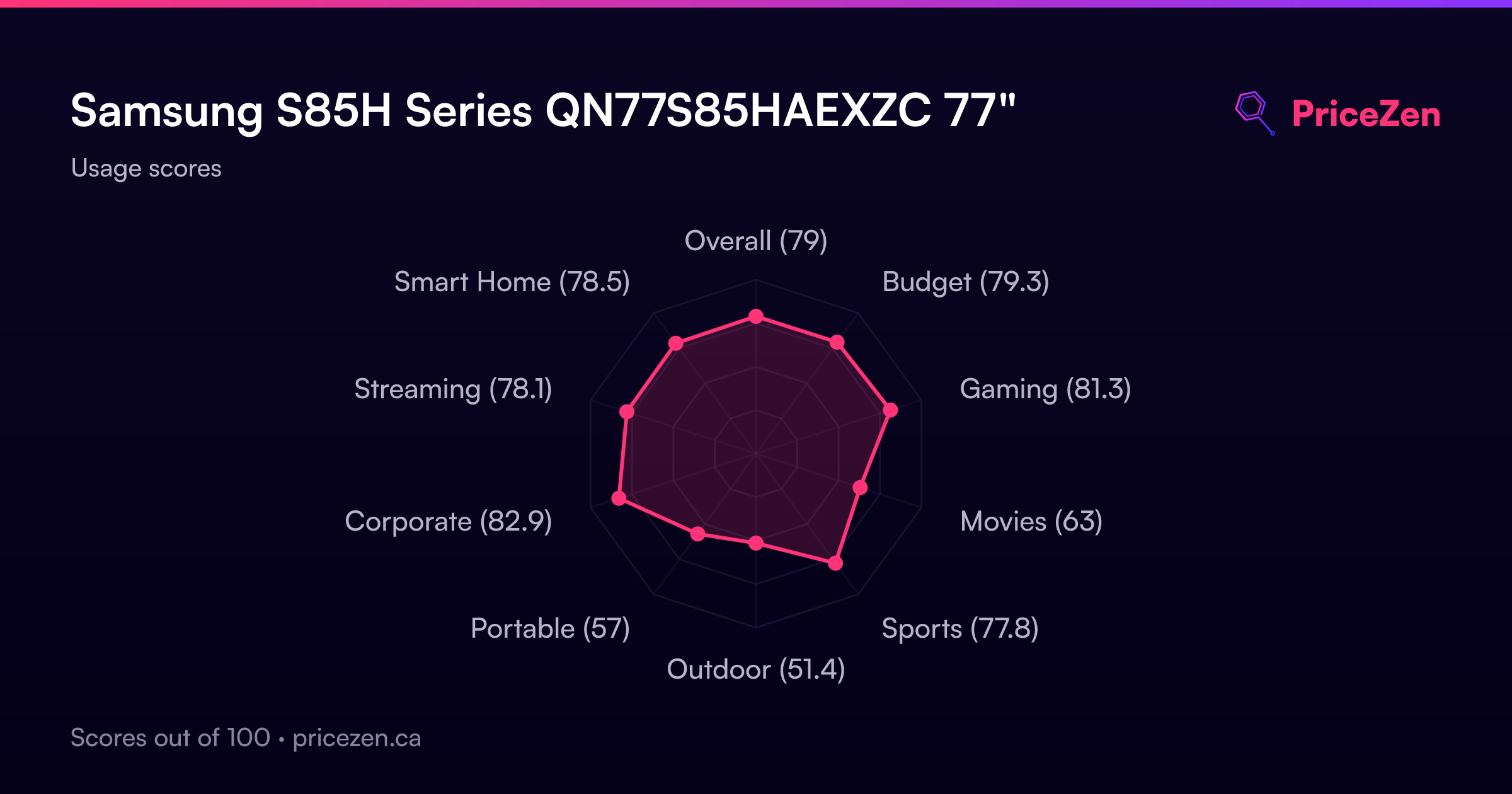
Usage Scores
- Overall79
- Budget78.5
- Gaming81.3
- Movies63
- Sports77.8
- Outdoor51.4
- Portable57
- Corporate82.9
- Streaming78.1
- Smart Home78.5