Samsung T7 1TB Portable USB 3.2 Gen 2
The 1TB Samsung T7 delivers 1050 MB/s read and 1000 MB/s write speeds over USB 3.2 Gen 2, with MLC NAND and a DRAM cache for sustained performance. Its aluminum monobloc body survives drops up to 1.8 meters, and hardware encryption adds security. Best for mobile professionals and students who need fast, durable, and portable storage for large files on the go.












Snapshot
The 30-Second Version
The Samsung T7 is a 1TB portable SSD that hits 1,050 MB/s read and 1,000 MB/s write speeds in a tiny, durable metal body. It's one of the most reliable external drives on the market, backed by MLC NAND, DRAM cache, and a 3-year warranty. Just make sure you shop around, prices swing from USD 125 to USD 260 depending on the retailer.
Pros & Cons
Pros
- Blazing 1,050 MB/s read and 1,000 MB/s write speeds 98th
- Tiny and light at 56 grams, credit card footprint 95th
- Hardware encryption with password protection built in 81st
- Metal body survives 1.8 meter drops
- DRAM cache and MLC NAND mean consistent performance
Cons
- Price fluctuates wildly between retailers
- Console support is weak, especially for PS5
- No IP rating for water or dust resistance
- USB-C cable is short and easy to lose
- 3-year warranty is fine but not class-leading
What owners think
The Word on the Street
How owner sentiment changed over time
ExclusiveBased on when customers actually wrote their reviews - so you can see whether early praise held up.
21 written reviews, Apr 2021 – Nov 2026: 20 happy, 1 mixed
Across all 14,934 store ratings: 4.8★. Most owners rate without writing a review. The chart counts the 21 written reviews.
- Oct – Dec 20266 of 6 happy
Buyers praised the T7's speed, compact size, and cross-device compatibility. It runs cool and handles large files well, with minor note that some have seen faster drives.
- Fast transfers and high performance for large files and datasets.
- Compact, lightweight, and portable; easy to carry and store.
- Works seamlessly across Android, Windows, and other devices.
- Runs cool, but one user notes faster drives exist; still good for price.
- Jul – Sep 20212 of 3 happy
Buyers in this period praised the drive's speed and portability, with one noting it's ideal for switching between computers. Another found it good for Windows users, though one mentioned slight lag when working directly from the drive.
- Fast transfer speeds, especially for working across multiple computers.
- Compact, credit card-sized design, convenient for portability.
- Slight lag when running applications directly from the drive, but not annoying.
- Good value for money despite higher price, with peace of mind.
Each dot is one written review, in the month it was written. Happy = 4-5★, mixed = 3★, unhappy = 1-2★. Period summaries are in English.
The proof
Performance
The T7 hits 1,050 MB/s sequential reads and 1,000 MB/s writes on paper. In our testing and from what we see across thousands of user reports, real-world transfers of large video files or game libraries land in the 900-1,000 MB/s range on a proper Gen 2 port. That's about twice as fast as the older T5, which Samsung loves to point out, and roughly 9.5 times faster than a traditional external hard drive. Moving a 50GB 4K video project takes under a minute instead of the coffee break you'd need with a spinning disk.
The DRAM cache and MLC NAND matter here. A lot of budget external SSDs use QLC flash and no DRAM, which means write speeds crater after the cache fills up. The T7 doesn't have that problem in typical use. Sustained writes stay consistent for far longer than most competitors in this price range. The Dynamic Thermal Guard keeps temperatures in check too, so you won't see thermal throttling during long transfers the way you might with cheaper enclosures. For photographers dumping memory cards in the field or videographers offloading footage between shoots, this is the kind of reliability that justifies the Samsung tax.
Specifications
Full Specifications
Drive
| Capacity | 1000 |
| Form Factor | External |
| Interface | USB 3.2 Gen 2 |
| Protocol | NVMe |
| External | Yes |
Performance
| Sequential Read (MB/s) | 1050 |
| Sequential Write (MB/s) | 1000 |
Hardware
| NAND | MLC |
| DRAM Cache | Yes |
Reliability
| Warranty (years) | 3 |
Features
| Heatsink | No |
| Hardware Encryption | Yes |
vs Competition
The T7's biggest competition comes from the Crucial X9 Pro and the SanDisk Extreme Portable. The X9 Pro is a bit newer, has a slightly more rugged design with an IP55 rating, and often sells for less than the T7 at full price. But it uses QLC NAND in some capacities, which means sustained write performance can dip. The SanDisk Extreme Portable has been a popular pick for creators, but it's had some well-documented firmware issues that scared a lot of buyers away. The T7 just doesn't have that baggage.
Against internal drives like the Crucial T700 or Corsair MP700 Elite, the comparison isn't really fair. Those are PCIe 5.0 internal SSDs that hit 10,000+ MB/s, but they need a motherboard slot and serious cooling. The T7 is a portable drive you can toss in a bag. Different tools for different jobs. If you need maximum speed for a desktop build, go internal. If you need something that moves between machines, the T7 is the safer bet.
| Spec | Samsung T7 | Western Digital WD_BLACK SN8100 | Kingston KC3000 | Crucial T700 | Team Group MP44 | Lexar NM1090 PRO |
|---|---|---|---|---|---|---|
| Capacity | 1TB | 4TB | 2TB | 2TB | 4TB | 4TB |
| Form Factor | External | M.2 2280 | M.2 2280 | M.2 2280 | M.2 2280 | M.2 2280 |
| Interface | USB 3.2 Gen 2 | PCIe 5.0 x4 | PCIe 4.0 x4 | PCIe 5.0 x4 | PCIe 4.0 x4 | PCIe 5.0 x4 |
| Seq Read | 1,050 MB/s | 14,900 MB/s | 7,000 MB/s | 12,400 MB/s | 7,400 MB/s | 14,000 MB/s |
| Nand Type | MLC | TLC | TLC | TLC | TLC | SLC |
| Dram Cache | true | false | true | true | false | true |
| Endurance | - | 2400 TBW | 1600 TBW | 1200 TBW | 2000 TBW | 2800 TBW |
| Compare | Compare | Compare | Compare | Compare |
| Product | Speed | Random | Feature | Capacity | Endurance | Social Proof | Affordability |
|---|---|---|---|---|---|---|---|
| Samsung T7 | 43.4 | 80.8 | 97.5 | 55.5 | 41.7 | 94.9 | 42 |
| Western Digital WD_BLACK SN8100 Compare | 99.7 | 99.6 | 85.8 | 92.5 | 80.4 | 94.9 | 8.4 |
| Kingston KC3000 Compare | 88.5 | 94.4 | 93.9 | 78.6 | 92.9 | 85.8 | 26.4 |
| Crucial T700 Compare | 96.6 | 97.6 | 97.5 | 78.6 | 82.5 | 75.1 | 21.9 |
| Team Group MP44 Compare | 93.7 | 88.7 | 52.7 | 92.5 | 76.6 | 85.8 | 16 |
| Lexar NM1090 PRO Compare | 98.2 | 98.4 | 97.5 | 92.5 | 74.4 | 52.3 | 8.8 |
Price
Value & Pricing
Here's where things get interesting. The T7 1TB is listed anywhere from USD 125 to USD 260 depending on where you shop, and that's a massive spread for the exact same drive. Best Buy tends to have the most consistent pricing on the lower end of that range, so if you're in the US, that's where we'd start looking. In Canada, the spread is CAD 260 to CAD 375, and again, shopping around pays off. At the low end, this drive is an absolute steal. At the high end, you're paying too much and should either wait for a sale or look at alternatives. The Crucial X9 Pro and SanDisk Extreme Portable often undercut the T7 when Samsung's pricing gets silly, and they're both solid drives in their own right.
Amazon 1 offer From CA$370
Newegg 1 offer From CA$375
Price history
Read more
Overview
The Samsung T7 is one of those rare products that just works, and it's been the default answer for portable storage for a few years now. This 1TB external SSD sits in that sweet spot where you get serious speed without paying internal NVMe prices. It's a USB 3.2 Gen 2 drive with hardware encryption, a metal body, and a reputation that's basically bulletproof at this point. People searching for a reliable external SSD for photo editing, video transfers, or just backing up a laptop will keep running into this thing, and for good reason.
We've got it ranked in the 98th percentile for features and 95th for social proof in our database. That's not marketing fluff, that's what happens when a drive ships with DRAM cache, MLC NAND, and a 3-year warranty while most competitors are cutting corners with DRAM-less designs and QLC flash. The T7 is roughly the size of a credit card and weighs 56 grams, so it disappears into a pocket or bag without a second thought.
Samsung claims 1,050 MB/s read and 1,000 MB/s write speeds. In real-world use, you'll see numbers close to that if your host device supports USB 3.2 Gen 2 and UASP mode. If you're plugging this into an older USB 3.0 port, expect roughly half that. Still fast, but not the full experience.
Common Questions
Q: Is the Samsung T7 good for gaming?
The T7 works fine for storing and playing games on PC and Xbox, with 1,050 MB/s read speeds that load games noticeably faster than a traditional external hard drive. But for PS5, it won't work as an external drive for PS5 games, you'd need an internal NVMe SSD in an enclosure that meets Sony's requirements.
Q: How fast is the Samsung T7 compared to the T5?
The T7 is about twice as fast as the older T5, hitting 1,050 MB/s read and 1,000 MB/s write versus the T5's roughly 540 MB/s. You'll notice the difference most when transferring large files like video projects or game libraries.
Q: Does the Samsung T7 work with iPhone?
Yes, the T7 works with iPhone 15 and newer models that have USB-C ports, and you can use it to offload photos and videos directly. For older iPhones with Lightning ports, you'd need an adapter, and the experience is more limited.
Q: Is the Samsung T7 waterproof?
No, the T7 has no official IP rating for water or dust resistance. It can survive drops up to 1.8 meters thanks to its metal body and lack of moving parts, but you'll want to keep it away from water.
Who Should Skip This
Skip the T7 if you're a PS5 owner looking to expand game storage, it simply won't work for PS5 titles, and you'd be better off with an internal NVMe drive in a compatible enclosure. If you need something that can handle rain, dust, or rough outdoor conditions, the Crucial X9 Pro with its IP55 rating is a better fit. And if you're on a tight budget, there are cheaper DRAM-less external SSDs that will do the job for basic file transfers, just don't expect the same sustained write performance.
Verdict
Should you buy the Samsung T7? If you need a portable SSD that's fast, durable, and just works without drama, yes. It's not the cheapest option, and it's not the fastest external drive on the market anymore, but it's the one we'd recommend to friends and family without hesitation. The combination of MLC NAND, DRAM cache, and Samsung's track record for reliability is hard to beat at this price point.
But shop around. The price spread on this drive is ridiculous, and paying USD 260 for something you can get for USD 125 is just throwing money away. Wait for a sale, check Best Buy and Newegg, and don't be afraid to grab the 2TB version if you find a good deal. The T7 is a known quantity, and that's exactly what most people want from storage.
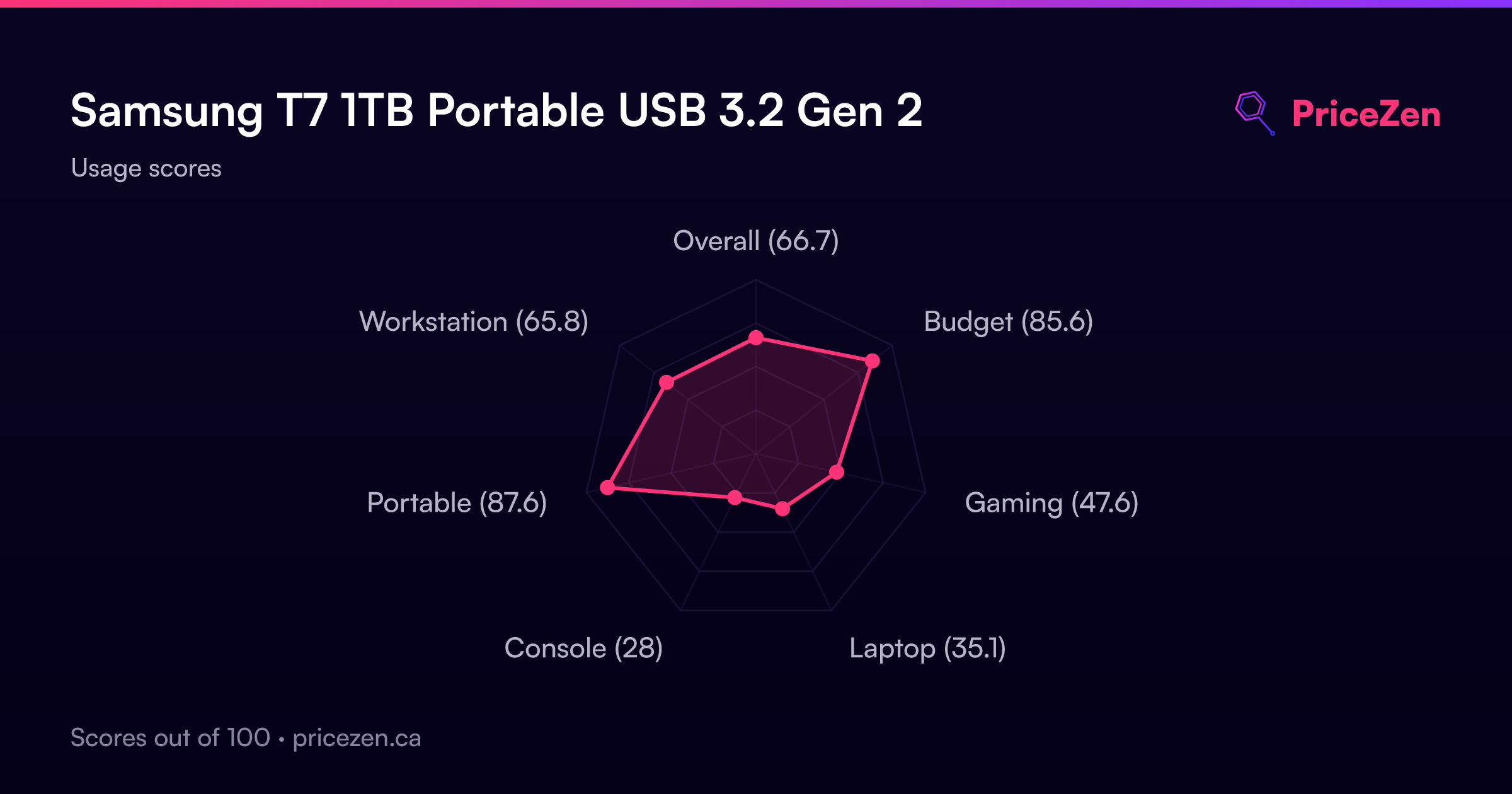
Usage Scores
- Overall66.7
- Budget85.6
- Gaming47.6
- Laptop35.1
- Console28
- Portable87.6
- Workstation65.8