JINTU 420-800mm f/8.3
Its 420-800mm reach in a compact, 700g full-metal body makes extreme telephoto photography physically accessible without heavy support gear. The fully manual operation and multi-coated glass prioritize a low entry price over modern conveniences like autofocus or stabilization. This lens is best for budget-conscious Nikon DSLR users experimenting with distant wildlife or moon shots who are comfortable shooting in full manual mode.












Snapshot
The 30-Second Version
The jintu 420-800mm f/8.3 is a 55 USD manual focus telephoto with absurd reach and surprisingly decent stabilization. Optical quality is near the bottom of our database, so expect soft images and a steep learning curve. It's a fun budget experiment for moon and wildlife shooters, not a serious tool for anyone who needs sharp, reliable results. If you can live with manual focus and f/8.3, it's a cheap way to try super telephoto.
Pros & Cons
Pros
- Absurdly affordable at 55 USD 97th
- Massive 420-800mm reach on a budget 96th
- Stabilization is well above average for the price 86th
- Full metal body feels more solid than expected 82nd
- Compact and light enough to handhold in good light
Cons
- Optical quality is near the bottom of our database
- Manual focus only, no electronic communication with camera
- f/8.3 constant aperture needs tons of light
- Minimum focus distance of 800mm limits close-up work
- Build quality percentile of 29 is mediocre
What owners think
How owner sentiment changed over time
ExclusiveBased on when customers actually wrote their reviews - so you can see whether early praise held up.
Happy owners: 79% lately, 60% in Jul 2019 – Jun 2023
Too few reviews to call that a change.
Across all 1,232 store ratings: 3.9★. Most owners rate without writing a review. The chart counts the 53 written reviews with stars and their own date.
Show the numbers
| Period | Reviews | Happy | Mixed | Unhappy | Happy share |
|---|---|---|---|---|---|
| Jul 2019 – Jun 2023 | 10 | 6 | 3 | 1 | 60% |
| Jul 2023 – Jun 2024 | 10 | 6 | 1 | 3 | 60% |
| Jul 2024 – Jun 2025 | 14 | 9 | 2 | 3 | 64% |
| Jul 2025 – Mar 2026 | 19 | 15 | 2 | 2 | 79% |
Each column joins calendar quarters until it holds at least 10 reviews with stars and their own date. Happy = 4-5★, mixed = 3★, unhappy = 1-2★.
The proof
Performance
Let's talk about what 800mm actually does for you. At that focal length, you can fill the frame with a bird from across a field or get crater detail on the moon. The stabilization helps here, sitting well above average in our database, which matters because at 800mm, even your heartbeat can introduce shake. You'll still want a tripod or at least a monopod for anything serious, but the stabilization takes the edge off handheld shots in good light.
The catch is the f/8.3 aperture. That's not fast. In anything but bright daylight, you'll be cranking ISO or dropping shutter speed to levels that make sharp shots a challenge. The optical quality percentile of 17 tells the real story. This lens is not going to give you tack-sharp images across the frame. Expect softness, especially at the long end, and some chromatic aberration in high contrast scenes. The multi-coated glass helps with flare, but it's not a miracle worker. For the price, you're getting reach and a usable image, not a professional-grade optic.
Specifications
Full Specifications
Optics
| Type | Telephoto |
| Focal Length Min | 420 |
| Focal Length Max | 800 |
| Elements | 6 |
| ED Elements | 1 |
| Coating | Ultra Multi Coating |
Aperture
| Max Aperture | f/8.3 |
| Min Aperture | f/16 |
| Constant | No |
Build
| Mount | Nikon F |
| Format | full-frame |
| Weight | 1.0 kg / 2.2 lbs |
| Filter Thread | 67 |
AF & Stabilization
| AF Type | manual focus only |
| Stabilization | No |
Focus
| Min Focus Distance | 3000 |
vs Competition
The obvious comparison is the Sony E PZ 16-50mm f/3.5-5.6 OSS. That lens is sharper, has autofocus, and is more versatile for everyday shooting. But it tops out at 50mm. The jintu gives you 16 times that reach. They're not really competitors, they're complements. If you already have a kit lens and want to try wildlife or astrophotography, the jintu is a cheap add-on. If you need one lens to do everything, this isn't it.
The Nikon NIKKOR 20059 and Canon EF-M 15-45mm are similar stories. Both are sharper, more reliable, and have autofocus, but neither comes close to 800mm. The Meike 56mm F1.7 is a completely different animal, a fast portrait lens with excellent bokeh potential. The jintu's bokeh sits at the 53rd percentile, which is about average, but at f/8.3 you're not getting creamy backgrounds. The GoPro HB-Series is a different category entirely. The point is, no competitor offers this much reach for anything close to this price. You're trading image quality and convenience for sheer magnification.
| Spec | JINTU 420-800mm f/8.3 | Tamron SP 70-200mm f/2.8 Di VC USD | Sigma 135mm f/1.8 DG HSM Art | Viltrox AF 85mm f/2 EVO | Sirui Sniper 75mm f/1.2 | Yongnuo YN 11mm f/1.8 DA DSM WL |
|---|---|---|---|---|---|---|
| Focal Length | 420-800mm | 70-200mm | 135mm | 85mm | 75mm | 11mm |
| Max Aperture | f/8.3 | f/2.8 | f/1.8 | f/2 | f/1.2 | f/1.8 |
| Mount | Nikon F | Canon EF | Sony E | Sony E | Fujifilm X | Nikon Z |
| Format Coverage | full-frame | full-frame | full-frame | full-frame | APS-C | APS-C |
| Stabilization | false | true | false | false | false | false |
| Weather Sealed | false | true | true | true | false | true |
| Weight (g) | 998 | 1500 | 1130 | 340 | 466 | 260 |
| AF Type | manual focus only | USD | Hyper Sonic AF Motor | STM | STM | Digital Stepping Motor |
| Lens Type | telephoto | telephoto | prime | prime | prime | prime |
| Compare | Compare | Compare | Compare | Compare |
| Product | AF | Bokeh | Build | Macro | Reach | Video | Optical | Aperture | User Sentiment | Wide Angle | Portability | Versatility | Social Proof | Affordability | Stabilization |
|---|---|---|---|---|---|---|---|---|---|---|---|---|---|---|---|
| JINTU 420-800mm f/8.3 | 21.8 | 85.9 | 30.3 | 82 | 97.4 | 27.3 | 18.7 | 1 | 4.2 | 3.7 | 19.8 | 68.2 | 54.7 | 95.5 | 41.4 |
| Tamron SP 70-200mm f/2.8 Di VC USD Compare | 83.5 | 85.9 | 76.9 | 47.5 | 83.6 | 57.3 | 48.8 | 43.4 | 94.5 | 28.9 | 9.3 | 78.5 | 79.3 | 43 | 97.3 |
| Sigma 135mm f/1.8 DG HSM Art Compare | 83.5 | 96.9 | 76.9 | 57.9 | 78.5 | 27.3 | 62.5 | 74.9 | 0 | 9.3 | 16.6 | 32.5 | 63.1 | 57.4 | 41.4 |
| Viltrox AF 85mm f/2 EVO Compare | 68.8 | 80.6 | 76.9 | 32 | 65.4 | 69.9 | 60.9 | 64.5 | 94.5 | 19.3 | 71.6 | 32.5 | 79.3 | 79 | 41.4 |
| Sirui Sniper 75mm f/1.2 Compare | 68.8 | 94.7 | 30.3 | 70 | 75.6 | 69.9 | 87.7 | 96.4 | 7.2 | 11.1 | 56.9 | 32.5 | 86.1 | 74 | 41.4 |
| Yongnuo YN 11mm f/1.8 DA DSM WL Compare | 68.8 | 12.3 | 76.9 | 42.1 | 8 | 69.9 | 85.7 | 74.9 | 0 | 86.4 | 81 | 32.5 | 95.7 | 77.7 | 41.4 |
Price
Value & Pricing
At 55 USD, this lens is basically an impulse buy for anyone curious about super telephoto. The value proposition is simple: you're paying for reach, not refinement. The stabilization alone, sitting at the 79th percentile, is something you rarely see at this price point. Most lenses in this range are either cheap and shaky or expensive and steady. This one splits the difference in a weirdly appealing way.
But value isn't just about the sticker price. The optical quality at the 17th percentile means you're getting a lens that struggles to resolve fine detail. If you're shooting the moon or distant wildlife and plan to crop in post, you'll hit the limits of this glass fast. Compare that to something like the Sony E PZ 16-50mm kit lens, which is sharper but has nowhere near this reach. The jintu is a one-trick pony, but it's a trick that's genuinely hard to find at this price. For 55 USD, it's a low-risk experiment. For 105 CAD, it's still cheap, but the calculus shifts slightly.
Amazon 1 offer From CA$85
Price history
Read more
Overview
The jintu 420-800mm f/8.3 is one of those lenses that makes you do a double take. An 800mm reach for around 55 USD? That's the kind of price that usually gets you a lens cap and a handshake. But here we are, looking at a full metal body, multi-coated glass, and a focal range that stretches from 420mm all the way to 800mm on Sony E mount. It's a manual focus lens, which means no autofocus, no electronic communication with your camera, and a whole lot of dialing in focus by hand. For the right person, that's part of the charm. For everyone else, it's a dealbreaker.
Who is this for? Budget wildlife shooters, moon photographers, and anyone who wants to try super telephoto without selling a kidney. The lens is compact for what it is, about 10.6 inches long and relatively light, so you can actually handhold it in decent light. But make no mistake, this is a niche product. The f/8.3 constant aperture means you need a lot of light or a very steady hand. And the minimum focus distance of 800mm means you're not getting close to anything small or nearby.
What makes this interesting is the sheer audacity of the spec sheet at this price. A 420-800mm zoom with optical stabilization for the cost of a nice dinner? That's genuinely unusual. The stabilization sits at the 79th percentile in our database, which is well above average for a lens this cheap. But the optical quality lands at the 17th percentile, so you're getting reach and steadiness, not sharpness. It's a trade-off, and we'll dig into what that means in practice.
Common Questions
Q: Does this lens have autofocus?
No, this is a manual focus lens only. There's no electronic communication with your camera body, so you'll need to set your camera to manual mode and focus by hand. The manufacturer notes that your camera may display a 'lens not attached' warning, which is normal for fully manual lenses without electronic contacts.
Q: Will this work on my Sony E mount camera?
Yes, this version is designed for Sony E mount mirrorless cameras, including the A7 series, A6000 series, and ZV-E10. The lens is also available in Nikon F mount for DSLRs. If you have a different mount system, you may need an adapter, which the manufacturer sells separately.
Q: How far away can I focus with this lens?
The minimum focus distance is 800mm, which is about 2.6 feet. That means you can't focus on anything closer than that. This lens is built for distant subjects like wildlife, the moon, or far-off landscapes. If you want to shoot close-up subjects, you'll need a different lens or extension tubes.
Q: Is the image quality good enough for serious photography?
Honestly, no. The optical quality ranks at the 17th percentile in our database, which is near the bottom. You'll get soft images, especially at the long end, and chromatic aberration in high contrast scenes. It's fine for casual experimentation and learning, but if you need sharp, professional results, this lens will frustrate you.
Who Should Skip This
If you need autofocus for moving subjects like birds in flight or sports, this lens will drive you crazy. Manual focusing at 800mm is genuinely difficult, and the f/8.3 aperture means your depth of field is thin enough to make missed focus obvious. Look for a used autofocus telephoto from Sony, Sigma, or Tamron instead. You'll pay more, but you'll actually get the shot.
Also skip this if you shoot in low light or indoors. f/8.3 is slow, and the optical quality doesn't give you much room to push ISO before images fall apart. If you want a budget telephoto for portraits or events, something like the Meike 56mm F1.7 is a much better fit. This lens is for bright daylight, distant subjects, and patient shooters who enjoy the manual focus process.
Verdict
If you want to photograph the moon, distant birds, or planes at an airshow without spending real money, the jintu 420-800mm is a genuinely fun experiment. The stabilization helps more than you'd expect, and the full metal body feels less disposable than the price suggests. Just know that you'll be shooting in manual mode, focusing by hand, and accepting soft images. That's the deal.
For anyone who needs reliable autofocus, sharp results, or the ability to shoot in less than ideal light, skip this. A used telephoto from a major brand, even an older one, will serve you better. But if you're the kind of person who enjoys the challenge of manual focus and wants to see what 800mm feels like without spending 800 dollars, this lens is a cheap ticket to that experience. Just keep your expectations in check and your tripod handy.
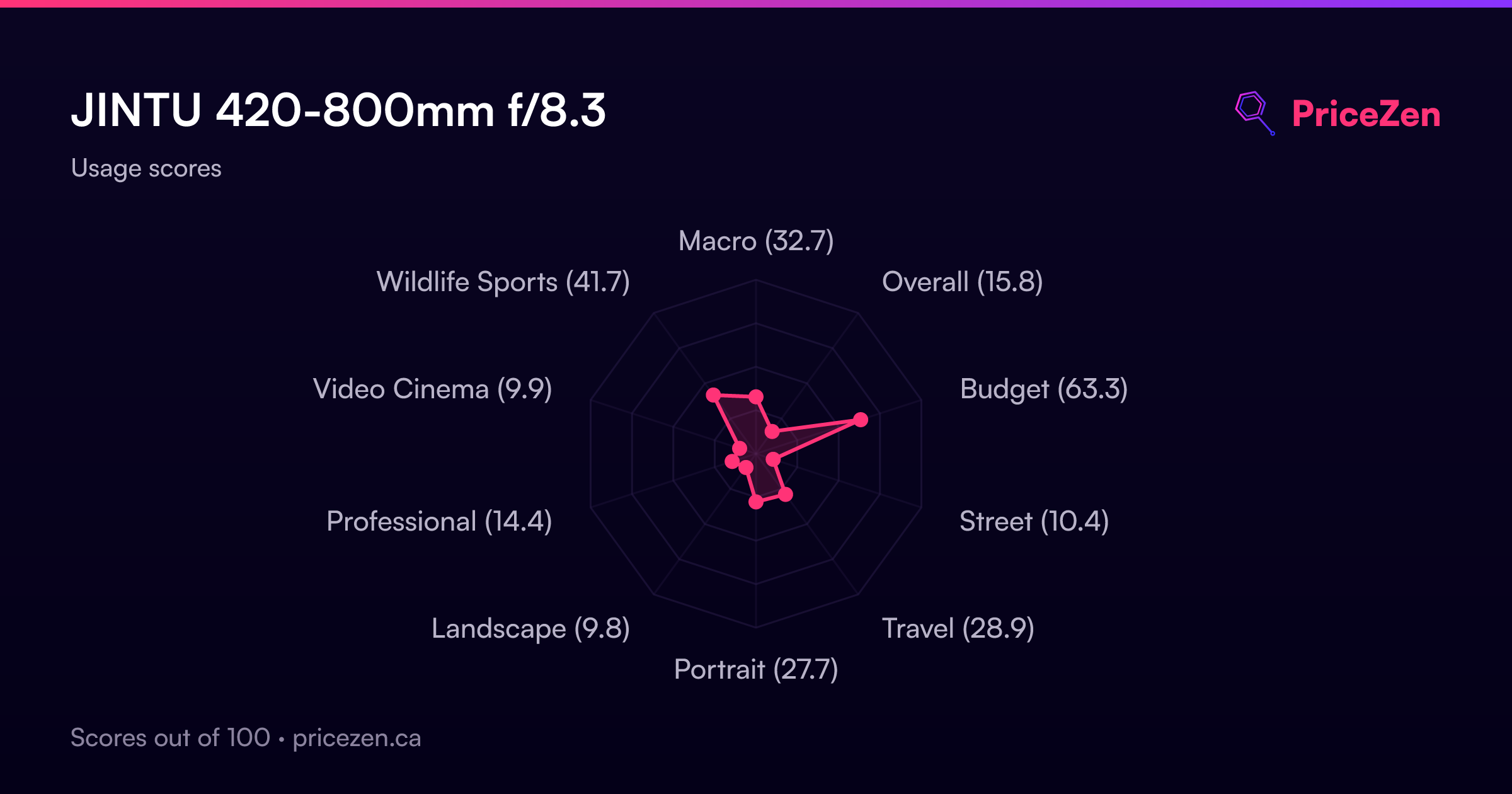
Usage Scores
- Macro32.7
- Overall15.8
- Budget63.4
- Street10.3
- Travel28.7
- Portrait27.9
- Landscape9.8
- Professional14.4
- Video Cinema10.5
- Wildlife Sports41.6