Tamron 50-300mm f/4.5-6.3 Di III VC VXD
The 50-300mm f/4.5-6.3 Di III VC VXD lens weighs just 665g, making it a compact telephoto zoom with a 1:2 maximum magnification and a 67mm filter thread. Its VXD linear motor delivers quick, precise autofocus, while VC image stabilization reduces camera shake at the 300mm end. This lens is best for wildlife and sports shooters on Sony E-mount full-frame cameras who prioritize mobility without sacrificing reach.












Snapshot
The 30-Second Version
The Tamron 50-300mm is the telephoto zoom that never leaves your camera. Light, sharp, and fast-focusing, it's the best travel telephoto value on Sony E-mount right now.
Pros & Cons
Pros
- 665g for a 50-300mm full-frame zoom is absurdly light 95th
- Autofocus is top-tier, 96th percentile in our database 95th
- 1:2 macro at 221mm minimum focus is a real bonus 91st
- Weather sealed with fluorine coating for outdoor use 90th
Cons
- f/6.3 at 300mm is slow, bottom 10% for aperture
- Focus ring feels rough, multiple owners mention it
- No teleconverter support, so 300mm is your hard ceiling
- Bokeh is mediocre, 31st percentile
What owners think
The Word on the Street
How owner sentiment changed over time
ExclusiveBased on when customers actually wrote their reviews - so you can see whether early praise held up.
18 written reviews, Jul 2024 – Jan 2026: 7 happy, 2 mixed, 1 unhappy, 8 without stars
Across all 33 store ratings: 4.1★. The chart counts the 18 written reviews.
Each dot is one written review, in the month it was written. Happy = 4-5★, mixed = 3★, unhappy = 1-2★.
The proof
Performance
The autofocus is the standout. VXD linear motors are Tamron's best tech, and it shows. Our database puts AF performance in the 96th percentile, which means it's up there with lenses costing twice as much. Sharpness holds up well across the range, and the 1:2 macro capability at 221mm minimum focus distance is a sneaky bonus. You can shoot a bird at 300mm, then focus on a flower at half life-size without changing lenses. The aperture is the trade-off. f/6.3 at the long end is slow, and our data puts it in the bottom 10% for aperture. In good light, you won't care. At dusk, you will.
Specifications
Full Specifications
Optics
| Type | Zoom |
| Focal Length Min | 50 |
| Focal Length Max | 300 |
| Elements | 19 |
| Groups | 14 |
| ED Elements | 4 |
| Coating | Fluorine Coating |
Aperture
| Max Aperture | f/4.5-6.3 |
| Min Aperture | f/22-32 |
| Constant | No |
| Diaphragm Blades | 9 |
Build
| Mount | Sony E |
| Format | full-frame |
| Weather Sealed | Yes |
| Weight | 0.7 kg / 1.5 lbs |
| Filter Thread | 67 |
AF & Stabilization
| AF Type | VXD linear motor |
| Stabilization | Yes |
Focus
| Min Focus Distance | 221 |
| Max Magnification | 1:2 |
vs Competition
The obvious comparison is the Tamron 70-300mm, which is cheaper but starts at 70mm and lacks the macro capability. That extra 20mm on the wide end is worth the price difference if you shoot travel or street. Against the Sony G Master 70-200mm f/2.8, the Tamron loses on aperture and bokeh but costs roughly a third of the price and weighs less. The Sony is the better lens for indoor sports or events. The Tamron is the better lens for hiking, travel, and general outdoor use. If you need f/2.8, this isn't your lens. If you need reach and portability, it's hard to beat.
| Spec | Tamron 50-300mm f/4.5-6.3 Di III VC VXD | Sony FE 70-200mm f/2.8 GM OSS II | Sigma 70-200mm f/2.8 DG DN OS Sports | Viltrox AF 35mm f/1.2 LAB FE | Canon RF 35mm f/1.4L VCM | Nikon NIKKOR Z 50mm f/1.2 S |
|---|---|---|---|---|---|---|
| Focal Length | 50-300mm | 70-200mm | 70-200mm | 35mm | 35mm | 50mm |
| Max Aperture | f/4.5-6.3 | f/2.8 | f/2.8 | f/1.2 | f/1.4 | f/1.2 |
| Mount | Sony E | Sony E | Sony E | Sony E | Canon RF | Nikon Z |
| Format Coverage | full-frame | full-frame | full-frame | full-frame | full-frame | full-frame |
| Stabilization | true | true | true | false | true | false |
| Weather Sealed | true | true | true | true | true | true |
| Weight (g) | 665 | 1045 | 1345 | 910 | 555 | 1090 |
| AF Type | VXD linear motor | XD Linear Motors | HLA (High-response Linear Actuator) | VCM | Nano USM | Multi-Focus Stepping Motor AF System |
| Lens Type | zoom | zoom | zoom | prime | prime | prime |
| Compare | Compare | Compare | Compare | Compare |
| Product | AF | Bokeh | Build | Macro | Reach | Video | Optical | Aperture | User Sentiment | Wide Angle | Portability | Versatility | Social Proof | Affordability | Stabilization |
|---|---|---|---|---|---|---|---|---|---|---|---|---|---|---|---|
| Tamron 50-300mm f/4.5-6.3 Di III VC VXD | 95.4 | 60.2 | 90.7 | 87 | 88 | 69.9 | 75.2 | 9.7 | 53.5 | 39.5 | 37.9 | 94.9 | 35 | 46.9 | 89.9 |
| Sony FE 70-200mm f/2.8 GM OSS II Compare | 95.4 | 88.6 | 99.9 | 77.3 | 83.5 | 85.5 | 89.4 | 43.3 | 94.3 | 28.9 | 19 | 78.4 | 95.7 | 12.3 | 97.3 |
| Sigma 70-200mm f/2.8 DG DN OS Sports Compare | 95.4 | 88.6 | 98.9 | 55.6 | 83.5 | 85.5 | 99.9 | 43.3 | 77 | 28.9 | 12 | 78.4 | 72.3 | 23.2 | 99.9 |
| Viltrox AF 35mm f/1.2 LAB FE Compare | 95.4 | 67.8 | 90.7 | 50 | 28.7 | 69.9 | 91.5 | 96.3 | 35 | 52.9 | 23.4 | 32.5 | 86.1 | 33.6 | 41.4 |
| Canon RF 35mm f/1.4L VCM Compare | 89.9 | 59.1 | 76.9 | 52.3 | 28.7 | 69.9 | 70.3 | 89.2 | 94.3 | 52.9 | 47.4 | 32.5 | 79.3 | 21.2 | 92.5 |
| Nikon NIKKOR Z 50mm f/1.2 S Compare | 68.9 | 80.1 | 76.9 | 42.1 | 43 | 69.9 | 86.4 | 96.3 | 94.3 | 39.5 | 17.8 | 32.5 | 95.7 | 20.2 | 41.4 |
Price
Value & Pricing
At $699 to $730 USD, this lens is a steal. You're getting 50-300mm of range, best-in-class autofocus, stabilization, and weather sealing for less than most 70-200mm f/4 lenses. The value proposition is so strong that the slow aperture feels like a fair trade rather than a dealbreaker. If you shoot outdoors in daylight, this is one of the best value telephotos on Sony E-mount right now.
Photo Laplante 1 offer From CA$969
Amazon 1 offer From CA$969
The Camera Store 1 offer From CA$969
Price history
Read more
Overview
The Tamron 50-300mm f/4.5-6.3 is the lens you grab when you don't want to think about which lens to grab. It starts at 50mm, which sounds boring until you realize most telephotos start at 70mm and force you to swap glass for anything remotely close. That extra 20mm on the wide end is the whole story here. It's a travel zoom that actually stays on your camera. At 665g, it's lighter than a lot of 24-70mm f/2.8 lenses, yet it reaches 300mm with stabilization and weather sealing. That's a genuinely rare combo.
Common Questions
Q: Does the aperture change as I zoom?
Yes. You get f/4.5 at 50mm, f/5 at 70mm, f/5.6 at 135mm, and f/6.3 by 200mm. It stays at f/6.3 from 200mm to 300mm. So the slowest aperture kicks in earlier than you might expect.
Q: Can I use this with a Sony teleconverter?
No. Tamron doesn't support Sony FE teleconverters on this lens. If you need more than 300mm, you'll need to crop or buy a longer lens.
Q: Is the macro mode available at all focal lengths?
The 1:2 maximum magnification is at the 50mm end with the 221mm minimum focus distance. You won't get half life-size at 300mm, but the close focus capability is still useful throughout the range.
Who Should Skip This
If you shoot indoor events, concerts, or anything in low light, this lens will frustrate you. f/6.3 at the long end means high ISOs and slow shutter speeds. Go get a 70-200mm f/2.8 instead. If you need teleconverter support for wildlife, this isn't it either. The Sony 100-400mm GM or Sigma 150-600mm are better fits for serious reach.
Verdict
Buy it. The Tamron 50-300mm f/4.5-6.3 is the most practical telephoto zoom for Sony E-mount shooters who value portability and versatility over shallow depth of field. It's sharp, focuses fast, and covers a range that would normally require two lenses. The slow aperture is the only real compromise, and for outdoor shooters, it's barely a compromise at all.
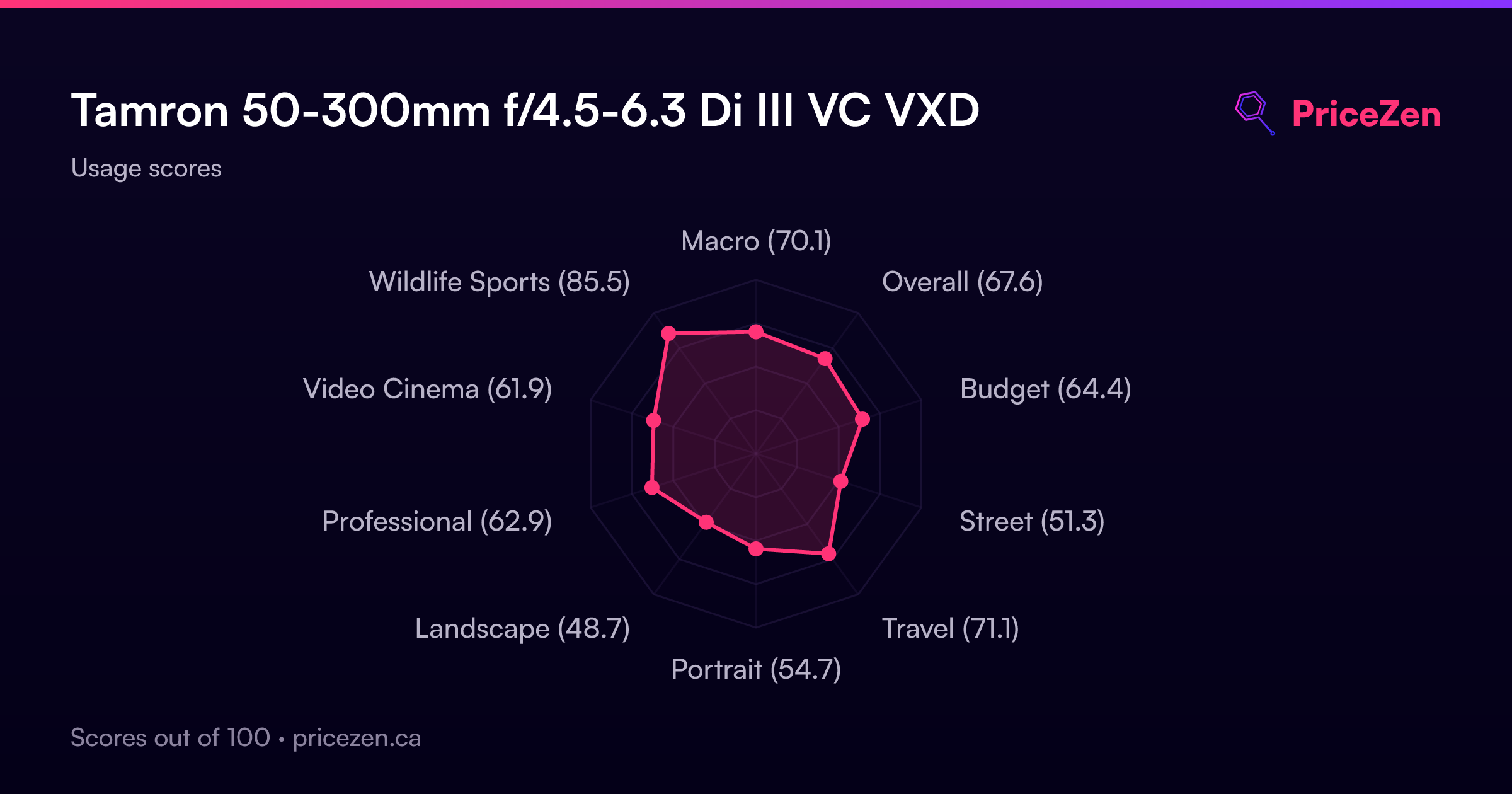
Usage Scores
- Macro70.2
- Overall68.5
- Budget63.4
- Street51.3
- Travel71.1
- Portrait54.9
- Landscape48.8
- Professional62.9
- Video Cinema62.3
- Wildlife Sports85.5