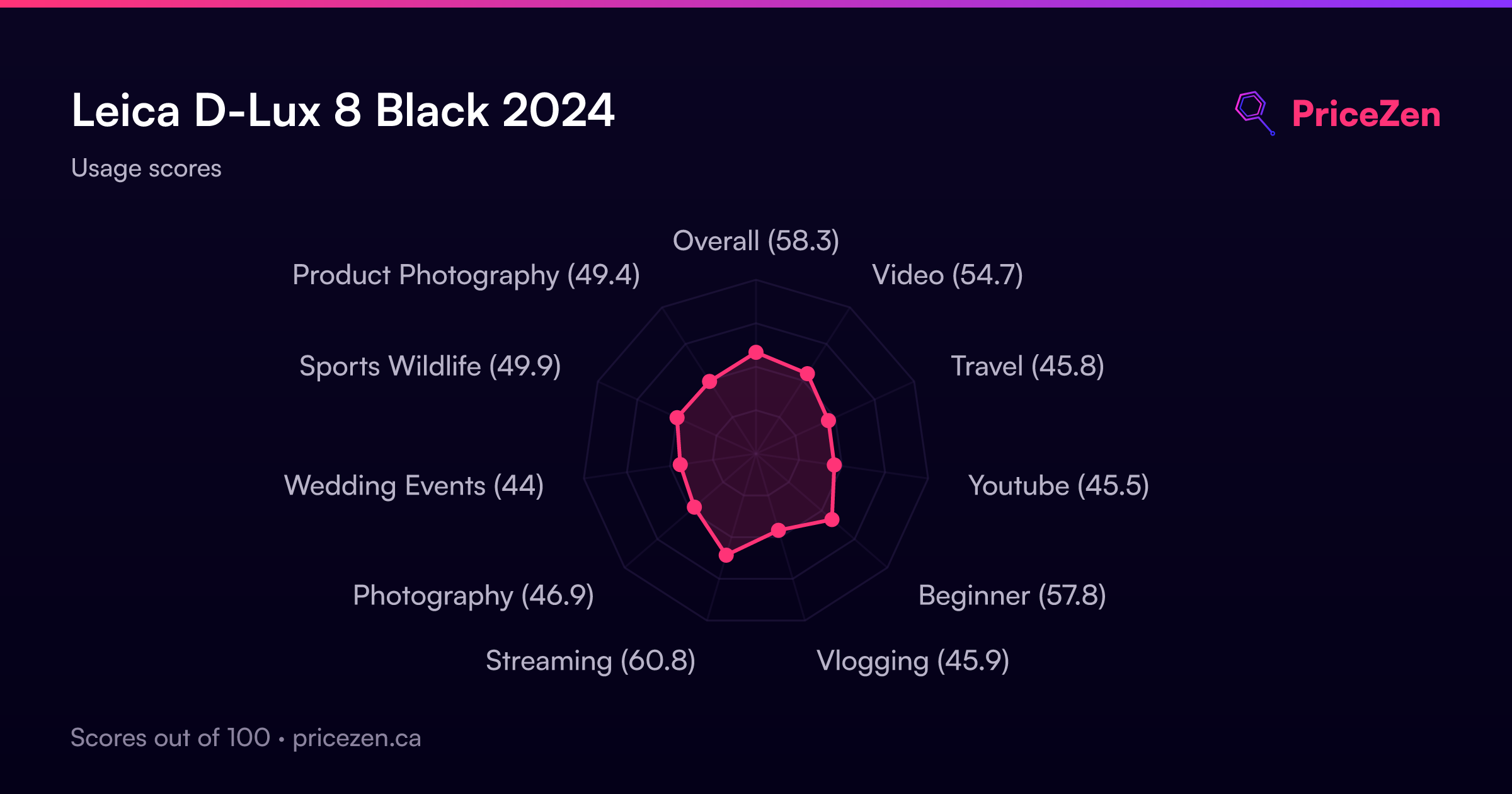
Leica D-Lux 8 Black 2024
The 17MP Micro Four Thirds CMOS sensor pairs with a Leica 10.9-34mm f/1.7-2.8 lens, delivering sharp, low-light images in a compact body. The included on-camera flash and DNG support add flexibility, while the fixed display and lack of stabilization limit video use. Best for beginner photographers who want a premium, portable Leica for everyday stills and travel.












Snapshot
The 30-Second Version
The D-Lux 8 pairs a lovely f/1.7-2.8 zoom with a Micro Four Thirds sensor in a pocket-sized body, and that lens is its best feature by a mile. Everything else ranks below average, with an overall score of 15.8 out of 100. At CAD 2,700, it's a style purchase, not a performance one.
Pros & Cons
Pros
- Fast f/1.7-2.8 zoom covering a handy 24-75mm equivalent range. 96th
- Micro Four Thirds sensor in a genuinely pocketable body. 94th
- DNG raw files give you real editing room. 81st
- An actual flash comes in the box, which is rare these days. 80th
Cons
- No stabilization, so slow shutter shots are a gamble.
- Video and vlogging are its weakest areas by far.
- Autofocus and burst speed lag behind most of the category.
- CAD 2,700 buys you a lot of camera elsewhere.
What owners think
How owner sentiment changed over time
ExclusiveBased on when customers actually wrote their reviews - so you can see whether early praise held up.
8 written reviews, Aug 2024 – Nov 2026: 8 happy
Across all 4 store ratings: 5.0★. The chart counts the 8 written reviews.
Each dot is one written review, in the month it was written. Happy = 4-5★, mixed = 3★, unhappy = 1-2★.
The proof
Performance
The glass is the story. An f/1.7-2.8 zoom covering 24-75mm equivalent is bright enough for dim rooms and gives you some subject separation, and 17MP from a Micro Four Thirds sensor is plenty for prints and social. But the supporting cast is weak. There's no stabilization listed at all, which hurts at the long end and in low light. Autofocus is one of the weaker results in our data, burst shooting is about average, and the sensor score lands in the 19th percentile, one of the weakest in our data. Video ranks 22nd percentile and vlogging is its worst area at 6.2 out of 100. Sports and wildlife scores 18.2, so forget tracking anything that moves quickly. Battery life is about average, connectivity slightly above it. The EVF and fixed display both fall behind most rivals.
Specifications
Full Specifications
Sensor
| Type | CMOS |
| Size | micro-four-thirds |
| Megapixels | 17 MP |
| ISO Range | 100 |
Autofocus
| AF Type | Automatic, Automatic (macro), or Manual |
| Eye AF | Yes |
Shooting
| Burst (Mechanical) | 11 |
| Max Shutter | 1/16000 |
| Electronic Shutter | Yes |
Video
| Max Resolution | 4K |
| 4K FPS | 30 |
| 1080p FPS | 60 |
| 10-bit | No |
| RAW Video | Yes |
| Codec | H.264 |
Display & EVF
| Screen Size | 3" |
| Touchscreen | Yes |
| Articulating | No |
| EVF Resolution | 2.36 M dots |
Build
| Weather Sealed | No |
| Weight | 0.4 kg / 0.9 lbs |
Connectivity
| Wi-Fi | Yes |
| Bluetooth | Yes |
| USB | USB-C |
| HDMI | ✓ |
| Hot Shoe | Yes |
vs Competition
Cross-shop seriously before you commit. The Panasonic Lumix G9 II and OM System OM-1 Mark II are the ones to look at if you actually want to shoot action or handheld video, since the D-Lux 8's burst and stabilization rankings are near the floor. The Fujifilm X-H2 is worth a look if raw file quality and detail are your priority, given how poorly this sensor scores in our data. And the Sony Alpha a7R VI and Nikon Z8 sit in a completely different performance tier. None of those match the D-Lux 8's pocketability, and that's the one argument it has. If size isn't your top constraint, every one of these competitors outranks it.
| Spec | Leica D-Lux 8 | Sony Alpha a7R VI | Fujifilm X-H2 | Nikon Z8 | Panasonic Lumix G9 II | OM System OM-1 Mark II |
|---|---|---|---|---|---|---|
| Type | compact | mirrorless | mirrorless | mirrorless | mirrorless | mirrorless |
| Sensor | 17MP micro-four-thirds | 66.8MP full-frame | 40.2MP aps-c | 45.7MP full-frame | 25.2MP micro-four-thirds | 20.4MP micro-four-thirds |
| AF Points | - | 759 | 425 | 493 | 779 | 1053 |
| Burst FPS | 11 | 30 | 15 | 30 | 75 | 120 |
| Video | 4K @30fps | 8K @120fps | 8K @60fps | 8K @120fps | 4K @120fps | 4K @60fps |
| IBIS | No | Yes | Yes | Yes | Yes | Yes |
| Weather Sealed | No | Yes | Yes | Yes | Yes | Yes |
| Weight (g) | 397 | 622 | 579 | 820 | 575 | 511 |
| Compare | Compare | Compare | Compare | Compare |
| Product | AF | EVF | Build | Burst | Video | Sensor | Battery | Display | User Sentiment | Connectivity | Social Proof | Affordability | Stabilization |
|---|---|---|---|---|---|---|---|---|---|---|---|---|---|
| Leica D-Lux 8 | 72.9 | 79.8 | 71.3 | 71.2 | 68.6 | 19.2 | 45.9 | 93.7 | 95.9 | 80.9 | 38 | 25.6 | 33.1 |
| Sony Alpha a7R VI Compare | 96.5 | 98.9 | 94.2 | 87.8 | 98.9 | 81.2 | 96.4 | 97.4 | 95.9 | 95.5 | 97.4 | 12.7 | 99.6 |
| Fujifilm X-H2 Compare | 91.5 | 96.2 | 93.2 | 79.1 | 94.6 | 98.8 | 97.1 | 95 | 86 | 95.5 | 92.5 | 24.7 | 95.9 |
| Nikon Z8 Compare | 92.8 | 90.6 | 97.4 | 94.7 | 98.5 | 67.8 | 88.5 | 97.1 | 86 | 95.5 | 97.4 | 16 | 87.8 |
| Panasonic Lumix G9 II Compare | 97.6 | 90.4 | 93.1 | 95.8 | 97.3 | 59.8 | 89.9 | 96.4 | 95.9 | 95.5 | 86.6 | 38 | 87.8 |
| OM System OM-1 Mark II Compare | 98.6 | 99.8 | 92.6 | 99.3 | 83.7 | 47.1 | 95.1 | 95 | 86 | 95.5 | 86.6 | 26.1 | 99.6 |
Price
Value & Pricing
At CAD 2,700 from Vistek, affordability is one of the lower-ranked results, and honestly that feels generous. You're paying for the Leica name, the design, and that fast lens. What you're not getting is modern autofocus, stabilization, or video capability. If the red dot and the handling matter to you more than spec sheets, fine, that's a personal call. If you want the most image-making ability per dollar, this isn't it.
Vistek 2 offers From CA$2,700
The Camera Store 1 offer From CA$2,700
Amazon 1 offer From CA$3,089
Price history
Read more
Overview
The Leica D-Lux 8 is a pocketable compact built around a 17MP effective Micro Four Thirds CMOS sensor and a fast Leica DC Vario-Summilux 10.9-34mm f/1.7-2.8 lens, which works out to a 24-75mm equivalent. That's a genuinely useful zoom range with real speed behind it. You also get DNG raw support, an included on-camera flash, and a link to the Leica FOTOS app.
Here's the catch: our scoring model puts it near the bottom of the point-and-shoot category overall, at 15.8 out of 100. The lens and the badge are doing most of the heavy lifting. Almost everything else about this camera ranks below average against what else you can buy right now.
Common Questions
Q: Can it shoot raw?
Yes, it records DNG alongside JPG, so you get proper raw files to work with in editing.
Q: Is it any good for video or vlogging?
Not really. Video ranks in the 22nd percentile and vlogging is its single weakest score at 6.2 out of 100, plus there's no stabilization listed.
Q: Does it have image stabilization?
None is listed, and its stabilization ranking is one of the lower results. The fast f/1.7-2.8 lens helps you keep shutter speeds up, but it's not a substitute.
Who Should Skip This
If you shoot sports, wildlife, or anything fast, skip it. The 18.2 sports score and weak burst and autofocus rankings mean you'll miss shots. Vloggers should look elsewhere too, since video is a real letdown here and there's no stabilization. And if you just want the best images for CAD 2,700, the Panasonic Lumix G9 II or OM System OM-1 Mark II will serve you far better.
Verdict
Buy this if you want a small, well-designed camera with a fast lens and you shoot stills at a relaxed pace. Street, travel, family stuff, casual portraits. It scores 25.8 for beginners, which tells you it's approachable but not a standout even there. Anyone chasing performance should keep walking.
Usage Scores
- Overall58.2
- Video54.6
- Travel45.7
- Youtube45.5
- Beginner57.8
- Vlogging45.8
- Streaming60.7
- Photography46.8
- Wedding Events43.9
- Sports Wildlife49.8
- Product Photography49.3